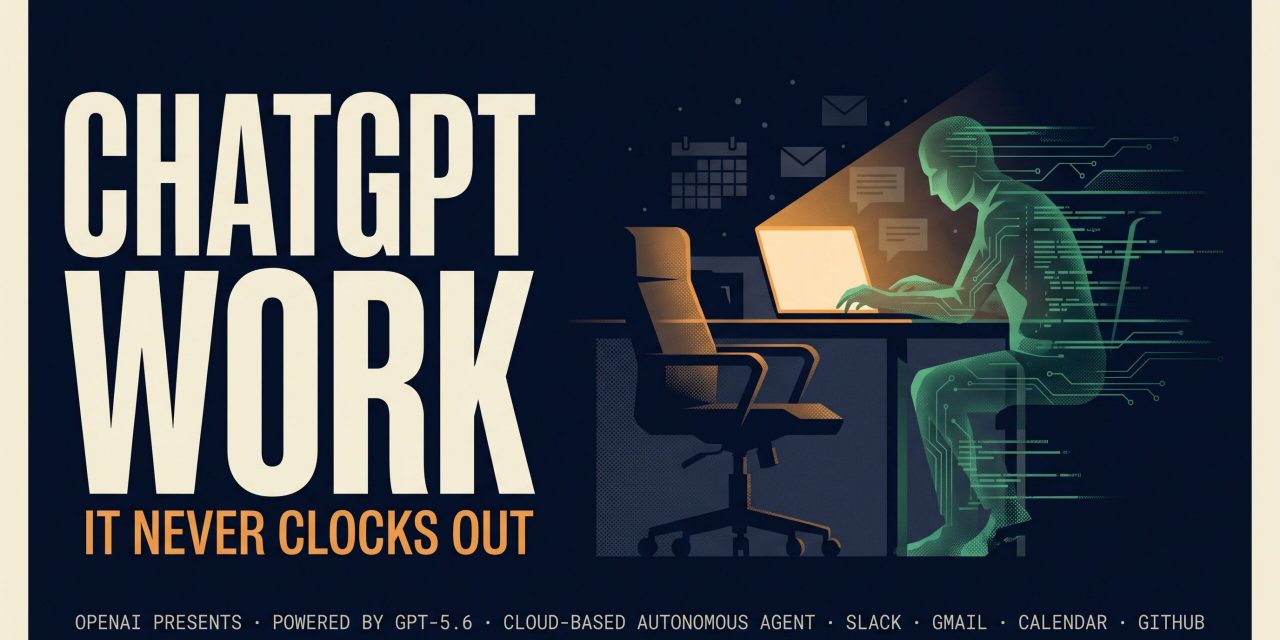
OpenAI has quietly redrawn what a chatbot is supposed to do. With the launch of ChatGPT Work, the company has embedded an autonomous agent inside ChatGPT that no longer waits for you to ask questions. It gathers context from your inbox, your calendar, your Slack channels and your code repositories, then executes multi-step projects that used to eat entire afternoons. Powered by the new GPT-5.6 model, ChatGPT Work is designed to finish the job rather than describe how you might finish it yourself.
The launch positions ChatGPT less as a conversational tool and more as a workplace platform. And the timing matters. OpenAI recently filed a confidential draft S-1 with the SEC, setting up what could be one of the largest technology IPOs in history. Convincing enterprises that AI agents actually finish real work is now central to that story.
What ChatGPT Work actually does
ChatGPT Work runs as a persistent cloud-based virtual machine that stays available regardless of the device you happen to be using. That is a deliberate architectural choice. Competing agents from other vendors often need a local machine to remain powered on and connected. OpenAI’s version keeps churning through tasks whether your laptop is closed or your phone is in your pocket.
Give it a goal and it breaks the goal into steps. It can spend hours on a project, checking in when it needs approval, adjusting when you redirect it, and delivering finished spreadsheets, documents, presentations, dashboards or interactive websites. Ty Geri, a product manager at OpenAI who helped build the product, described it as the difference between getting information and getting outcomes.
Some concrete examples from OpenAI and its early customers illustrate the range:
- Scheduling ten coordinated internal testing sessions across dozens of contributors, pulling data from Slack, GitHub and Docs to find the right people and the right times.
- Reviewing thousands of monthly leads at Zapier, tracing customer touchpoints across CRM and email, and generating a weekly executive dashboard that flagged seven figures in potential sales.
- Benchmarking Virgin Atlantic’s customer journeys against competitors, turning a weeks-long analysis cycle into a few hours of work.
- Identifying the biggest causes of user churn on a specific feature and generating candidate product solutions, compressing what would previously have been a three-month effort into roughly one week.
Plugins, Sites and Scheduled Tasks
The connective tissue is a plugin system built on the Model Context Protocol. Users link ChatGPT Work to the systems where their work already lives: Slack, Microsoft Teams, Google Drive, SharePoint, Gmail, calendars, CRMs and project trackers. The agent decides when to reach for a plugin automatically, or you can point it at a specific app by typing “@” followed by the app name.
Alongside the plugin architecture, OpenAI is rolling out Sites, which turns work into interactive web apps that can be shared through a URL. Instead of a static slide deck with formatting restrictions, teams get live dashboards, project trackers, launch calendars, prototypes and internal portals that ChatGPT can keep updated as the underlying information changes.
Scheduled Tasks handles the repetitive layer. It can run an action once, repeat it on a schedule, trigger on an event, or monitor systems for changes over time. A sales team might ask the agent to refresh an account command centre every morning at 8am. A marketing lead might have it update a presentation whenever new campaign feedback arrives by email.
Desktop, browser and Computer Use
The desktop application is where OpenAI’s ambitions become most visible. It merges the previous Codex app into a unified ChatGPT desktop client that combines Chat, Work and Codex in one interface. Inside it, a built-in browser lets the agent research markets, compare sources, pull information from websites and open files from Google Workspace or Microsoft 365 without leaving the app.
Computer Use goes further. It lets ChatGPT operate your computer directly, clicking, typing and moving files across applications and browsers. That capability sits closer to a software coworker than a chatbot, and it points toward a future where the primary interface to your machine is an agent rather than a mouse and keyboard.
OpenAI is also updating its Chrome extension so ChatGPT can live in the browser sidebar, and it is winding down the standalone Atlas browser while helping users migrate.
GPT-5.6 and the Codex lineage
Under the hood is GPT-5.6, which OpenAI positions as its most capable model series for professional work. It ships in three variants: Sol tuned for raw power, Luna optimised for speed, and Terra as the balanced everyday option. The model is designed to handle ambiguity, adjust as work progresses, and deliver polished results with fewer prompts.
The engine underneath is Codex, OpenAI’s internal engineering tool that has already reshaped how the company builds software. More than five million people now use Codex every week, with over a million using it for tasks outside software development. ChatGPT Work is essentially Codex’s methodology generalised for knowledge workers of every stripe.
Privacy, governance and the data surface problem
An agent that reads your Slack messages, scans calendar invitations and pulls GitHub commit histories represents a very different data surface than a chatbot session where you paste in text yourself. Enterprise security teams will scrutinise it carefully.
OpenAI says ChatGPT Work is built on the security, privacy and compliance foundation of ChatGPT Enterprise. Enterprise and Edu admins can centrally manage who has access, which company context the model can draw on, which tools it can connect to, and which actions it is allowed to take. A Compliance API is meant to give oversight at scale. Enterprise accounts have Zero Data Retention, and users can opt out of letting their conversations improve future models.
An auto-review layer uses OpenAI’s most advanced models to check important actions before they run. The company claims that during adversarial red-teaming it blocked every attempt to extract protected data, including attack patterns the reviewing model had not seen in training. That figure is OpenAI’s own and has not been independently verified.
A three-way race for the workplace agent
ChatGPT Work lands in the middle of a defining competitive battle. Anthropic moved Claude Cowork to general availability in April, and Microsoft made Copilot Cowork generally available in June, built in partnership with Anthropic. All three products share a strikingly similar vision: a persistent cloud agent that breaks complex tasks into steps, connects to workplace tools via plugins, and produces finished outputs across desktop, web and mobile.
OpenAI’s distinguishing advantage is distribution. ChatGPT has reached 900 million weekly active users, and the company now counts 50 million paying subscribers. More than 9 million paying business users rely on ChatGPT for work, and 92% of Fortune 500 companies use it in some form. By making ChatGPT Work available to Plus subscribers at $20 per month rather than restricting it to premium enterprise tiers, OpenAI is betting that broad accessibility will drive adoption faster than any competitor can match.
Availability and rollout
The product is rolling out first to Pro, Enterprise and Edu users on web and mobile, reaching Plus and Business plans in the following days. The updated desktop app is available globally for Mac and Windows. Chat, Work and Codex sit inside every plan, including Free, though usage is metered. Because ChatGPT Work runs longer and more involved tasks, it consumes more of a plan’s included capacity than a standard chat request, and admins can set spend controls, group limits and individual overrides.
The uncomfortable question underneath the pitch
OpenAI is careful with its framing. Geri describes ChatGPT Work as a partner and an extension of the worker, not a replacement. He notes that people using it feel more productive and often work harder, because they can now focus on the parts of their job they actually want to do. That is a genuine benefit, and it is easy to believe when you hear a product manager describe compressing three months of analytical work into a single week.
But the same story raises a harder question that OpenAI does not answer directly. If one person with an agent can now do what previously required a small team, the labour market implications extend well beyond calendar management. The interesting thing about ChatGPT Work is not that it schedules meetings. It is that it handles genuinely difficult analytical work, and it does so at consumer pricing. How teams are structured, staffed and paid over the next few years will depend on how honestly companies confront that reality rather than repeating the reassuring line about partnership.