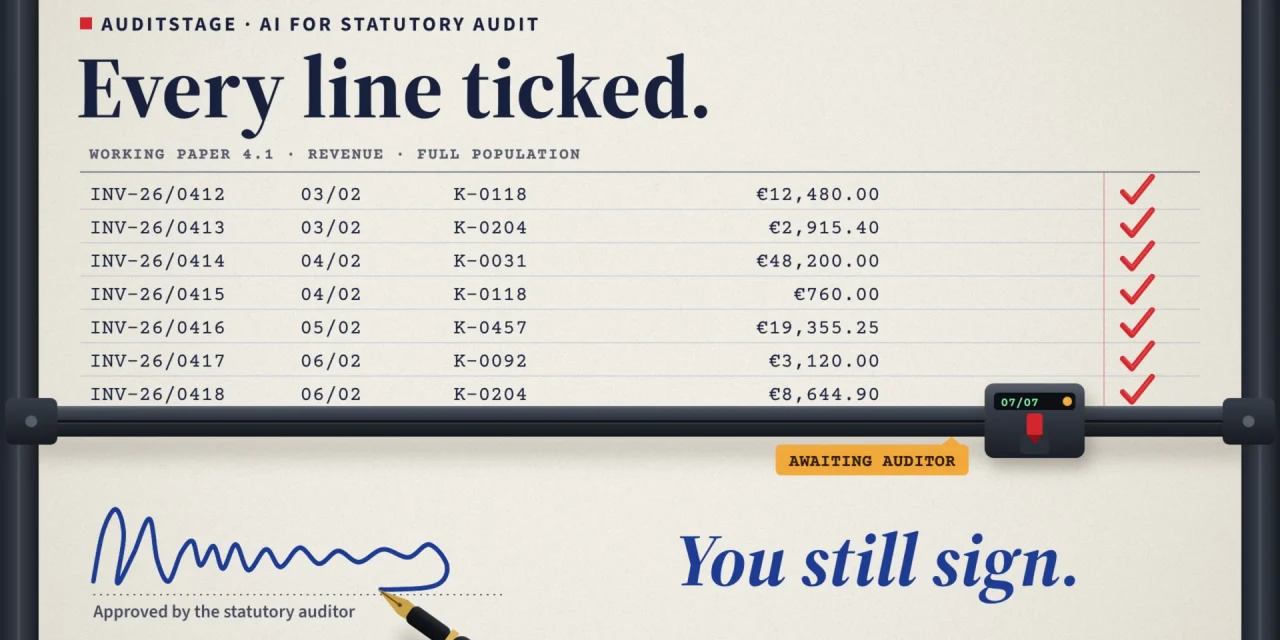
Auditstage, a Belgian start-up, is building an AI platform that runs a statutory audit from the first data upload to the partner’s sign-off in one file. AI agents ingest the trial balance, send document requests to the client, match invoices to entries and draft the working papers. The auditor reviews, decides and signs. The company raised €2 million in July 2026 and wants to show the full platform to audit firms before the 2026-2027 busy season.
It is a small company in a crowded field, but its pitch says a lot about where audit is heading in Europe. Below you find what Auditstage builds, why mid-tier firms are its market, where standard setters and regulators draw the line on AI, and what audited companies should expect.
What Auditstage is building
Natalia Khamraeva founded Auditstage in 2024 after nearly fifteen years as an auditor. The leadership team also includes Jonas Plancke, who led Audit Transformation at PwC for ten years, and Valérie Brouwers, who represents the company in the United States. In May 2026 the team had five people. Brussels-based Smartfin led both the €750,000 pre-seed in May 2025 and the €2 million seed round in July 2026, with business angels joining.
The platform splits an audit into four steps in one workspace:
- Ingestion. The client’s trial balance or general ledger is uploaded from any ERP format and mapped into one structure.
- Planning and requests. Methodology, risks, procedures and the PBC list, the documents the client must provide, sit together. The platform sends requests and reminders, then validates and classifies what comes back.
- Documentation. Working papers are generated around the evidence. Auditstage shows a revenue-testing agent that selects high-value items, matches them to invoices and drafts a conclusion.
- Review and sign-off. Quality checks, the evidence trail and partner review happen in the same system.
Underneath the agents sits what the company calls a deterministic backbone: fixed rules that follow the firm’s methodology and guide the agents from information request to review. In other words, the value is less in the language model than in the harness around it. On its about page Auditstage puts its ambition as “clone the auditor’s workflow, not their judgment”. It also says the platform is ISO 27001 certified and locally hosted, so client data stays in its jurisdiction.
Why mid-tier firms are the market
The Big Four build their own systems. PwC is developing a $1 billion AI-native audit platform with Microsoft and plans to extend it to all its audit clients by 2028. Mid-tier firms cannot fund that, and they feel the staff shortage hardest. DataSnipper’s chief executive Vidya Peters told Fortune that audit has two to two and a half times as many open jobs as people to fill them.
Belgium, Auditstage’s home market, shows the pattern clearly. The Belgian Audit Oversight Board reported in 2025 that the number of signing auditors keeps falling, that experienced auditors are very scarce and that some firms have stopped taking on clients for lack of staff. At the same time, the higher EU size thresholds that Belgium applied from financial year 2024 mean roughly 1,300 fewer companies must appoint a statutory auditor, a drop of 13% according to the Belgian institute of auditors. Fewer engagements, fewer people and stricter quality management make every hour count.
That is why Auditstage targets mid-sized firms and not Deloitte, PwC, EY or KPMG. Its competitors are the vendors those firms already use.
How Auditstage compares
| Platform | What it is | For whom | Status in November 2026 |
|---|---|---|---|
| Auditstage | Full audit file with client portal, fixed rules and AI agents | Mid-sized audit firms | Pilots, first module since late 2025 |
| Caseware Verity | AI layer in Caseware Cloud with agents for disclosures, risks and engagement review | Firms already on Caseware | Launched in May 2026, read-only review agent this autumn, first in the Netherlands |
| DataSnipper Alwin | Agents that run complete procedures, every output linked to the source | Audit and finance teams, Excel-based | Launched in September 2026 |
| PwC Next Generation Audit | Own AI-native platform, built with Microsoft | PwC teams only | Pilot, rollout by 2028 |
Caseware and DataSnipper add agents to tools firms already run. Auditstage wants to replace the whole chain, client communication included. That is a bigger promise and a bigger switch.
Where the rules draw the line
Auditstage’s slogan matches what standard setters and regulators are saying. The tools may do the work, the auditor keeps the responsibility.
The IAASB. In August 2026 the international standard setter published exposure drafts of ISA 330, ISA 500 and ISA 520. There are no AI-specific requirements. Guidance in a new appendix to ISA 500 says responsibilities are the same for manual and tool-based work, and that results which are hard to trace or reproduce may need extra procedures or corroborating evidence. The draft names automation bias as a risk, the habit of accepting a system’s suggestion too readily that we also discuss in how to collaborate with AI without losing control of your work. Comments close on 15 December 2026 and approval is expected in December 2027.
The FRC. On 16 November the UK regulator published guidance on insights obtained through technology. Insights from tools used for the audit itself rarely threaten independence, so they can often go to management and the audit committee. Giving clients access to the tool is judged on purpose, functionality, users and duration, and access that lets management re-run the analysis is less likely to count as part of the audit. The guidance is UK-specific and non-authoritative, but it maps directly onto Auditstage’s client portal. As Auditstage itself suggests, firms should log the purpose, scope and end date of every client access.
The EU AI Act. Audit software is not a high-risk use, since auditing is not among the Annex III areas. Article 4 does ask organisations that deploy AI to support the AI literacy of their staff, and it has applied since February 2025. Our overview of the AI Act after the Digital Omnibus sets out what else applies now.
In an episode of the Belgian institute’s podcast, Khamraeva and EY partner Filip Simpelaere put it in practical terms. AI output is context until an auditor adopts it, nothing enters the file without explicit confirmation, and the platform records who approved what and when.
What audited companies will notice
For a CFO or group controller, the first change is the client portal. Requests, reminders and uploads move out of email and spreadsheets. A Suralink survey found that 70% of clients blame vague or unclear requests, not their own disorganisation, for delays, so structured requests can save time on both sides.
The second change is less comfortable. Auditstage, like PwC, promises full-population analysis instead of sampling. Every invoice and journal entry is checked against rules, which surfaces more exceptions, and each exception may become a question for the finance team. The IAASB draft on analytical procedures also asks for reliable data and predictable relationships. Clean, well-documented books will matter more, not less.
AI is moving on the client side too. ChatGPT for Accounting already reconciles accounts and drafts entries in the US. When one AI agent audits what another AI agent booked, human review becomes the control that matters.
What is still unproven
- Customers. Auditstage works with a select group of firms in a pilot programme but names none.
- Price. There is no public pricing, only pilot access.
- Results. There are no measured time savings. The figures on the website come from sample dashboards.
- Technology. Which AI models the platform uses and where exactly data is hosted is not public, beyond the ISO 27001 claim and local hosting.
- Scale. A five-person team in May 2026 is up against Caseware, DataSnipper and the Big Four’s own budgets.
Questions to ask before a pilot
- Which steps does an agent take on its own, and where must a person confirm?
- Can a reviewer with no prior link to the file trace every conclusion back to the source document, as ISA 230 requires?
- Where is client data stored, which AI models process it and who are the subprocessors?
- How does the platform encode your methodology, and what happens when it changes?
- How will you measure time saved? Run a baseline on one recent file first.
Audit committees can ask their auditor the mirror questions: which AI tools are used on our audit, who reviews their output, and what do we get access to.
Frequently asked questions
What is Auditstage?
A Belgian start-up founded in 2024 that builds AI software for statutory audits. It combines data, client requests, working papers and review in one file, with AI agents for routine work.
Does Auditstage replace the auditor?
No. The auditor reviews and confirms the output and signs the opinion. Under the auditing standards, that responsibility stays with the auditor whatever tools were used.
How much has Auditstage raised?
€2.75 million in total: €750,000 in May 2025 and €2 million in July 2026, both rounds led by Smartfin.
Can firms use it today?
Only through the pilot programme. The company aims to show the full platform to the profession before the 2026-2027 busy season.
Judgement is the scarce resource now
The work that agents take over, ticking, vouching and chasing, is also the work through which juniors used to learn the profession. The Big Four have already cut junior recruitment. A Thomson Reuters and IDC study of 1,005 professionals found that two thirds of firms have AI in their strategy or in pilots, but only 7% feel extremely prepared. Buying the platform is the easy part. The harder task for European firms is training auditors who can tell when a tick mark is wrong without ever having made a thousand of them.