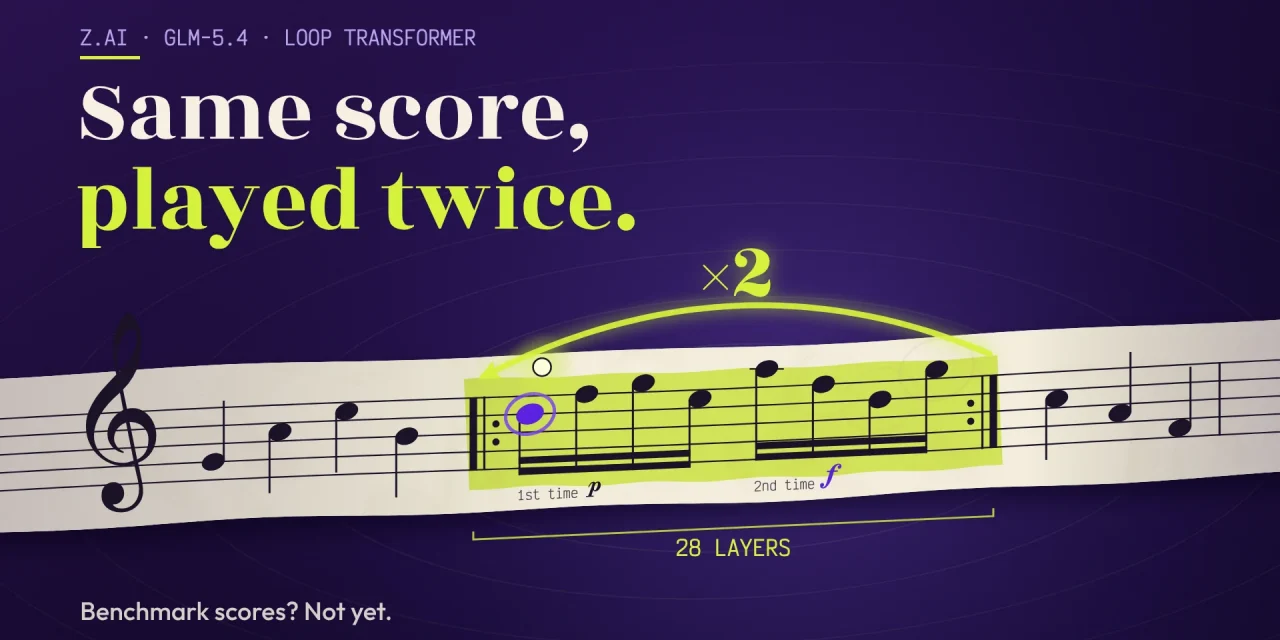
Z.ai released GLM-5.4 on 23 November 2026, a flagship that gets more depth out of the same weights. The new model from the company also known as Zhipu runs a block of 28 layers of its GLM-5 base twice for every token, in a model of about 750 billion parameters, and Z.ai says that lifts it to the level of models with 2 to 3 trillion parameters. It also reads images and video, and handles a 1 million token context. What it does not have yet is just as important for European organisations: no benchmark scores for the model itself, no pay-as-you-go API until a safety evaluation is done, and no downloadable weights until what Z.ai calls safety hardening is complete. For now GLM-5.4 is a model you can rent inside a coding subscription, not one you can build on or host.
What Z.ai released on 23 November
GLM-5.4 went live for every subscriber of the GLM Coding Plan, in Z.ai’s own coding tool ZCode and in Z.ai Chat. Zixuan Li of Z.ai announced it on X, and the developer documentation lists two model names: glm-5.4 for most tools and glm-5.4[1m] to switch on the 1 million token context window in Claude Code. Zhipu’s Chinese model guide fills in the rest:
- Input and output: video, images, text and files in, text out, up to 128,000 output tokens.
- Features: several thinking modes, streaming, function calling, context caching and structured output such as JSON.
- Speed: up to 200 tokens per second outside peak hours and 70 to 80 at peak load.
- Allowance: subscribers with weekly limits get 1.5 times the usable quota they had on GLM-5.3, because each token costs fewer credits.
Z.ai frames the release as the start of what it calls generalised coding: code as the way into work beyond software. Its demos include a music video in which the visuals are drawn entirely by front-end code without a single image file, an interactive 3D bird-watching scene built from geometry and custom GLSL shaders, and a six-axis robot arm that the model modelled in FreeCAD and then animated and set to sound in Blender. Z.ai also says a significantly larger model is coming soon.
How a Loop Transformer gets more depth from the same weights
In a standard transformer every token passes through every layer once. GLM-5.4 sends each token through a block of 28 layers twice, with the same weights on both passes. The GLM-5 base has 78 layers, according to its technical report, so a token now makes 106 layer passes while the model in memory stays the same size. Z.ai traces the idea back to the Universal Transformer of 2018. It did not train a looped model from scratch, because in its experience such models still trail standard ones at the same pre-training budget. Instead it took the fully trained GLM-5 base and continued training it into a loop.
Running layers twice sounds simple. Three engineering choices keep it from becoming expensive or unstable, according to the launch blog and the Chinese guide.
- Gates per token. Simply overwriting the hidden state on each pass made activation norms swell from one loop to the next. Each pass now has its own gate per token that decides how much of its change is written back. After training, the first pass writes cautiously and builds global context, and the second pass opens the gates to refine. The gate also adjusts to how hard a token is to predict.
- A hybrid KV cache. The second pass reuses the sparse key-value entries the first pass selected and keeps only its own new entries in a sliding window. An extra loop therefore costs one window of cache instead of a full-context cache, which Z.ai says keeps the cost increase over GLM-5.3 modest even at 1 million tokens.
- Reused attention indices. GLM-5 uses sparse attention with an indexer that picks which tokens to attend to. The second pass reuses the first pass’s choices, which Z.ai says performs almost the same as recomputing them. Fused kernels cut the extra memory traffic further.
GLM-5.4 is the second looped model in a week. On 20 November Thinking Machines released Inkling 2 Mini, which runs the middle 12 of its 24 layers three times and fits on a 32 GB laptop under an Apache 2.0 licence. The same idea now sits at both ends of the scale: small and open on a desk, and at 750 billion parameters behind a subscription.
The only numbers come from a 30B test model
Z.ai says it tested the design step by step on base models of 1, 4, 30 and 750 billion parameters. The one table it published compares a 30B model with the same architecture as the 750B base, with and without the loop. Parameter counts were identical, the looped version used about 10% more training compute, and both were measured after 200K long-context fine-tuning with thinking switched on. The rows below were reported by MarkTechPost and BeatAPI from the blog’s table.
| Benchmark, 30B test model | Standard | With loop | Average answer length |
|---|---|---|---|
| AIME25, competition maths | 19.17 | 30.42 | about 2% shorter |
| GPQA-Diamond, science | 47.58 | 56.26 | 11.7% shorter |
| AA-LCR, long context | 40.33 | 47.67 | 9.7% shorter |
| MMLU-Pro, knowledge | 71.65 | 75.05 | 14.9% shorter |
Z.ai’s reading is that part of the reasoning moves out of the written chain of thought and into the depth of the loop, so the model needs fewer output tokens to reach a better answer. That is plausible and it matches what Thinking Machines reported for Inkling 2 Mini. It is also all there is. There is no score for GLM-5.4 itself on any benchmark, vendor-run or independent, and no evidence yet for the claim that a 750B looped model performs like a 2 to 3 trillion parameter one. A Z.ai team member said the scores will follow.
The one outside signal so far points at a trade-off. Software reviewer AICodeKing tested GLM-5.4 before release on his KingBench 4, six large build projects such as a game emulator and a 3D room designer. According to WinBuzzer, it ranked seventh of 19 models with 55.3% of the available points. At its highest reasoning setting it needed 431 minutes for the suite, against 109 for Google’s Gemini 4 Neon, and took about 4.6 times as many steps, each slightly faster. Z.ai itself admits the model can get caught in overly long “marathon thinking”, which it says still improves accuracy through self-correction. Shorter answers on a 30B test model and long deliberation on the flagship are not a contradiction you can resolve without the missing numbers.
Why this release looks different from GLM-5.3
When GLM-5.3 arrived in August it came with full benchmark tables, and its weights appeared on Hugging Face within a week. GLM-5.4 arrives with a blog post, an architecture and a subscription. Z.ai says the API “will open after safety evaluation” and that the weights will follow after “necessary safety hardening”. It gives no dates.
Z.ai does not say what prompted the change, and two things happened in between. In September its coding tool ZCode was found packaging local repositories and trying to upload them to Alibaba Cloud storage without clear consent; Z.ai apologised, removed the feature, open-sourced ZCode and had the deletion checked by third parties. And on 29 September Anthropic’s Frontier Red Team reported that the open GLM-5.3 builds working exploits almost as well as Claude Mythos Preview, a model Anthropic only gives to vetted defenders, with safeguards that simple techniques could bypass. Whatever the reason, the result is a staged release: subscribers first, the API after an evaluation, the weights last. For a European team that wants to build on GLM-5.4 or run it in-house, the staging is the news.
What European organisations can use today
The only route to GLM-5.4 right now is the GLM Coding Plan, and the plan type matters more than the model.
- Individual plans are personal. The subscription terms license Lite, Pro and Max to one natural person, forbid sharing the account or quota with colleagues and limit use to officially supported coding tools. Using the quota as a general API from your own applications is excluded. Lite starts at $18 a month. A developer can test GLM-5.4 on their own account. A company cannot roll it out that way.
- The Team Plan is the organisational route. It needs at least two seats, includes GLM-5.4 and adds central billing and seat management. Price trackers list the Standard seat at $88 per month. Z.ai’s Team Plan page says code, prompts and conversations are excluded from model training by default, but says nothing about retention or where data is processed.
- The data goes to Singapore. Z.ai’s international services are run by a Singapore company, Jingsheng Hengxing Technology, and its privacy documentation says customer data is generally processed in Singapore, with transfers to group companies allowed. There is no EU region. Singapore has no EU adequacy decision, so personal data in prompts or code needs standard contractual clauses and a transfer impact assessment. Our post on GLM-5.3-FlashX-Legal walks through that data route in detail.
- Choose the harness yourself. GLM-5.4 works in Claude Code, Cline, OpenCode and other supported agents, not only in ZCode. After the September incident that choice is part of the risk assessment, and so is turning off any repository indexing or upload feature you do not need. Our guide to AI harnesses explains what the tool around the model controls.
Two practical details change the economics for teams in Europe. First, credits: GLM-5.4 costs fewer credits per token than GLM-5.3, so the same allowance stretches further.
| Credits per 10,000 tokens | Input | Cached input | Output |
|---|---|---|---|
| GLM-5.4 | 4.6 | 1.1 | 16 |
| GLM-5.3 | 6.9 | 1.7 | 24 |
| GLM-5.3-Flash | 2.3 | 0.56 | 8 |
Source: Z.ai Coding Plan overview, 23 November 2026. Lite has 10,000 credits a week and 2,000 per five hours, Pro 60,000 and 12,000, Max 140,000 and 28,000; a Team Standard seat has 66,000 and 15,000.
On Lite, 10,000 weekly credits buy about 6.25 million output tokens of GLM-5.4, or about 21.7 million fresh input tokens, at the standard rate. Second, timing: Z.ai’s peak hours are Monday to Friday from 14:00 to 18:00 Singapore time. That is 07:00 to 11:00 in Brussels in winter. European mornings are charged at the full rate, while usage outside those hours, including afternoons, evenings and weekends, counts at half the credits.
What to check before a pilot
| Question | What we found | What to do |
|---|---|---|
| How good is it? | No published GLM-5.4 scores; one independent coding test puts it seventh of 19, and slow. | Run 20 of your own tickets through GLM-5.4 and your current model, and record pass rate and minutes per task. |
| Which plan may we use? | Individual plans are personal and cannot be shared; the Team Plan starts at two seats. | Use individual accounts only for personal evaluation; buy seats for anything a team relies on. |
| Where does our code go? | Singapore, group transfers allowed, no EU region, no stated retention for the Team Plan. | Start with open-source or synthetic code; get the DPA, SCCs and a transfer impact assessment before client or personal data. |
| Can we build on it? | No API yet; quota may only be used in supported tools. | Keep production integrations on an API model; plan GLM-5.4 for when the API and pricing are published. |
| Can we host it? | No weights, no licence, no date. | If sovereignty is a requirement, evaluate open models you can run now and revisit when the weights land. |
| Vendor review | Zhipu has been on the US Entity List since January 2025; the ZCode incident was in September 2026. | Document both in the supplier assessment; they do not bind a European company, but clients will ask. |
If you plan to build GLM-5.4 into your own product once the API opens, the EU AI Act gives you a lever: under Article 53, providers of general-purpose AI models must make documentation available to the companies that integrate them. Ask for it before you sign.
What the loop means for running it yourself later
When the weights do arrive, the loop changes the hardware sums in an unusual way. Memory follows the number of stored parameters, and that stays at the 750B scale of the GLM-5 family. Compute follows the number of layer passes, and that rises by 28 per token, roughly a third more, minus what the reused cache and attention indices save. So a looped model is not harder to fit, but all else being equal it is slower per token on the same hardware. For organisations that already plan on-premises deployments of the GLM family, such as the compressed GLM-5.3 in Aikido Altar, the loop moves the bottleneck from memory to throughput. The licence for GLM-5.4 is unknown; earlier GLM-5 releases used MIT. Z.ai is one of the labs in our overview of China’s most innovative AI labs, and its open weights have become a base for other companies’ products, so the release matters beyond this one model.
Measure it in minutes
For years the size of a model on its model card told you roughly what it could do and what it would cost to run. Looping breaks that link. GLM-5.4 keeps the memory of a 750B model, claims the ability of a much larger one and spends extra depth on every token, sometimes a great deal of it. Neither the parameter count nor the price per token tells you what a finished task costs. The number that does is time and credits per completed job, and Z.ai has published that no more than the benchmarks. Until it does, the useful test is the one you run yourself, with a stopwatch next to the diff.
Frequently asked questions
Is GLM-5.4 open source?
Not yet. Z.ai says it will release the weights after safety hardening, without a date or a licence. Earlier GLM-5 models were released under the MIT licence.
Can I use GLM-5.4 through the API?
Not yet. Z.ai says the API will open after a safety evaluation. Today GLM-5.4 is available only through the GLM Coding Plan, ZCode and Z.ai Chat.
How big is GLM-5.4?
About 750 billion parameters, built on the GLM-5 base. A block of 28 layers runs twice per token, which Z.ai says gives it the intelligence of a 2 to 3 trillion parameter model. That claim has not been backed by published scores yet.
How do I use GLM-5.4 in Claude Code?
Point Claude Code at Z.ai’s Anthropic-compatible endpoint, https://api.z.ai/api/anthropic, with your Coding Plan key, and set the model to glm-5.4[1m] in ~/.claude/settings.json. The default effort level is max.
Is GLM-5.4 better than GLM-5.3?
Z.ai says it codes better all round and adds vision, but has published no comparison. The only independent test so far ranks it seventh of 19 models on KingBench 4.