The Cerebras IPO is a public test of whether investors believe the AI compute boom can keep expanding beyond Nvidia, beyond traditional GPU clusters and beyond today’s data center model.
Cerebras is expected to list on Nasdaq under the ticker CBRS, with pricing reportedly lifted from an earlier range of $115 to $125 per share to $150 to $160. The company is now aiming to raise about $4.8 billion at a valuation near $33 billion. Demand is said to be intense, with orders around 20 times the shares available.
That enthusiasm has a simple reason. AI is moving from a training race to an inference race. Training is how models learn. Inference is the moment they answer your prompt, write code, search files, analyze research or power an agent. If inference becomes cheaper and faster, the whole AI market changes.
Why Cerebras matters in AI compute
Most AI data centers today are built around racks of GPUs. Each rack contains many chips, and those chips must constantly move data between one another. That works, but it creates latency, networking complexity and cost.
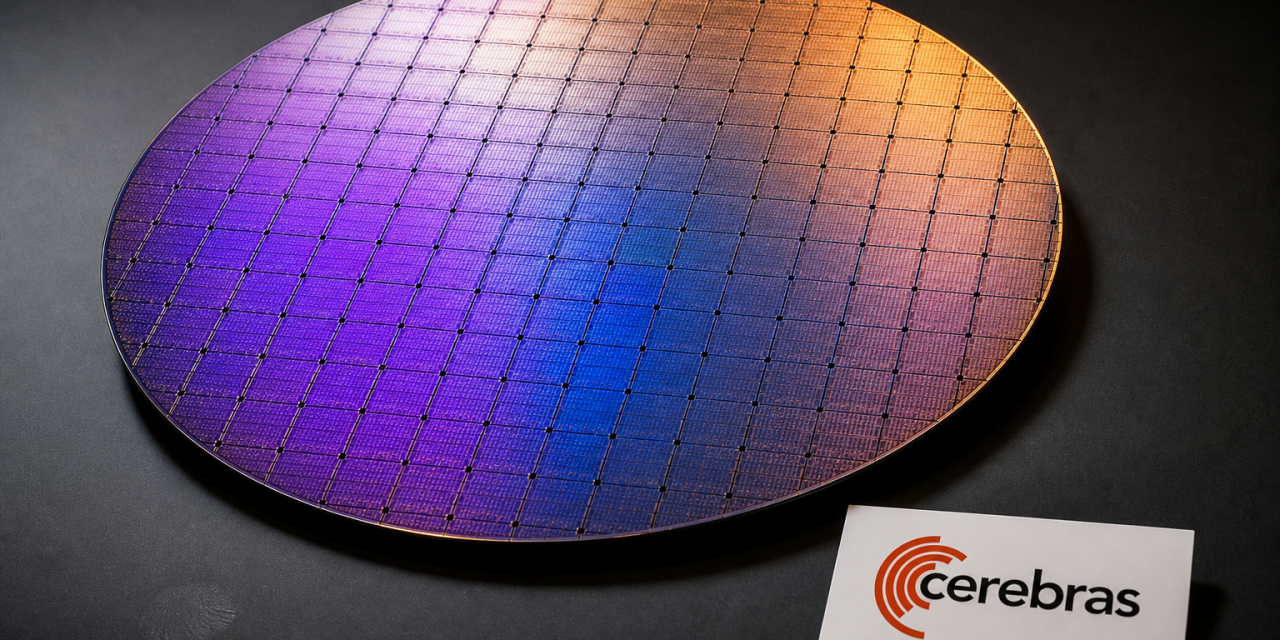
Cerebras took a different path. Instead of cutting a silicon wafer into hundreds of smaller chips, it builds one enormous wafer scale processor. Its Wafer Scale Engine is roughly dinner plate sized and designed to keep more compute, memory and communication on one giant piece of silicon.
The core argument is easy to understand. If AI workloads spend too much time moving data between chips, make the chip bigger. Less shuttling can mean lower latency, higher throughput and better performance for the kind of real time AI people use every day.
Cerebras describes its platform as purpose built for ultra fast AI inference. The company claims major speed advantages over GPU based systems, although real world results depend on the model, workload and setup. Its public materials highlight use cases such as coding assistants, enterprise search, voice AI, scientific research and agents that need rapid multi step reasoning.
The Cerebras IPO arrives at the right moment
The timing of the Cerebras IPO is important because the market is searching for credible alternatives to Nvidia. Nvidia remains the dominant supplier of AI accelerators and one of the most valuable companies in the world. But demand for AI chips has become so large that even dominant supply is not enough.
OpenAI is reportedly paying Cerebras more than $20 billion for 750 megawatts of inference compute through 2028. This frames AI not just as a software market, but as an energy and infrastructure market. A megawatt is not a dashboard metric. It means land, power, cooling, interconnects, permits and physical capacity.
This is why data centers have become the hidden engine of AI. Every ChatGPT, Claude, Gemini or enterprise AI request needs machines somewhere to calculate the answer. More usage means more compute. More compute means more chips. More chips mean more racks, more buildings and more electricity.
That is the backdrop for investor demand. If AI usage continues to grow, inference could become one of the largest recurring infrastructure markets in technology.
Inference is where AI becomes expensive
Training gets the headlines because it creates the frontier model. Inference gets the bill because it happens every time someone uses that model.
For a popular AI assistant, inference is not a one time cost. It happens billions of times. Every generated answer consumes compute. Every longer context window needs memory. Every voice interaction demands low latency. Every coding agent that loops through files creates more tokens.
This is why faster inference is not only about speed. It changes product design.
- Lower latency makes AI feel more natural in chat, voice and search.
- More tokens per second can support deeper reasoning inside the same response window.
- Better price performance can make advanced AI features affordable for more products.
- Dedicated capacity can reduce reliance on scarce GPU supply.
Cerebras claims its systems can deliver extremely high token generation rates for open models. Its website cites examples above 2,000 tokens per second in some deployments. Those numbers should always be read in context, but they point to the company’s main pitch: inference speed is becoming a first class feature.
Why Nvidia is still hard to beat
Cerebras may be a real challenger, but challenging Nvidia is not the same as replacing it.
Nvidia’s advantage is not only the GPU. It has CUDA, networking, software libraries, developer habits, cloud availability and years of production maturity. Most AI teams know how to run on Nvidia infrastructure. Many models and workflows are optimized for it. Switching hardware can be technically attractive and still operationally difficult.
That is why the most likely near term outcome is not a clean winner takes all shift. It is workload specialization. GPUs keep many training and general purpose workloads. Cerebras competes where very fast inference, low latency and large on chip communication matter most.
This also explains why OpenAI would want a broader compute portfolio. If Nvidia capacity is scarce, expensive or better suited to some workloads than others, specialized systems become valuable. The right question is not whether Cerebras replaces GPUs. The better question is which AI workloads become valuable enough to justify specialized silicon.
Answer inference and agentic inference
One useful way to understand the market is to separate answer inference from agentic inference.
Answer inference is what most people use now. You ask a chatbot a question and wait for a reply. Speed matters because a human is watching. If the system feels slow, the product feels worse. This is the market where Cerebras looks especially well timed. Fast responses, fluid voice interactions and real time copilots all benefit from low latency.
Agentic inference is different. An AI agent might work overnight, scan documents, write tests, compare suppliers or generate reports while nobody watches each intermediate step. In that world, memory, cost and availability can matter more than raw response speed. Some of that compute might run on slower and cheaper systems, or wherever electricity is cheapest.
This distinction is important for the Cerebras IPO. Investors are not only valuing today’s chatbot usage. They are making a bet on what the next wave of AI workloads will look like. If real time AI dominates, Cerebras has a direct opening. If agentic workloads become more flexible and cost driven, the infrastructure market could fragment across many hardware types.
The data center boom is becoming a power market
The strongest argument for the AI infrastructure boom is that demand for intelligence may start to resemble demand for energy. Wealthy economies use enormous amounts of electricity because energy multiplies productivity. If AI becomes a basic factor of production, businesses may consume compute in the same way they consume power, cloud storage or internet bandwidth.
That idea helps explain the scale of recent activity around AI data centers. SoftBank’s Masayoshi Son has reportedly discussed up to $100 billion in French data center investment. xAI has reportedly turned major GPU capacity into leased compute for Anthropic. Even orbital data center concepts are attracting funding, with the bottleneck described as rocket capacity rather than engineering.
Some of this will sound excessive. Some of it probably is. But the direction is clear. AI is no longer limited by model ideas alone. It is limited by physical infrastructure.
The risks behind the Cerebras story
The bullish case for Cerebras is compelling, but the risks are real.
- Customer concentration can matter if a few large buyers drive a large share of revenue.
- Hardware transitions are difficult because customers need software, support and proof at scale.
- Data center constraints include power availability, cooling, construction timelines and regulation.
- Competition is intense from Nvidia, cloud chips, custom AI accelerators and other startups.
- Workload uncertainty could shift demand toward cheaper compute rather than the fastest systems.
Cerebras has already faced scrutiny around its earlier IPO plans and its relationship with G42, which triggered review by United States authorities. The company later moved forward again, and its current listing plan suggests those concerns no longer block the offering. Still, the episode shows that AI infrastructure is now strategic technology, not just enterprise hardware.
What the Cerebras IPO signals
The Cerebras IPO will show whether public markets are ready to value AI compute companies as core infrastructure providers rather than cyclical chip suppliers. The excitement is not only about one giant chip. It is about a broader belief that inference demand could grow for years as AI becomes embedded in search, software, healthcare, finance, research and operations.
If Cerebras succeeds, it will strengthen the idea that AI infrastructure has room for specialized architectures. If it struggles, it may suggest that Nvidia’s ecosystem advantage is even harder to challenge than expected.