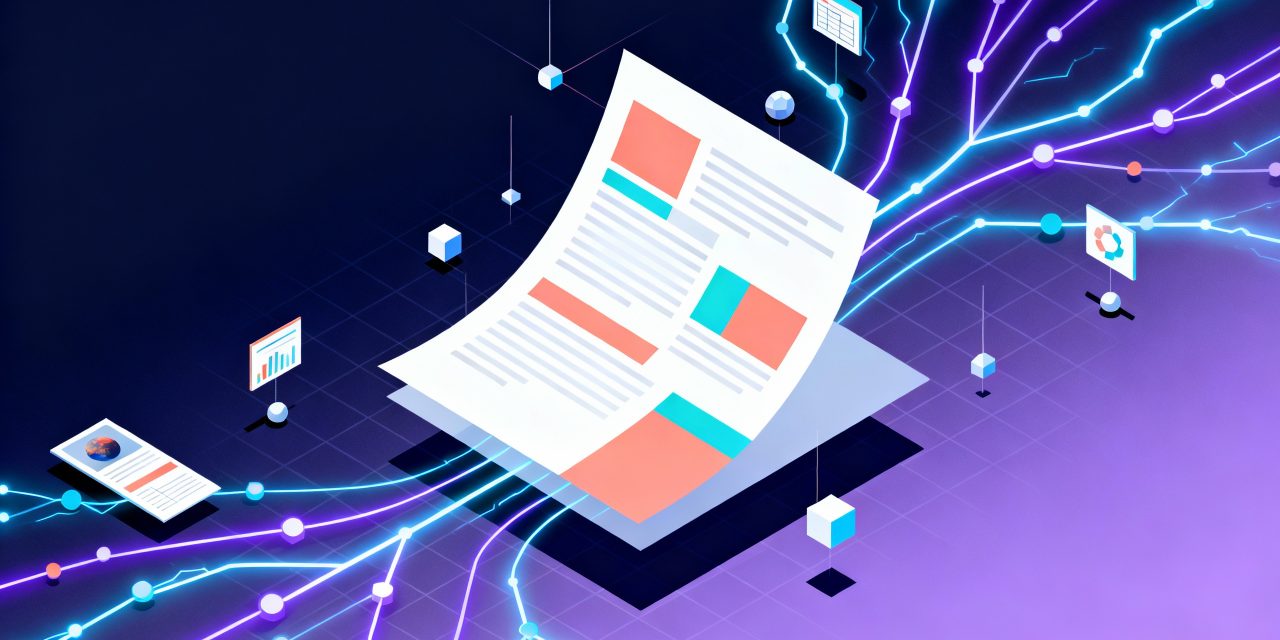
For decades, Optical Character Recognition (OCR) has been the necessary evil of data processing. It was the bridge between the physical world of paper and the digital world of databases. However, traditional OCR has always had a significant flaw: it reads, but it does not understand. It sees a table as a collection of floating words, a mathematical formula as a jumble of symbols, and a complex layout as a chaotic stream of text. In 2026, the landscape of document processing is shifting rapidly with the introduction of multimodal models designed specifically to bridge this gap.
Enter GLM-OCR. This isn’t just another tool that converts pixels into ASCII characters. It represents a fundamental shift towards Document Understanding. By combining computer vision with language modeling, GLM-OCR promises to turn messy, unstructured PDFs and images into clean, semantic data like Markdown and JSON. But how does it actually work? What makes it superior to the giants of the industry, and perhaps most importantly, what are the limitations that developers and businesses need to be aware of before integrating it?
In this deep dive, we explore the architecture, capabilities, and critical considerations of GLM-OCR.
What Is GLM-OCR?
At its core, GLM-OCR is a multimodal model designed for complex document understanding. Unlike traditional OCR engines (like Tesseract) that focus on character-level recognition, GLM-OCR is derived from the GLM-4V / GLM-V vision-language architecture. It is developed by Z.ai (Zhipu) and has gained traction for its ability to handle in-the-wild documents, files that are messy, handwritten, or contain complex formatting like nested tables and scientific notation.
The model is relatively lightweight, sporting 0.9 billion parameters. While this might sound small compared to massive Large Language Models (LLMs) that boast hundreds of billions of parameters, this compact size is a strategic design choice. It allows for efficient inference on local hardware while maintaining high accuracy. The model is released under open licenses (Apache 2.0 and MIT), making it a highly attractive option for developers who want to avoid the recurring costs and privacy concerns associated with proprietary cloud APIs.
How Does It Work? The Architecture
To understand why GLM-OCR performs differently than its predecessors, we have to look under the hood. It utilizes a sophisticated pipeline that marries visual perception with linguistic prediction.
1. The Visual Encoder (The Eyes)
The process begins with the CogViT visual encoder. This component is pre-trained on large-scale image-text data. Instead of scanning a document line by line looking for black pixels on a white background, the encoder looks at the document as a whole image. It captures the layout, the spatial relationships between text blocks, and visual artifacts like stamps or signatures.
2. The Cross-Modal Connector
Raw visual data is heavy. To make it digestible for the language model, GLM-OCR employs a lightweight cross-modal connector with efficient token downsampling. This compresses the visual information into a format that the language decoder can process without getting bogged down by unnecessary pixel data.
3. The Language Decoder (The Brain)
The processed visual tokens are fed into a GLM-0.5B language decoder. This is where the magic happens. Because it is a language model, it understands context. If a scan is blurry and the word looks like “c0rn,” the model uses the surrounding context (e.g., “farm,” “harvest”) to predict that the word is likely “corn.”
4. Multi-Token Prediction (MTP)
A standout feature of this architecture is the introduction of Multi-Token Prediction (MTP) loss. Traditional models often predict one token (part of a word) at a time. MTP allows the model to predict multiple future tokens simultaneously during training. This improves training efficiency and helps the model maintain coherence over longer sequences of text, which is crucial when parsing dense legal contracts or academic papers.
What Makes GLM-OCR Different?
If you have used tools like PaddleOCR or proprietary solutions from major cloud providers, you might wonder why a switch to GLM-OCR is warranted. The differentiation lies in the output quality and structural awareness.
Semantic Structure vs. Raw Text
The biggest pain point in OCR is losing structure. A standard OCR engine will give you the text inside a table, but it won’t tell you it’s a table. You are left with a soup of words that you have to write complex Regular Expressions (Regex) to parse.
GLM-OCR is trained to output semantic Markdown and JSON. It doesn’t just see text; it sees headers, lists, bold text, and table rows. If you feed it a financial balance sheet, it can output a JSON object where “Total Assets” is a key and the value is correctly associated, even if the columns are far apart visually. This capability alone saves developers hundreds of hours of post-processing scripting.
Handling Complex Elements
Scientific and academic documents are notoriously difficult for OCR due to mathematical formulas. GLM-OCR excels here by outputting LaTeX code for formulas. This makes it a powerful tool for digitizing academic archives or processing research papers where preserving the integrity of equations is non-negotiable.
Contextual Correction
Because it is a Vision-Language Model (VLM), it possesses common sense regarding language. It is significantly better at handling handwriting and noisy scans (like crumpled receipts) because it doesn’t rely solely on edge detection of characters. It infers the text based on what should be there, much like a human does when reading bad handwriting.
What Does It Do Better? (Performance & Benchmarks)
Marketing claims are one thing, but benchmarks provide the necessary reality check. According to the available data, GLM-OCR has positioned itself as a leader in the lightweight model category.
- OmniDocBench V1.5: GLM-OCR achieved a score of 94.62, which is reported as a state-of-the-art result for this benchmark. This test covers diverse document layouts, including tables, formulas, and information extraction tasks.
- Throughput: Efficiency is key for bulk processing. On capable hardware, the model reaches a throughput of roughly 1.86 pages per second for PDFs. While this might not match the raw speed of some lightweight, non-AI OCR tools, it is exceptionally fast for a model that is performing deep semantic understanding simultaneously.
- Precision Mode: The model includes a specific Precision Mode which claims up to 99.9% accuracy. This is particularly relevant for high-stakes environments like finance or law, where a single misplaced decimal point can be disastrous.
Real-World Applications
The capabilities of GLM-OCR map directly to several high-value verticals:
1. Financial Analysis
Investment firms and banks deal with millions of PDFs, annual reports, invoices, and receipts. GLM-OCR’s ability to convert these directly into structured JSON allows for automated ingestion into algorithmic trading models or risk assessment software without manual data entry.
2. Legal Tech
Legal discovery involves sifting through mountains of scanned contracts and case files. The model’s ability to recognize document structure (clauses, sections, signatures) allows for better indexing and searchability. Furthermore, because it can be deployed locally, it adheres to strict data privacy regulations that often prevent law firms from sending client data to public cloud APIs.
3. Academic Research
Researchers can use the LaTeX output feature to convert old, scanned papers into editable Markdown formats. This integrates seamlessly with tools like Obsidian, Jupyter Notebooks, or Overleaf, modernizing the workflow for literature reviews.
Criticism and Limitations
No AI model is perfect, and despite the impressive specs, there are valid criticisms and limitations regarding GLM-OCR that users must consider. It is vital to look beyond the hype.
1. The Hallucination Risk
Because GLM-OCR is generative (based on a language model decoder), it carries the inherent risk of hallucination. Unlike a deterministic OCR engine that either reads a character or fails, a generative model might guess a word that looks plausible but isn’t actually there. While the Precision Mode attempts to mitigate this, users processing critical data (like medical records) must implement a human-in-the-loop verification step.
2. Hardware Requirements
While 0.9B parameters is small for AI, it is huge compared to Tesseract. You cannot run GLM-OCR efficiently on a Raspberry Pi or a low-end server. It requires GPU acceleration to achieve the stated throughput speeds. This increases the infrastructure cost compared to traditional OCR solutions.
3. Prompt Sensitivity
The model supports specific prompt scenarios, particularly for information extraction. However, it is not a general-purpose chatbot. If you deviate from the expected prompt structure or ask it to perform complex reasoning tasks outside of document parsing, the performance degrades. It is a specialist, not a generalist.
4. Strict Schema Adherence
When using the model for information extraction (IE) to output JSON, the model must strictly adhere to a defined schema. In complex, real-world documents where data fields might be ambiguous or missing, the model might struggle to force the data into the requested JSON format, potentially leading to malformed outputs or omitted data.
5. Language Support Nuances
While the model supports multiple languages, its primary training data and optimization often lean heavily towards English and Chinese environments. Performance on languages with vastly different scripts or complex diacritics (outside of the major supported ones) may not match the high benchmarks seen in English documents.
Deployment: Putting It Into Practice
One of GLM-OCR’s strongest selling points is its flexibility in deployment. It supports the modern AI stack, making it easy for engineers to integrate.
- Local Inference: You can run the model using vLLM or SGLang. This is the preferred method for enterprise environments requiring high throughput and data privacy.
- Ollama Integration: For developers who want to test the model quickly on their local machines, GLM-OCR is compatible with Ollama. This allows for a drag-and-drop experience in the terminal to test image recognition capabilities instantly.
- API Availability: For those who prefer not to manage infrastructure, hosted API options exist, though they trade off the privacy benefits of local deployment.
Conclusion
GLM-OCR represents a significant maturity milestone in the field of document processing. It moves us away from the era of dumb character recognition into an era of semantic document understanding. By leveraging a multimodal architecture, it solves the dual problems of accuracy and structure that have plagued developers for years.
However, it is not a magic wand. The requirement for GPU hardware and the potential for generative errors mean it is best suited for complex, high-value workflows rather than simple text extraction tasks. For businesses dealing with messy, unstructured data in finance, law, or academia, GLM-OCR offers a compelling, open-source alternative to expensive proprietary tools. As we move further into 2026, the ability to turn static documents into structured, AI-ready data will be a key competitive advantage, and GLM-OCR is currently one of the best tools available to achieve that.