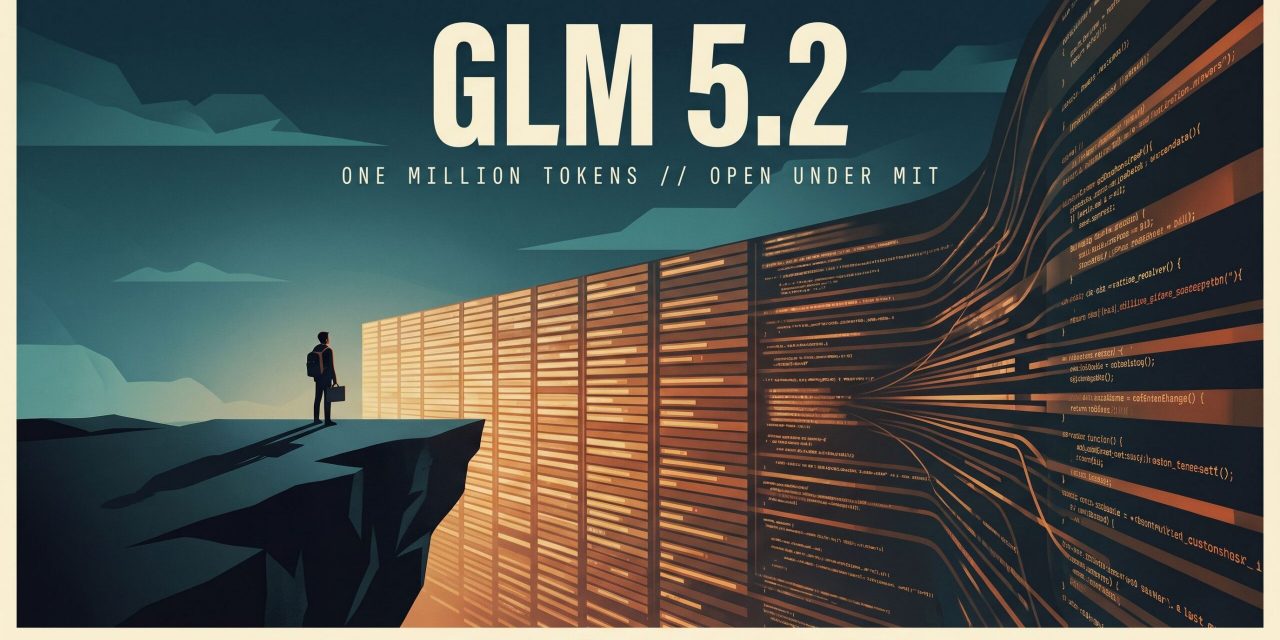
Zhipu has pushed GLM 5.2 to every paying tier of its GLM Coding Plan, from Lite through Pro, Max and the Team edition. The rollout went live at 5:21 PM on June 13, and it brings something developers have been chasing for a while: a one-million-token context window that the company describes as genuinely usable rather than a marketing figure. The API follows next week, and the model weights will be released under the MIT license shortly after.
There are no published benchmarks yet. That is unusual for a release of this scale, and it shifts the early conversation toward real-world testing rather than leaderboard positioning. For teams that have been working with GLM 5.1 since March, or with the 400 tokens-per-second high-speed variant released in May, GLM 5.2 is positioned as the strongest open model Zhipu has shipped so far.
What changes with GLM 5.2
The headline upgrade is the context window. A one-million-token capacity puts GLM 5.2 in the same league as the longest-context frontier models, and Zhipu is explicit that this is not a theoretical ceiling. The company claims the model holds its performance on long-range tasks, which is where most long-context implementations quietly fall apart. Models often advertise huge windows but lose track of details past a few hundred thousand tokens, miss instructions buried in the middle of the input, or hallucinate when asked to reason across an entire document set.
If GLM 5.2 delivers on the long-range claim, it opens up workflows that have been awkward to handle until now:
- Reading an entire mid-sized codebase in a single pass without chunking or retrieval scaffolding
- Reviewing long technical specifications alongside the implementation that should match them
- Summarising and cross-referencing legal, financial or research documents that run into hundreds of pages
- Maintaining agent state across extended multi-step tasks without aggressive context compression
The absence of benchmarks means the community will set the tone. Expect needle-in-a-haystack tests, RULER-style evaluations and practical coding trials to surface within days of the API going live.
Open weights under MIT
Zhipu plans to release the weights next week under the MIT license. That choice is deliberate. MIT is one of the most permissive licenses available, allowing commercial use, modification, redistribution and integration into closed-source products with minimal obligations. It stands apart from the custom community licenses that several large open-weight releases use, which often carve out restrictions on competitors, on users above a certain scale, or on specific application areas.
For startups, internal tooling teams and researchers, MIT removes most of the legal friction that comes with deploying a model in production. You can fine-tune it, ship it inside a paid product, host it on your own infrastructure and build derivatives without negotiating terms. That has been a consistent argument for choosing open weights over API-only frontier models, and Zhipu is leaning into it.
The company tied the release to a broader statement about access. In its announcement, Zhipu framed the decision around the idea that frontier intelligence should not belong to a small group, nor be subject to rules that can be revoked at any time. The reference to recent moments when frontier models have suddenly become unavailable to certain users is not subtle. It positions GLM 5.2 as a stable, buildable foundation rather than something that could vanish behind a policy change.
Coverage across the GLM Coding Plan tiers
One detail that often gets lost in model launches is which customers actually get access on day one. With GLM 5.2, Zhipu has avoided the staged rollout pattern. Every tier of the GLM Coding Plan gets the model at the same time:
- Lite for individual developers and lighter workloads
- Pro for professionals running more intensive coding sessions
- Max for power users who need the full capability ceiling
- Team for organisations sharing access across multiple seats
This matters because long-context models are usually gated behind the most expensive tier first. By giving Lite subscribers the same model that Max and Team subscribers use, Zhipu is making the long-context capability available at the entry price point. The differences between tiers presumably come down to quota, throughput and team features rather than model quality.
How GLM 5.2 fits into Zhipu’s release cadence
The pace is worth noting. GLM 5.1 launched in March. A high-speed variant pushing 400 tokens per second arrived in May. GLM 5.2 ships in June with a redesigned context window and an MIT-licensed open release. That is three significant updates in roughly three months, which suggests Zhipu is iterating on a tight cycle rather than waiting for a flagship moment.
The high-speed variant is particularly relevant context. Throughput at 400 tokens per second changes how a model feels in an interactive coding environment. Pair that with a million-token window and the practical experience starts to resemble something closer to a senior engineer who has actually read the whole repository before answering, rather than one who is guessing based on a few snippets.
What to watch when the API and weights drop
Next week’s release will answer the questions that the initial deployment cannot. A few things are worth tracking specifically:
- Real long-context performance. Independent tests on tasks that genuinely require reasoning across the full window, not just retrieval of a single fact
- Inference cost and memory profile. A million-token window is expensive to serve. How Zhipu prices the API and what hardware the open weights demand will determine practical adoption
- Coding benchmarks. Given the GLM Coding Plan branding, the community will run SWE-bench, LiveCodeBench and similar evaluations quickly
- Fine-tuning behaviour. MIT-licensed weights only matter if the model fine-tunes cleanly. Early results from the open-source community will tell that story
- Stability of the long-context claim. Whether the quality holds at 500K, 800K and the full million tokens, or degrades sharply past a threshold
The bigger picture
GLM 5.2 lands at a moment when the gap between proprietary frontier models and open-weight alternatives is narrower than it has ever been. The differentiator is increasingly about access conditions rather than raw capability. A million-token context, MIT licensing and same-day availability across every paid tier is a coherent answer to a specific question: where do you build when you cannot afford to have a model pulled out from under your product?
The quieter signal in this release is that Zhipu skipped the benchmark theatre entirely. No leaderboard claims, no curated demos, just shipped weights and an open license. Whether that confidence is earned will be visible within a week, and the answer will not come from a press release.