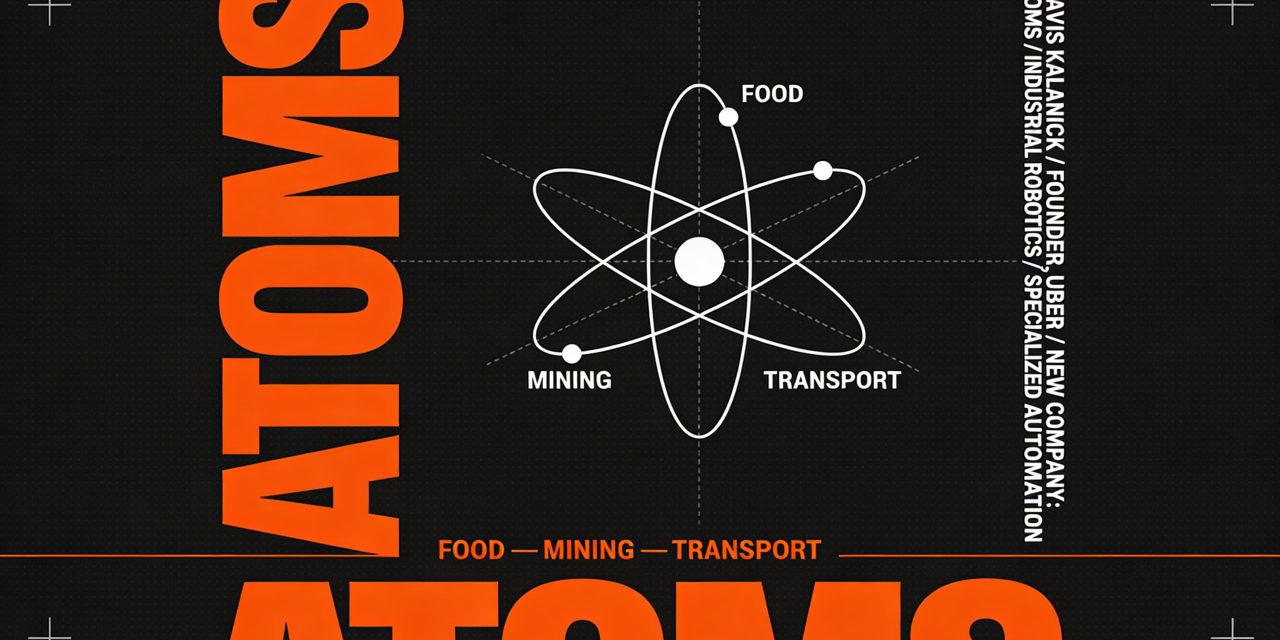
Atoms is the new company launched by Uber founder Travis Kalanick, and it is not positioning itself as another humanoid robot startup. Instead, Atoms appears to be aiming at a more practical and commercially grounded part of robotics: specialized machines for food operations, mining, and eventually transportation. That focus matters because it says a lot about where useful robotics may scale first.
Based on what is publicly known so far, Atoms combines Kalanick’s existing food infrastructure business with a broader robotics push. The company’s website points to automated kitchen systems, autonomous haulage for mines and quarries, restaurant operating software, office meal logistics, and food production infrastructure. Kalanick has also said the company is building a wheelbase for robots that can be applied to specialized use cases rather than humanoids.
That makes Atoms interesting for a simple reason. It is not trying to sell a futuristic vision before proving a workflow. It seems to be targeting environments where robotics already have a clear economic case, where tasks are repetitive, where layouts are semi structured, and where labor, safety, and throughput all matter.
What Atoms is
Atoms is a robotics focused company created by Travis Kalanick, best known as the cofounder and former CEO of Uber. The company appears to fold in CloudKitchens, Kalanick’s ghost kitchen business, and extend beyond food into industrial automation and transport adjacent robotics.
Its public positioning spans several areas:
-
Automated kitchen systems for producing food more consistently and at lower cost
-
Delivery first kitchens designed for modern restaurant brands
-
Restaurant operations software that connects orders, delivery apps, and kitchen workflows
-
Office lunch logistics that simplify meal delivery to teams
-
Industrial autonomy for mines and quarries through autonomous haulage systems
-
Food infrastructure including facilities and production environments for food brands
Read together, this looks less like a single product company and more like a systems company. Atoms is not only interested in a robot. It seems interested in the full stack around that robot: the site, the workflow, the software layer, the physical environment, and the business model.
Why the focus on specialized robots matters
Kalanick has explicitly said Atoms is focused on specialized robots, not humanoids. That is a notable choice at a time when much of the public discussion around robotics is centered on human shaped machines. Humanoids attract attention because they resemble people and promise flexibility across many tasks. But they also bring major technical and commercial challenges.
Specialized robots often have a clearer path to deployment. They operate in narrower environments. They do fewer things, but they do them repeatedly and efficiently. In industrial settings, that usually matters more than generality.
There are several reasons this approach is more practical in the near term:
Structured environments are easier to automate
Kitchens, quarries, warehouse corridors, loading zones, and production lines are not perfectly predictable, but they are far more controlled than city sidewalks or busy homes. That reduces the perception and planning complexity a robot has to handle.
The return on investment is easier to measure
If a robot can reduce food prep variability, lower waste, increase kitchen throughput, or improve mine haulage uptime, buyers can quantify the value. That tends to matter far more than a broad promise about future capabilities.
Safety and labor pressures create demand
Mining and industrial hauling are difficult environments with real safety risks. Food operations, meanwhile, are under pressure from labor shortages, thin margins, and demand volatility. Both are areas where operators are actively looking for process improvements.
Mobility can be modular
The idea of a wheelbase for robots suggests a platform strategy. Instead of building a new machine from scratch for every market, Atoms may be building a common mobility and control layer that can support several robot types. If that works, it could make iteration faster and deployment cheaper.
How CloudKitchens fits into Atoms
One of the most important clues about Atoms is that Kalanick is rolling his existing CloudKitchens business into it. That suggests Atoms is not a fresh robotics startup starting from zero. It may already have access to physical sites, customer relationships, operational data, and a set of use cases where automation can be introduced gradually.
That matters because robotics is rarely just about hardware. Many robotics companies struggle because they build a machine first and only later work out where it truly fits. CloudKitchens gives Atoms a different starting point. It already sits close to food preparation, delivery workflows, and kitchen economics.
In practice, that could mean Atoms is better positioned than a pure robotics entrant in several ways:
-
It may already understand the operational pain points inside delivery focused kitchens
-
It can test automation in environments it partly controls
-
It can combine robotics with software and facility design
-
It can sell efficiency as part of a broader service, not only as a machine purchase
This model is often stronger than standalone robotics because it reduces adoption friction. Restaurants do not always want to become robotics integrators. They want lower costs, smoother operations, and more predictable output. If Atoms can package those outcomes into infrastructure and software, its robotics layer becomes easier to deploy.
Food robotics may be Atoms’ most immediate opportunity
Of the sectors Atoms mentions, food looks like the most natural near term fit. The website repeatedly emphasizes robotics for better food, automated kitchen systems, and delivery first kitchen infrastructure. This suggests that food automation is not just a side experiment. It may be the core use case where Atoms can move fastest.
That would make sense for several reasons.
Food service is operationally messy but repetitive
Commercial kitchens involve repetitive steps, strict timing, quality control, and constant cost pressure. Some tasks are hard to automate completely, but many are structured enough for targeted robotics. Portioning, dispensing, moving trays, cooking specific menu items, and coordinating order flow are all candidates for specialized systems.
Consistency has direct value
Restaurants and food brands need meals to be consistent across locations and shifts. Automation can help reduce variance in prep, temperature, timing, and assembly. That has an immediate impact on customer experience and waste.
Margins are thin
Small improvements in labor allocation, throughput, and ingredient usage can matter a lot in food operations. A robot does not need to replace a full role to justify itself. It may only need to stabilize a bottleneck.
If Atoms can connect kitchen robotics with ordering software, delivery coordination, and purpose built facilities, it could offer a more complete food automation stack than companies that only provide a cooking machine or back of house robot.
Mining is a very different market, but also a logical one
At first glance, food and mining seem like an odd combination. But from a robotics perspective, they share an important trait: both reward specialized automation in controlled workflows.
Kalanick has said the industrial side is probably Atoms’ main focus, and he has discussed acquiring Pronto, an autonomous vehicle startup focused on industrial and mining sites. He also said he is already Pronto’s largest investor. If that deal happens or if the two businesses align closely, it would give Atoms a serious foothold in autonomous haulage.
Mining is one of the strongest real world domains for autonomy because the environment is constrained compared with public roads. Vehicles typically operate on private sites with mapped routes, controlled traffic patterns, and professional operators. The commercial logic is also clearer than in consumer autonomy.
Autonomous haulage systems can improve:
-
Safety by reducing human exposure in hazardous zones
-
Productivity through more consistent vehicle operation
-
Efficiency via route optimization and reduced idle time
-
Labor allocation by shifting workers toward supervision and exception handling
This is where the Atoms strategy starts to look more coherent. If the company is building a robotics platform around wheeled autonomy, then mines and quarries are a natural deployment zone. They are commercially demanding, but they do not require the full complexity of urban robotaxis.
Will Atoms move into transportation
Transportation is the most speculative part of the Atoms story. The company’s website says it operates in transportation, but public details remain limited. Kalanick has been linked to renewed interest in self driving technology, and reports suggest support from Uber may have been discussed. At the same time, he has downplayed the idea of moving people in the near term.
That distinction is important. There is a big difference between industrial vehicle autonomy and autonomous passenger transport.
Moving goods, materials, or equipment in restricted environments is hard, but it is often easier than moving people safely in open urban traffic. If Atoms starts with industrial haulage, logistics, and site constrained vehicle autonomy, that would follow the same pattern as its food robotics strategy: pick the use cases where automation can deliver measurable value before chasing the broadest possible vision.
Kalanick has also said that once you solve movement in the physical world, many adjacent opportunities open up. That is true, but the hard part is not mobility in the abstract. It is reliable mobility under specific constraints, at acceptable cost, with enough uptime to matter commercially. Atoms will need to prove that one domain at a time.
The shadow of Uber’s autonomous vehicle history
Any discussion of Atoms and Travis Kalanick also needs context. Kalanick previously pushed Uber into self driving vehicles, a project that became one of the most controversial chapters in the company’s history. That period involved aggressive competition, legal conflict with Google over trade secrets, and later a fatal crash involving one of Uber’s test vehicles after Kalanick had left the company.
Those events do not define Atoms, but they do shape how the market will read it. Investors, partners, and customers will likely ask three questions.
Can Atoms be disciplined where Uber was aggressive
Autonomy rewards ambition, but it punishes shortcuts. If Atoms wants credibility in robotics and industrial autonomy, it will need a reputation for careful deployment, clear safety processes, and realistic claims.
Can it turn platform thinking into execution
Kalanick’s strength has often been building and scaling systems around logistics. Atoms looks like another attempt at that. The challenge is that robotics requires tight integration between software, hardware, operations, and maintenance. Platform logic helps, but execution depth matters more.
Can it avoid spreading too wide
Food robotics, mine autonomy, restaurant software, office meals, and transportation infrastructure is a broad mix. There may be a common thread around physical operations, but focus will matter. The strongest version of Atoms is one where these pieces reinforce each other. The weaker version is one where the company becomes too diffuse.
What makes Atoms different from many robotics startups
Most robotics startups begin with a technical capability and then search for a market. Atoms seems to be moving the other way. It starts from operating environments that already exist and asks where robotics can improve them.
That is a meaningful difference.
In food, the company already has roots in kitchen infrastructure. In mining, it is targeting a domain where wheeled autonomy has immediate industrial value. In both cases, the robot is only one part of the system. The larger product is operational improvement.
This makes Atoms less of a pure robotics company and more of an automation infrastructure company. That could be a strength if it allows the business to capture value beyond hardware sales. It could also make the company harder to categorize, especially if observers expect a single headline product.
What to watch next
Atoms is still early, so the most useful signals will come from execution rather than branding. A few developments are worth watching closely:
-
Whether Pronto becomes part of Atoms, which would strengthen its mining autonomy position
-
How visible the food robotics products become, especially in kitchens tied to existing infrastructure
-
Whether the wheelbase platform is real and reusable across several robot categories
-
How the company defines transportation, particularly whether it stays in industrial logistics or moves toward passenger mobility
-
How much of the business is software and infrastructure versus robotics hardware
If Atoms can show real deployments in food and mining, the company may avoid a trap that hurts many robotics ventures: being judged on future ambition before current utility. The market is increasingly skeptical of robotics stories that rely on general purpose promises without narrow proof.
Why Atoms matters beyond Travis Kalanick
It is easy to focus on the founder, especially when that founder is Travis Kalanick. But Atoms matters for a broader reason. It reflects a shift in robotics toward domain specific automation with clear economics. That is where many of the most useful systems are likely to scale first.
The public conversation around robots often centers on what looks most human. The commercial conversation is usually about what solves a bottleneck. Atoms appears to understand that distinction. If it succeeds, it will probably not be because it built the most dramatic robot. It will be because it chose environments where autonomy and robotics can be tightly connected to measurable outcomes.