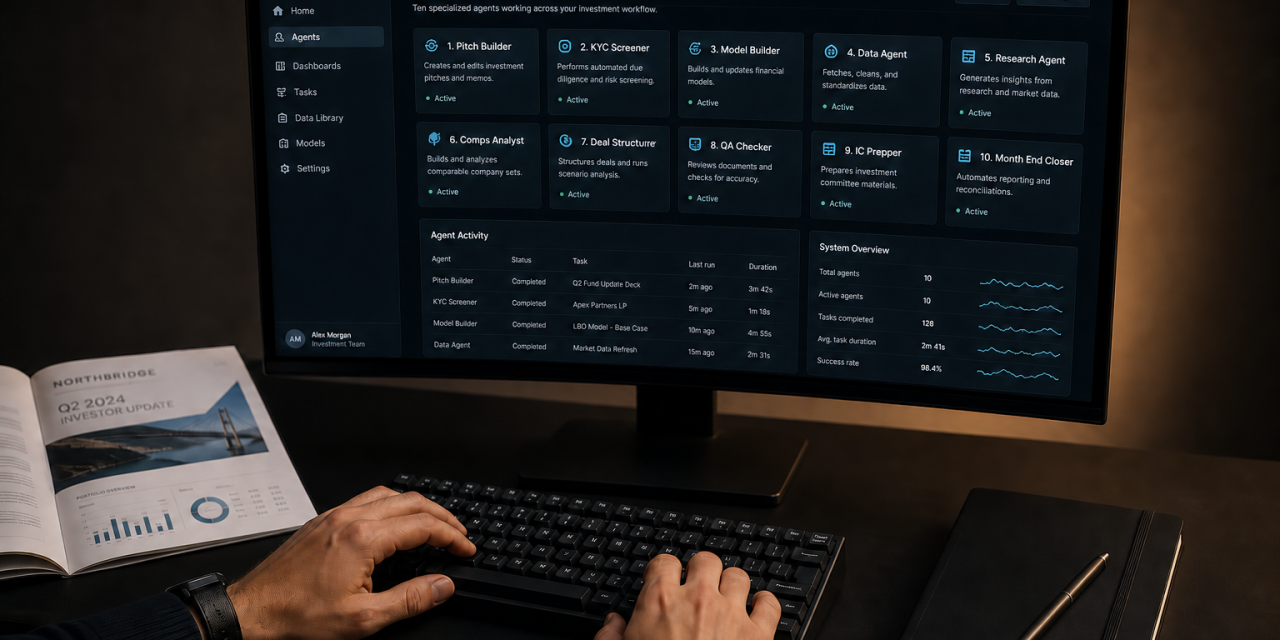
Claude financial agents are moving from general AI assistance into specific finance workflows. Anthropic has launched ten agent templates for financial services and insurance, aimed at work that usually consumes analyst, operations, compliance, and finance team capacity. The list includes pitchbook creation, KYC screening, financial model building, valuation review, statement audit, and month end close.
Anthropic describes each agent template as a reference architecture with three core parts: skills, connectors, and subagents. That means the agent is designed around a defined finance task, can access approved data sources, and can call on other Claude models for specialist steps such as selecting comparables or checking methodology.
What Anthropic launched with Claude financial agents
Anthropic is releasing ten ready to run agent templates for finance and insurance teams. They are available as plugins in Claude Cowork and Claude Code, and as cookbooks for Claude Managed Agents. The idea is to let firms adapt these templates to their own modeling standards, risk policies, data permissions, and approval flows without building the full architecture from scratch.
The agents fall into two broad groups. The first group supports research and client coverage. The second targets finance, operations, compliance, and control workflows.
Research and client coverage agents
- Pitch builder creates target lists, runs comparables, and drafts pitchbooks for client meetings.
- Meeting preparer assembles client and counterparty briefs before calls.
- Earnings reviewer reads transcripts and filings, updates models, and flags changes that matter to an investment thesis.
- Model builder creates and maintains financial models using filings, data feeds, and analyst input.
- Market researcher tracks sector and issuer developments, combines news, filings, and broker research, and flags items for credit or risk review.
Finance and operations agents
- Valuation reviewer checks valuations against comparables, methodology, and internal review standards.
- General ledger reconciler reconciles general ledger accounts and runs net asset value calculations against books of record.
- Month end closer runs close checklists, prepares journal entries, and produces close reports.
- Statement auditor reviews financial statements for consistency, completeness, and audit readiness.
- KYC screener assembles entity files, reviews source documents, and packages escalations for compliance review.
Anthropic is not only targeting investment banking presentation work. The company is also going after repeatable control processes where auditability, consistency, and clear handoffs matter.
How the agents work inside finance teams
Anthropic offers two ways to use the templates. As plugins in Claude Cowork or Claude Code, they work alongside a human analyst on the desktop. Anthropic gives the example of handing the pitch agent a target list and receiving a comparables model in Excel, a drafted pitchbook in PowerPoint, and a cover note ready for Outlook.
The second route is Claude Managed Agents on the Claude Platform. This is meant for larger or scheduled workflows, such as work across a full book of deals or a recurring nightly process. The managed setup includes long running sessions, per tool permissions, managed credential vaults, and audit logs in the Claude Console. Those details are especially relevant for regulated firms, because compliance and engineering teams need to inspect what the agent accessed, what tools it used, and how it reached a decision.
Anthropic is careful and frames the agents as human supervised systems. Users remain responsible for reviewing, iterating on, and approving Claude’s work before anything reaches a client, gets filed, or triggers action. That distinction matters. In finance, the highest value use case is often not replacing judgment. It is reducing the manual work around judgment so professionals can spend more time checking assumptions, interpreting risk, and making decisions.
Claude across Excel, PowerPoint, Word, and Outlook
A major part of the announcement is Microsoft 365 integration. Claude can now work directly in Excel, PowerPoint, and Word through add ins, while Outlook support is coming soon. This is likely to be as important as the agents themselves, because finance workflows rarely live in one tool.
Anthropic says Claude can build financial models from filings and data feeds in Excel, audit formulas across linked workbooks, and run sensitivity analyses. In PowerPoint, it can draft decks that update when the underlying numbers change. In Word, it can edit credit memos against firm templates. In Outlook, it is expected to triage inboxes, arrange meetings, and draft responses in the user’s voice.
The benefit is context continuity. If an analyst starts with a model in Excel, Claude can carry the context into PowerPoint without requiring the analyst to restate the thesis, assumptions, and outputs. That reduces one of the common friction points in AI adoption: the constant need to re explain work when moving between tools.
Connectors are central to the Claude finance strategy
Financial agents are only useful if they can work with trusted data. Anthropic is expanding Claude’s connector ecosystem so agents can access governed, real time data from market data platforms, research providers, internal systems, CRMs, data warehouses, and document repositories.
The announcement names existing and new integrations across providers such as FactSet, S&P Capital IQ, MSCI, PitchBook, Morningstar, Chronograph, LSEG, Daloopa, Dun and Bradstreet, Fiscal AI, Financial Modeling Prep, Guidepoint, IBISWorld, SS&C IntraLinks, Third Bridge, and Verisk. Moody’s has also launched an MCP app that brings credit ratings and data on more than 600 million public and private companies into Claude for areas such as compliance, credit analysis, and business development.
For finance people, this is the real differentiator. A generic model can summarize a filing. A governed agent that can pull the right market data, check an internal policy, search a data room, and leave an audit trail is much closer to enterprise grade workflow automation.
What this means for financial services
Claude financial agents point to a more structured phase of AI adoption in finance. Early experiments often focused on summarization, writing assistance, or coding support. These new templates target named workflows with defined outputs, tool access, and oversight.
The impact could be broad across front, middle, and back office teams. In the front office, agents can help analysts prepare for meetings, monitor earnings, build models, and draft pitch materials. In the middle office, they can support underwriting, risk review, valuation checks, and KYC escalation packages. In the back office, they can help with close processes, reconciliations, financial statement review, and operational reporting.
Bloomberg reported that the launch is part of Anthropic’s push to win more Wall Street business. It also noted market pressure on some financial data and analytics companies after the announcement. That reaction is understandable, but it may overstate the direct threat. Claude still depends heavily on high quality data providers. Anthropic’s strategy appears less about replacing financial data sources and more about turning them into workflow ready intelligence inside the tools professionals already use.
Anthropic’s ten Claude financial agents show where enterprise AI is heading: fewer generic prompts and more task specific systems embedded in daily tools. The agents will not remove the need for financial expertise. They will raise the bar for how that expertise is applied. The teams that benefit most will be the ones that treat AI output as structured work product, not as final judgment.