Christopher Nolan’s The Odyssey is doing something strange to bookshops. Weeks after the film’s release, booksellers report a run on every version of Homer’s epic, from verse translations to illustrated editions for children. Teenagers buy the story in English. One young woman, fresh from the cinema, asked for the Greek text she had studied years ago. Customers keep repeating the same line at the counter. “I want to read the book first and then see the film.”
A poem of 2,700 years is outselling most new releases, carried by Matt Damon’s careworn Odysseus and Nolan’s three-hour vision of war, monsters and homecoming. That revival invites a question. What would Homer make of artificial intelligence?
Homer was never a single author
Classicists call it the Homeric Question. The Iliad and the Odyssey were sung for generations before anyone wrote them down, and the scholar Milman Parry showed in the 1920s how oral singers composed in performance. They drew on a memorized stock of formulas, the wine-dark sea, rosy-fingered dawn, swift-footed Achilles, each shaped to slot into the meter, and recombined those blocks in real time.
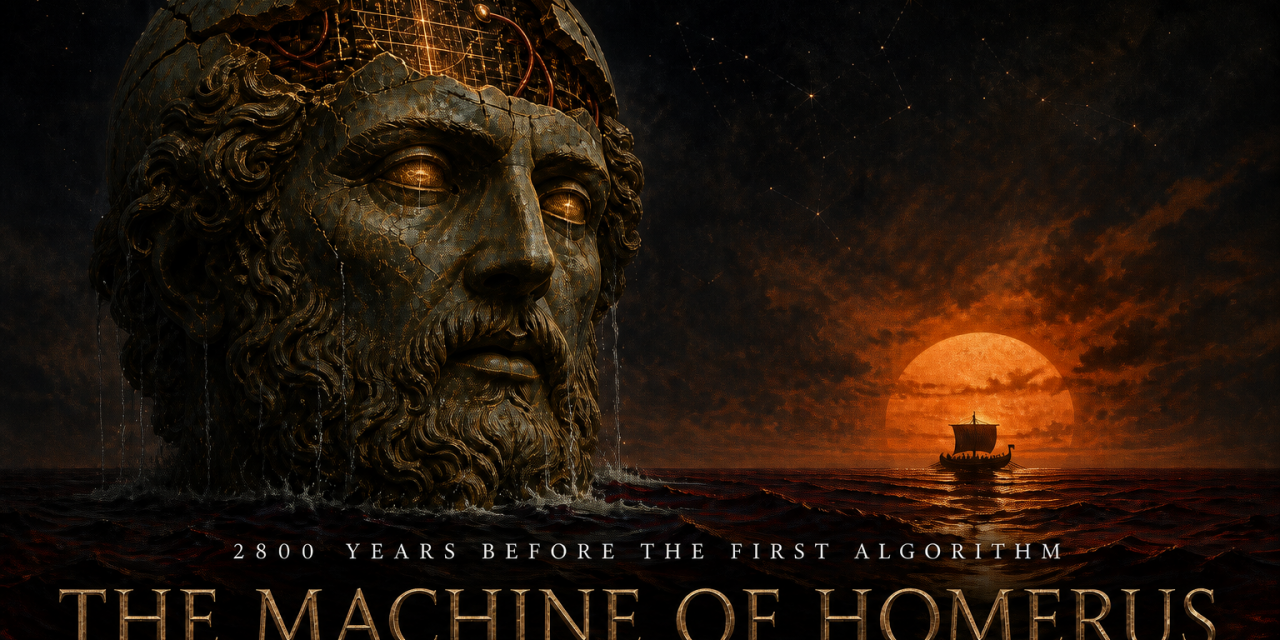
That should sound familiar. A large language model does something eerily similar, recombining learned patterns into fluent language on demand. Homer, in this light, looks less like an author and more like a training process spanning centuries, a distributed intelligence running on human memory and refined by thousands of performers. The first great generative text engine in Western culture was a crowd.
So Homer of all people cannot sneer at a machine that composes by recombining patterns. His sharper question would concern experience. The formulas carried real grief, real wars and real homecomings. What happens to a song when the singer has never lost anyone?
The robots were already in the epics
Here is the part most coverage of Nolan’s film misses. Homer’s poems already contain machines.
- In the seventh book of the Odyssey, the palace of King Alcinous is guarded by gold and silver dogs forged by Hephaestus, ageless and immortal. Golden statues of youths stand inside, holding burning torches.
- In the eighth book, the Phaeacians sail ships that need no helmsman and no rudder. They know what their passengers think and intend, and they cross the sea wrapped in mist. Autonomous navigation, imagined 3,000 years ago. Alcinous also recalls a prophecy that Poseidon will one day smash one of these ships and bury the city beneath a mountain. Even in myth, transport that steers itself came with a doom clause.
- In the Iliad, Hephaestus is served by golden handmaidens “that moved and breathed in animated gold”, beside tripods that rolled to the gods of their own volition.
Later Greek myth pushed further. Talos, the bronze sentry of Crete, was “made, not born”, a creature of biotech, life crafted through art. A single vein carried his ichor and was sealed with a bolt at his ankle. The sorceress Medea brought him down through persuasion and his own fear of death, in what classicist Adrienne Mayor reads as the first documented hack. However advanced a creation may be, Mayor notes, someone will always find and exploit its weakness. Pandora, an artificial woman built by Hephaestus with one mission, to enter human society and open a jar of miseries, reads today like an early warning about malicious agents.
The Greeks posed Alan Turing’s question, can machines think, more than two thousand years before he asked it in 1950. Their answer was ambivalent. That ambivalence still feels current.
The Sirens now run on algorithms
The Odyssey’s most famous brush with dangerous information is the Sirens. Odysseus survives because he distrusts his future self. His crew plugs its ears with wax, and he has himself lashed to the mast with strict orders to ignore his own commands. It is the first safety protocol in literature, a physical constraint built against a perfectly persuasive technology.
Your Sirens sit in your pocket. The feed that knows exactly what outrages you, the recommender that knows your appetites, the synthetic voice that tells you what you want to hear. A Greek newspaper, reflecting on Nolan’s decision to film the Odyssey now, described the modern Sirens as overconsumption, the worship of image, the acceleration of time and the illusion that information can replace wisdom.
Homer’s answer still stands. Do not rely on willpower. Lash yourself to something stronger through rules, friction or deliberate limits, and sail past.
Gods with an alignment problem
Nolan’s Olympus unsettles because its gods “participate on almost equal terms with the humans”, powerful, arbitrary and bored. Zendaya plays Athena as a sorrowing ally who grieves for Odysseus while Poseidon persecutes him. Read the pantheon as a thought experiment about superintelligence and you get powers far beyond your own, with goals that overlap with human interests only intermittently, and alignment that is partial, personal and reversible.
Odysseus survives through metis, the cunning, adaptive intelligence that defines him. He never defeats Poseidon. He learns to sail around him. Our equivalent of metis is governance, auditing and a measure of humility about what we deploy, because the sea god is not going away.
The question Homer would ask
Nolan reads the homecoming as trauma. Soldiers return in person quickly enough, his film argues, while the emotional return takes years, decades, or never arrives. The war’s cause, a banal contest over trade routes, is forgotten almost at once. The aftermath is the story.
That reading hands us Homer’s real test for AI. The famous Turing question asks whether machines can think. Homer’s question would be blunter. What does the machine do to the humans who must live with it, ten years after the triumph? Does it help people get home, or does it strand them further out at sea?
The same Greek commentary framed the stakes plainly. Technology evolves at exponential speed, while human nature changes slowly. The fears, temptations, ambitions and loneliness that move us are the same forces that moved Bronze Age audiences. The challenge of this century is ethical progress, keeping wisdom level with power. An AI worthy of Homer’s respect would have to pass what you might call the nostos test, after the Greek word for homecoming. Does it help human beings complete the journey back to themselves?
Full circle in the ashes of Herculaneum
One last detail would please the old singers. AI is now recovering voices from the classical world itself. The Vesuvius Challenge uses 3D X-rays and machine learning to unroll scrolls carbonized when Vesuvius erupted in AD 79, scrolls that crumble at a touch. Three students won the 700,000 dollar grand prize by teaching software to detect ancient ink in the scans. An Oxford scroll, unread for almost 2,000 years, has now yielded its first words, among them the Greek διατροπή, meaning disgust, twice in a few columns.
Hundreds of scrolls from that buried library remain unread. Some may carry poetry from Homer’s own tradition. The newest intelligence on earth is being used to hear the oldest words we have. There is something Homeric about that.
The person you become after the journey
So would Homer have feared AI? He would have recognized it. His epics already held bronze guardians, ships that steer themselves, golden servants with minds and Sirens with irresistible songs. He was, himself, a chorus of generations singing through a single name.
What he would demand from AI is what he demanded from every trial on the voyage, that the traveler return wiser. The real Ithaca, as the Greek writer put it, is the person you become after the journey. The machines will keep getting smarter. Homer would want to know whether you will keep getting wiser, and he would treat your answer as the only story worth telling.