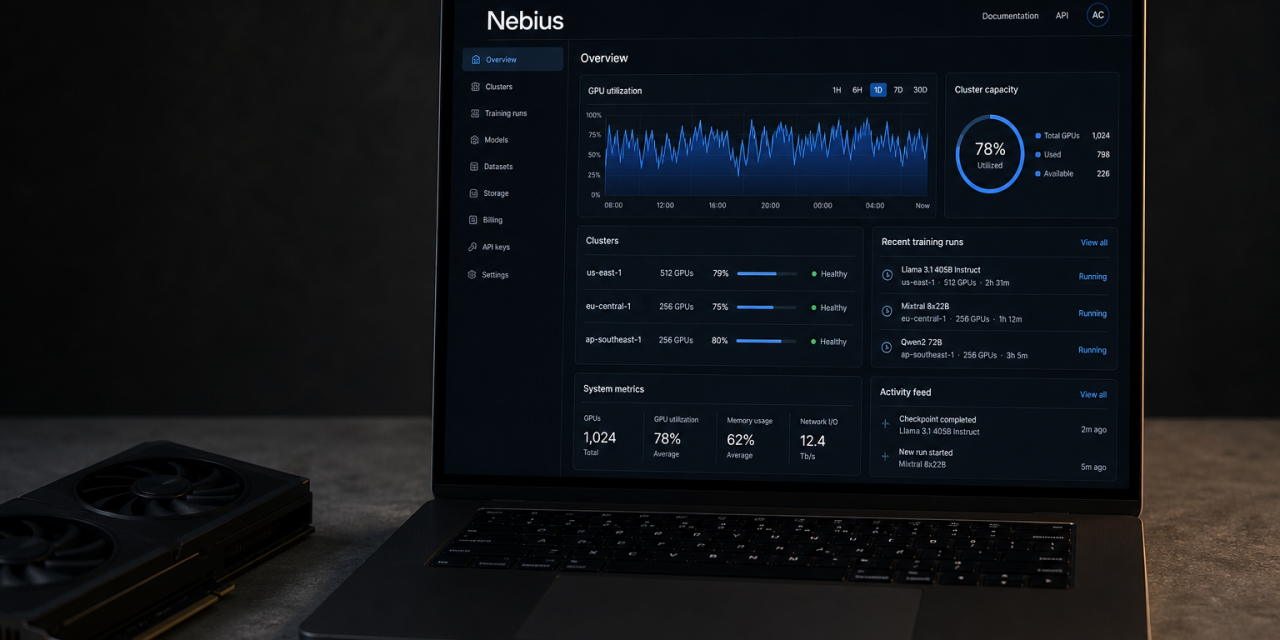
Nebius is positioning itself as an AI cloud for teams that need more than basic GPU access. Its platform is built around large NVIDIA GPU clusters, high speed networking, managed orchestration and practical tooling for training and inference workloads. That makes Nebius especially relevant for AI labs, startups and enterprises that want to move from experiments to production without rebuilding the infrastructure stack from scratch.
What Nebius is building
Nebius describes its core promise clearly: scale AI from a single GPU to pre optimized clusters with thousands of NVIDIA GPUs. The platform supports both model training and inference, which matters because the infrastructure needs are different. Training demands sustained parallel compute, fast interconnects and reliable distributed orchestration. Inference demands throughput, latency control, utilization and cost discipline.
The company combines hardware, software and operational support into a cloud environment focused on demanding AI workloads. On the hardware side, Nebius offers access to recent NVIDIA GPUs such as GB300 NVL72, GB200 NVL72, B300, B200, H200 and H100. It also highlights NVIDIA InfiniBand and Quantum X800 InfiniBand for high performance cluster networking.
On the software side, teams can orchestrate workloads with Managed Kubernetes or Slurm based clusters. Nebius also supports infrastructure as code through Terraform, API and CLI workflows. That is important for ML teams that need reproducible environments rather than one off server setups.
Why the Nebius AI cloud matters
The AI infrastructure market is no longer just about renting GPUs by the hour. The real challenge is turning expensive accelerators into productive capacity. Poor utilization, slow storage, mismatched networking and fragile cluster configuration can make powerful GPUs feel surprisingly inefficient.
Nebius tries to solve this by optimizing the full stack. Its website emphasizes pre configured drivers, InfiniBand, fast storage, orchestration and expert support. The company also offers managed services such as MLflow, PostgreSQL and Apache Spark, which helps teams avoid spending engineering time on maintenance work that does not directly improve models.
This full stack approach is one reason Nebius is often discussed alongside neocloud providers. These companies focus on high performance AI compute instead of general purpose cloud infrastructure. For AI builders, the difference is practical. They want clusters that are ready for PyTorch, distributed training, model serving and performance tuning from day one.
From Yandex restructuring to AI infrastructure company
Nebius Group emerged after the restructuring of Yandex, with the Russian internet activities separated from the remaining international businesses. The company now focuses on artificial intelligence, infrastructure and related software. Public background sources describe Nebius as a Netherlands registered technology company with activities including Nebius AI, Toloka AI, TripleTen and Avride.
The infrastructure story is central. Nebius operates a data center in Finland and has been connected with additional data center capacity in locations such as France, Iceland and the United States. Its Finnish site is especially important to the company narrative. Nebius says this is where it built ISEG, listed by the company as the number 19 most powerful supercomputer in the world, along with a supercluster containing thousands of GPUs in custom designed servers and racks.
That matters because AI cloud credibility depends on physical execution. Buying GPUs is only one part of the problem. Power, cooling, network topology, rack design and operational reliability decide whether those GPUs can support serious workloads.
Nebius for training large AI models
Training large models requires stable distributed infrastructure. When hundreds or thousands of GPUs work together, small configuration issues can become expensive failures. Nebius aims to reduce that risk with Kubernetes, Slurm, fast networking and architecture support for multi node use cases.
The goal is not only raw speed. It is reducing the number of infrastructure problems that interrupt research and product development.
Nebius for AI inference at scale
Inference is becoming a defining workload for AI infrastructure. Once models are in production, the question shifts from can we train it to can we serve it reliably, quickly and affordably. Nebius addresses this through GPU clusters, orchestration and its Token Factory platform for open source AI model serving.
A recent development reinforces that direction. Nebius announced an agreement to acquire Eigen AI for about 643 million dollars, according to Techzine. Eigen AI focuses on inference optimization and is expected to integrate its technology into Nebius Token Factory. Reported techniques include post training quantization, KV cache optimization and custom CUDA kernels.
Those optimizations matter because inference economics are unforgiving. If a platform can produce more tokens per GPU while preserving model quality, it can reduce costs and improve response times. Techzine also reported that the Eigen AI founders come from MIT’s HAN Lab and have worked on areas such as sparse attention and activation aware weight quantization, both relevant to efficient large language model deployment.
Real world Nebius use cases
The strongest signal in Nebius material is the range of workloads it highlights. The company is not only targeting generic chatbot deployment. Its examples span search, biotechnology, chemistry, music generation and image model optimization.
- CRISPR GPT used Nebius to enable rapid model screening and fine tuning for an AI agent system developed by researchers from Stanford, Princeton and Google DeepMind. Nebius reports that junior researchers without gene editing experience achieved 80 to 90 percent efficiency on a first attempt.
- vLLM, an open source inference framework under the Linux Foundation, used Nebius compute clusters for large scale inference experiments. Nebius says the project optimized transformer inference including DeepSeek R1 and advanced features such as multi latent attention and multi token prediction.
- Brave uses Nebius infrastructure for AI search responses. Nebius states that Brave runs large AI models with nearly 100 percent compute utilization and serves AI summaries for more than 11 million queries daily.
- CentML uses Nebius compute to support cost optimized open source model deployment with better scaling and hardware utilization.
- TheStage AI tested stable diffusion acceleration methods on NVIDIA H100 Tensor Core GPUs, including quantization and structured sparsification, to reduce the number of GPUs needed for inference.
These examples are useful because they show the platform across both research heavy and production heavy contexts. A drug discovery workflow and an AI search engine do not have the same needs, but both depend on reliable access to accelerated compute.