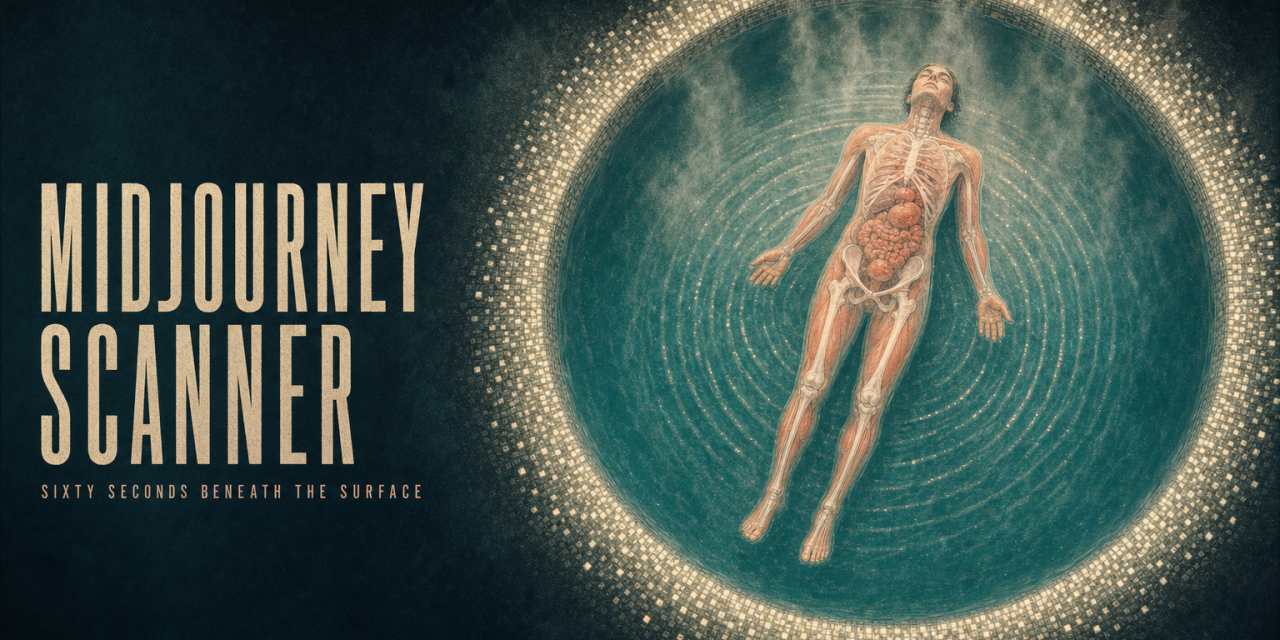
Midjourney built its name on text-to-image generation, and now the same company wants to image something far more personal: your body. The Midjourney Scanner is a full-body ultrasound system that produces a 3D map of muscle, fat, bone, and organs in under 60 seconds. It sits inside a warm pool of water, surrounded by half a million tiny ultrasonic transducers, and it is meant to feel less like a hospital visit and more like a trip to the spa.
The announcement caught most of the AI world off guard. There is no clear bridge between generating pictures of cats and reconstructing the inside of a human torso, yet Midjourney CEO David Holz argues that the company has the compute, the imaging expertise, and the curiosity to make preventive scanning a daily habit.
What is the Midjourney Scanner
The Midjourney Scanner is the first hardware product from Midjourney Medical, a new branch of the company. It is an ultrasound-based full-body CT scanner that captures vertical slices of your body and reconstructs them into a high-resolution 3D map. According to Midjourney, the resulting images look close to what you would get from an MRI, but the scan finishes nearly a hundred times faster.
You step onto a platform inside a shallow pool. The platform lowers you into the water at about 2 inches per second, passing your body through a ring of sensors. After roughly a minute, you step back out with a detailed dataset of your internal anatomy. No radiation, no powerful magnets, no contrast injections.
The project is built in partnership with Butterfly Network, a company known for its handheld ultrasound devices. Midjourney signed a licensing agreement with Butterfly in late 2025 for exclusive use of its ultrasound-on-chip technology. Each scanner uses 40 Butterfly imaging modules. The hardware effort is led by Ahmad Abbas, who previously worked on the Vision Pro at Apple before joining Midjourney in late 2023.
How the scanning process works
The ring around the pool is made up of about half a million tiny squares, each the size of a fine grain of sand. Every square can act as both a speaker and a microphone. It sends out ultrasonic waves, then listens for the ripples bouncing back off your tissue.
Midjourney compares this to being surrounded by half a million dolphins, each using echolocation from a slightly different angle. The waves change shape as they pass through different densities and stiffnesses in your body, moving from water to skin to fat to muscle to bone. By analyzing how those waveforms deform, the system reconstructs a detailed map.
The data load is staggering. The sensors produce terabytes of information per second. Midjourney claims that converting that raw output into HD video would mean roughly 500 hours of footage for every single second of scanning. To process it, the company streams the data to a cluster where thousands of computers work in parallel, turning waveforms into images slice by slice. Two petaflops of compute power sit behind a single scan.
The output is a sub-millimeter 3D volume of your body. Each reconstructed slice is paired with an AI segmentation layer that labels organs, tissues, and structures. Midjourney has already shared examples of reconstructed slices from the abdomen and thighs in test scans.
From scanner to spa
A medical machine is one thing. Convincing people to use it regularly is another. Midjourney’s answer is to wrap the scanner in something that feels welcoming: a spa.
The first Midjourney Spa is planned for San Francisco’s Union Square, with an opening targeted before the end of 2027. It will combine hot tubs, saunas, cold plunges, and quiet rooms with scanner pools. The idea is that the scan becomes a side effect of a visit you would want to make anyway. You drop in, relax, get scanned, and leave with fresh data about your body.
Holz has talked about scanning yourself once a year, once a month, or even every day. The pitch is that consistent imaging lets you track how your body responds to diet, training, sleep, and other lifestyle choices. Instead of a single snapshot taken in a clinic during a yearly checkup, you get a continuous record of change.
The roadmap and the regulatory wall
Midjourney has laid out an ambitious timeline. The next twelve months focus on refining algorithms, running research trials, and developing a second-generation hardware design. Around the end of 2027, the first spa opens, serving as a research site that builds operational experience at scale.
In 2028, the plan is to expand to more cities and roll out a third-generation scanner with custom silicon, promising significantly better image quality and shorter scan times. By 2031, the company hopes to have more than 50,000 scanners worldwide, with enough collective capacity for a billion scans per month.
That trajectory runs into one major obstacle: regulation. Any diagnostic medical imaging tool in the United States needs FDA clearance, and a system that aims to rival MRI is not going to slip through quietly. Midjourney plans to sidestep this in the early phase by offering only body composition maps, which fall outside the strictest diagnostic category. Diagnostic capabilities will be added gradually as the company submits test results to the FDA.
This staged approach buys time. It also raises questions about what users actually get out of an early scan. A body composition map can show muscle and fat distribution, but it cannot legally tell you whether a shadow on your liver needs attention.
The data question
A scanner that produces terabytes of internal imagery per session creates a serious data footprint. Midjourney has said users will build a personal library of scans, which they can share with doctors, with AI health tools, or with other parties. The company has stated that more details on data policies will follow closer to launch.
That timing is worth watching. Body scans are some of the most sensitive personal data imaginable. Who owns the scans, how long they are stored, and what kind of secondary use is permitted will shape whether people trust the spa model. Tracking changes in your body over time only works if the underlying record is durable and protected.
A different kind of side project
What makes the Midjourney Scanner interesting is not just the technology. It is the choice. A company with no investors, funded by its image-generation community, decided to spend its compute, capital, and engineering talent on medical hardware and a chain of spas. That is a strange bet by any standard, and it suggests the line between AI lab and consumer health company is going to blur further in the coming years. Whether that blur produces better outcomes for patients, or just better marketing, is the part nobody can predict yet.