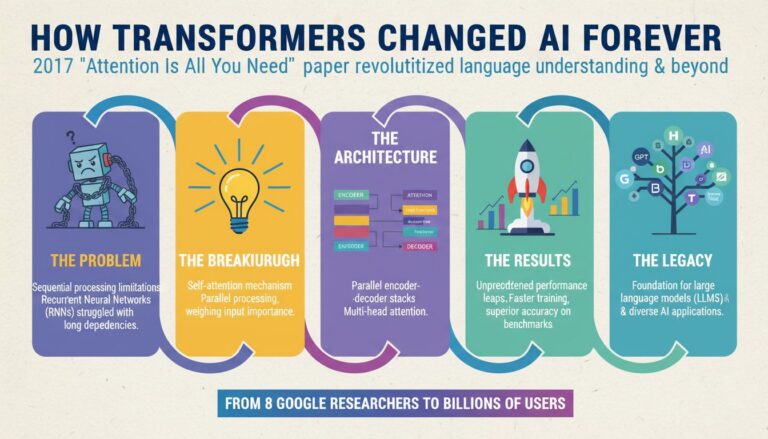
The Era Beyond the Transformer
For the past few years, the landscape of artificial intelligence has been dominated by a single, colossal entity: the Transformer. From the early days of BERT to the explosive capabilities of GPT-5 and Claude, the “Attention is All You Need” paradigm has been the undisputed king of Natural Language Processing (NLP). It has powered the chatbots we talk to, the code assistants we rely on, and the creative tools that generate our images. However, despite its brilliance, the Transformer is not without its flaws. It is computationally hungry, notoriously opaque, and fundamentally different from the only other intelligent system we know: the biological brain.
Enter the Dragon Hatchling. In a recent groundbreaking paper titled “The Dragon Hatchling: The Missing Link between the Transformer and Models of the Brain,” researchers have proposed a novel architecture that could fundamentally shift how we build Large Language Models (LLMs). This isn’t just a tweak to the existing system; it is a reimagining of neural computation that bridges the gap between modern deep learning and biological plausibility.
In this deep dive, we will explore what the Dragon Hatchling (often referred to as BDH) actually is, where it comes from, the critical problems it aims to solve, and how it might be applied to create the next generation of efficient, “living” AI systems.
What is the Dragon Hatchling?
At its core, the Dragon Hatchling is a generative language model architecture, but it abandons the most defining feature of the Transformer: the global self-attention mechanism. To understand the Dragon Hatchling, we first need to look at what it replaces.
In a standard Transformer, every token (word or part of a word) in a sequence looks at every other token to determine context. If you have a sentence of 10 words, the model calculates relationships between all of them. If you have a book of 100,000 words, the computational cost explodes quadratically. This is known as the $O(N^2)$ bottleneck. Furthermore, this process is static; the model processes the context window as a monolithic block.
The Dragon Hatchling takes a radically different approach, inspired by local distributed graph dynamics. Instead of a dense matrix where everything connects to everything, the Dragon Hatchling models intelligence as a graph of nodes (neurons) that only communicate with their immediate neighbors.
The Mechanism: Local Dynamics, Global Emergence
Imagine a crowded room. A Transformer is like a person who can simultaneously listen to every single conversation happening in the room, process them all at once, and then speak. The Dragon Hatchling, on the other hand, operates like a rumor spreading through a crowd. One person whispers to their neighbor, who whispers to another. Information propagates through the network via local interactions.
Technically, the Dragon Hatchling (specifically the Baby variant mentioned in the research) utilizes a graph structure where the state of the model evolves over time through local message passing. When a new token is input, it activates specific nodes in the graph. These nodes then pass signals to their connected neighbors based on learned weights. Over time, these local interactions allow the network to form a global understanding of the sequence, much like how waves ripple across a pond.
This architecture is proven to be Turing Complete, meaning that despite its sparse, local nature, it is theoretically capable of performing any computation that a standard computer (or a Transformer) can do, provided it has enough time and nodes.
The Missing Link
The name Dragon Hatchling is evocative, suggesting a powerful entity in its infancy. The origin of this architecture stems from a desire to reconcile two diverging fields: Computer Science (specifically Deep Learning) and Neuroscience.
For years, there has been a disconnect. We call our models Neural Networks, but they function very differently from biological brains.
- Brains are sparse: Neurons in your brain do not connect to every other neuron. They have local connections.
- Brains are asynchronous: Different parts of the brain process information at different times; there is no global clock or single attention step that freezes the world.
- Brains are energy-efficient: The human brain operates on roughly 20 watts of power. Training and running a large Transformer requires megawatts.
The researchers behind the Dragon Hatchling (associated with institutions like Pathway and various academic bodies) sought to find the Missing Link. They wanted to create a model that retains the mathematical rigor and trainability of the Transformer (using gradient descent and backpropagation) but adopts the structural elegance of biological systems.
By moving to a graph-based, locally connected architecture, they are essentially trying to grow a digital brain that adheres to the constraints of physics and biology, locality and sparsity, rather than the brute-force matrix multiplication that defines current AI.
What Problems Does It Solve?
Why do we need a Dragon Hatchling when GPT-5 works so well? The answer lies in the sustainability and scalability of AI. The current trajectory of bigger is better is hitting hard physical and economic limits. The Dragon Hatchling addresses several critical pain points.
The Computational Bottleneck
As mentioned, Transformers scale quadratically. Doubling the length of the text you want the model to remember quadruples the amount of compute needed. This makes “infinite context” extremely difficult to achieve efficiently.
The Dragon Hatchling’s local graph dynamics scale much more favorably. Because nodes only talk to their neighbors, the computational cost is linear relative to the number of active nodes or edges. This opens the door to models that can process endless streams of data without choking on memory requirements.
The Black Box Problem
Transformers are notoriously difficult to interpret. When a model hallucinates or makes a mistake, looking at the weights often tells us nothing—it’s just a massive soup of numbers.
Graph-based models like the Dragon Hatchling offer a path toward better interpretability. Because information flows through specific paths in the graph, researchers can theoretically trace the “thought process” of the model. You can visualize which clusters of nodes activated in response to a specific word and how that activation traveled to produce the output. It turns the Black Box into a Glass Box, allowing us to see the internal topology of the model’s reasoning.
Energy Efficiency
The biological inspiration isn’t just for show; it’s about efficiency. By utilizing sparse activations (where only a small percentage of the network is active at any given time), the Dragon Hatchling mimics the brain’s energy-saving tactics. In a Transformer, the entire model is often active for every single token generated. In a Dragon Hatchling architecture, large portions of the graph can remain dormant until needed. This could lead to drastic reductions in the energy required to train and run these models, making AI more environmentally sustainable.
Continuous Learning
Transformers are typically static. You train them once, and then they are frozen. Teaching them new information usually requires expensive re-training or fine-tuning. The dynamic nature of the Dragon Hatchling’s graph state suggests a potential for lifelong learning. The graph structure could theoretically adapt and rewire itself over time, absorbing new information without catastrophically forgetting what it learned before, a feature that remains a Holy Grail in AI research.
How Can It Be Applied?
While the Dragon Hatchling is currently in the research phase (a hatchling, after all), its potential applications are vast and transformative. Here is how this architecture could reshape the industry.
Next-Generation Edge AI
Because of its potential for sparsity and linear scaling, the Dragon Hatchling is a prime candidate for running powerful LLMs on local devices (Edge AI). Imagine a smartphone assistant that is as smart as a server-grade model but runs entirely on your phone’s chip without draining the battery in an hour. The efficiency of local graph dynamics makes this feasible.
Real-Time Data Processing
The architecture is particularly well-suited for streaming data. In scenarios like financial modeling, log analysis, or autonomous driving, data comes in an endless stream. Transformers struggle to maintain context over long streams without resetting. The Dragon Hatchling, with its evolving graph state, can maintain a memory of the stream indefinitely, adjusting its internal state as new data arrives. This aligns with the mission of technologies like Pathway, which focus on high-throughput data processing.
Complex System Modeling
Beyond language, this architecture is a natural fit for modeling other graph-based systems. This includes:
- Social Network Analysis: Predicting trends or misinformation spread.
- Molecular Biology: Modeling protein folding or drug interactions where local geometry is key.
- Traffic and Logistics: Optimizing flow in physical networks.
Toward Artificial General Intelligence (AGI)
If we accept the premise that the human brain is the only proof of concept we have for General Intelligence, then mimicking its architecture is a logical step toward AGI. By moving away from the rigid mathematical abstraction of the Transformer and towards a dynamic, biological topology, the Dragon Hatchling might be the architecture that allows AI to develop more flexible, robust, and human-like reasoning capabilities.
Conclusion
The Dragon Hatchling represents a bold step sideways in an industry that has been sprinting forward in a straight line. While the Transformer has given us miracles, it has also given us massive energy bills and opaque reasoning. The Dragon Hatchling offers a glimpse into a future where AI is not just a brute-force statistician, but a dynamic, efficient, and intelligible system.
It is still early days. The Hatchling needs to grow. It needs to be tested at scale against the giants of the industry. But the theoretical groundwork laid out in this research suggests that the missing link between our silicon creations and our biological reality might finally have been found. As we look for ways to make AI more sustainable and capable, we might find that the answer lies not in bigger matrices, but in better connections.