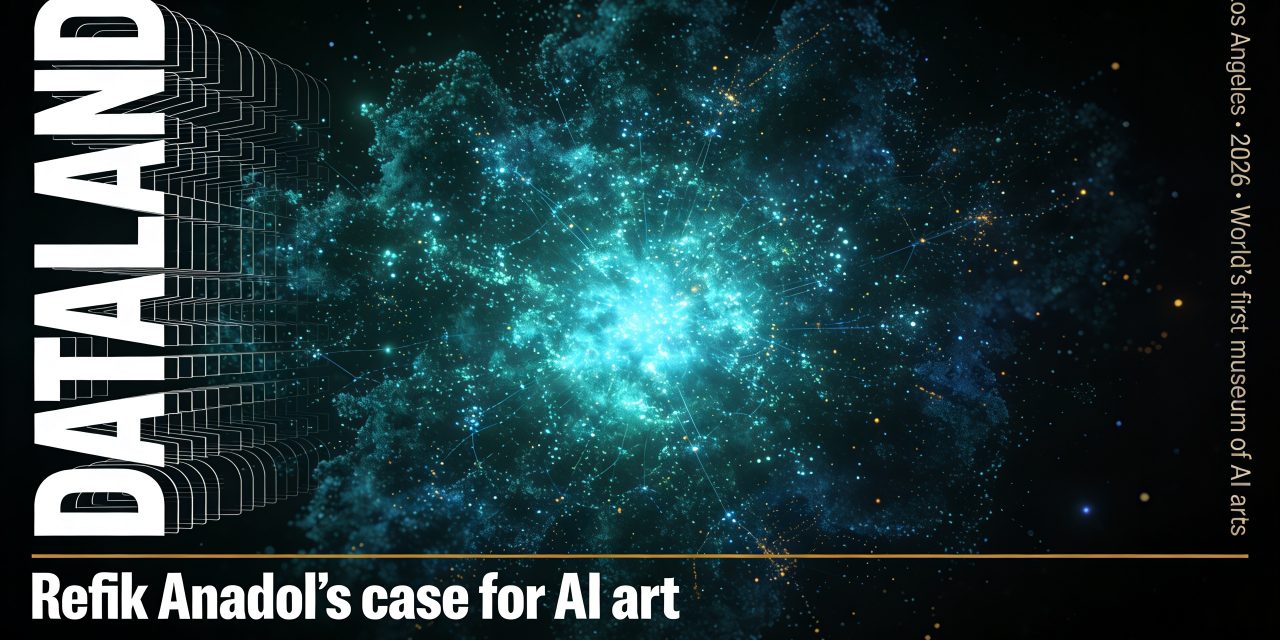
Dataland opens in Los Angeles on June 20, 2026 with an explicit claim. It presents itself as the world’s first museum of AI arts. Refik Anadol and Efsun Erkiliç are not launching another immersive exhibition. They are building a permanent framework around a contested artistic medium.
The project sits at the intersection of art, machine intelligence, architecture, archives and environmental data. It also enters a field marked by unresolved disputes over authorship, copyright, energy use and the difference between artistic practice and automated image production. Dataland is therefore not just a venue. It is an argument about what AI art is, how it should be made and why it deserves a dedicated public space.
Who is Refik Anadol
Refik Anadol is a Turkish American media artist whose practice combines machine intelligence, data visualisation and large scale public installation. His work has appeared at the Museum of Modern Art in New York, the Venice Biennale, the World Economic Forum in Davos and Google’s headquarters in Mountain View. Across those settings, he has built a recognizable method. He takes large datasets, trains or uses machine systems to process them and translates the outputs into moving image environments, data sculptures and architectural scale projections.
Anadol’s work rarely treats AI as a simple image generator. He frames it as a system for sensing, modelling and reimagining the world through data. In his language, data becomes a material. Archives become dynamic. Nature becomes computational memory. Buildings become display surfaces. That conceptual vocabulary has defined projects such as Machine Hallucinations, Machine Memoirs, Living Architecture and more recent works linked to his studio’s Large Nature Model.
His public profile has also grown because he operates at unusual scale. He works with curved LED walls, monumental projections and environments designed for immersion rather than detached viewing. This places him in a hybrid zone between contemporary art, media architecture and computational design. It also exposes him to criticism from different sides. Some art world observers see spectacle first and reflection second. Others question whether AI mediated work can carry the communicative depth traditionally associated with art.
What defines Refik Anadol’s work
Anadol’s practice revolves around three linked moves.
Data as source material
He often starts with institutional or scientific datasets. In one project, his team used almost 68,000 botanical images from Oxford’s Bodleian Libraries for Archive Dreaming, an immersive installation for the Stephen A. Schwarzman Centre for the Humanities. In earlier work, he used high resolution images from NASA’s Mars Reconnaissance Orbiter. In other cases, he worked with neurobiological signals such as heart rate, skin conductance and electroencephalogram outputs.
This matters because Anadol draws a line between generic prompting and data specific artistic construction. He has argued that artists who build custom models, work with their own datasets and collect large volumes of data should not be treated as equivalent to users of off the shelf image tools. That distinction sits at the core of his artistic and institutional pitch.
Immersion as method
Anadol does not primarily produce framed objects. He produces environments. Screens curve around viewers. Image, sound and spatial design interact. Dataland extends that logic. The museum spans 35,000 square feet, with 10,000 square feet reserved for the technology required to support the exhibitions. It includes five galleries and 30 foot ceilings designed for total immersion rather than conventional display.
He has explicitly said that AI art is not image only. In his account, the medium combines sound, image, video, text, smell, taste and touch. That is a direct challenge to the reduction of AI art to static outputs generated from text prompts. Anadol wants the category to include multisensory and multimedium environments in which machine systems shape the aesthetic field in real time.
Nature as computational subject
Over the past several years, Anadol’s work has increasingly centred on environmental intelligence. His studio developed the Large Nature Model, an original AI system trained on nature data including high resolution images, field recordings and biosensor signals. The goal is not only formal experimentation. It is also to represent the complexity of the natural world at scales that human perception and conventional museum formats struggle to capture.
Anadol has described this ambition in broad civilizational terms. He points to the difficulty of seeing the big picture in a natural world that contains more than 2.2 million documented species in the Encyclopedia of Life. His work translates that scale into perceptual experience. Critics may dispute the result, but the intention is clear. He uses machine systems to turn scientific and archival abundance into sensory narrative.
What Dataland is
Dataland is a privately funded museum project located at the Grand LA complex in downtown Los Angeles, a development designed by Frank Gehry. The site places it among established cultural institutions such as Walt Disney Concert Hall, the Broad and the Museum of Contemporary Art. That proximity is symbolic. Dataland does not position AI art outside the art world. It inserts it directly into a major institutional corridor.
The project defines itself as both a museum and a digital ecosystem. Its own framing is telling. It describes a place where human imagination meets the creative potential of machines, where data becomes pigment and art evolves continuously in real time through the interaction of human presence, machine intelligence and the invisible information that shapes the world.
This language contains more than aesthetic ambition. It reframes the museum itself. Instead of collecting fixed objects and presenting stable authorship, Dataland foregrounds process, computation and responsiveness. That makes it less a repository than a platform. It is closer to a live system than a traditional exhibition hall.
What the new project stands for
Dataland stands for a specific interpretation of AI art. It advances at least four propositions.
AI art deserves institutional legitimacy
By creating a museum dedicated to AI arts, Anadol and Erkiliç move the discussion from novelty to infrastructure. This is not a temporary festival commission or a one off installation. It is a permanent institutional statement that AI based artistic practice belongs inside the cultural mainstream. That mirrors a broader shift already visible elsewhere. Oxford’s decision to open a major humanities venue with Anadol’s Archive Dreaming also signalled that AI art now sits inside serious cultural and academic debate, not outside it.
AI art should be more than prompt based image production
Dataland’s first exhibition underlines that point. Machine Dreams: Rainforest is powered by the Large Nature Model, described as a foundational AI trained on one of the most extensive permission based datasets of the natural world. The emphasis on permission based data is deliberate. So is the choice of subject. Rather than showcasing synthetic style transfer or internet scale collage, the exhibition centres on ecological intelligence, environmental memory and sensory immersion.
The installation was inspired by a trip to the Amazon. Anadol’s studio fed the model millions of images of nature and prompted it to learn and play with the intelligent behaviours of the natural world. Visitors encounter digital sculptures, immersive soundscapes and evolving visual environments. The audio dimension includes oral histories of the Yawanawá people of Brazil and the last recorded call of the extinct Kaua‘i ‘ō‘ō bird of Hawaii. The project therefore treats AI less as an automatic image engine and more as a medium for environmental interpretation.
Ethics can be designed into the workflow
Dataland enters a debate that AI companies and many AI image platforms have often tried to move past too quickly. Generative systems are controversial because they rely on massive datasets of pre existing images, often gathered without permission from artists. That creates unresolved questions around consent, compensation and the legal status of outputs. The U.S. Supreme Court’s refusal earlier in 2025 to take up a case on whether AI generated art can be copyrighted under existing law showed how unsettled the field remains.
Anadol’s response is to insist on data provenance. He has said the images he uses are sourced ethically from institutions including the Smithsonian, London’s Natural History Museum and the Cornell Lab of Ornithology. Dataland’s own materials stress permission based datasets. This does not end the debate. It does, however, mark a strategic distinction. Anadol is trying to separate institutional, licensed and custom trained artistic AI from the extractive logic that has defined much of mainstream generative AI.
Sustainability cannot stay outside the frame
Dataland also foregrounds energy use, because AI art carries environmental costs. MIT researcher Noman Bashir explained that generating one image with AI can consume up to 1,000 times more energy than performing a simple web search. That ratio does not by itself describe the energy footprint of a museum scale immersive installation, but it captures the broader issue. Computational creativity is not immaterial. It runs through data centres, power systems and hardware stacks.
Anadol and Erkiliç say they address this partly by hosting the Large Nature Model on cloud servers in Oregon that run on 87 percent carbon free, renewable energy. That is not a complete sustainability solution, and Dataland does not claim it is. But it places energy sourcing inside the production narrative. In the current AI market, where sustainability often appears as an afterthought, that is a material point.
Machine Dreams Rainforest as institutional manifesto
The inaugural exhibition matters because opening shows define a museum’s thesis. Machine Dreams: Rainforest functions as Dataland’s manifesto in exhibition form.
First, it positions nature rather than consumer culture at the centre of AI art. Second, it privileges custom modelling over generic generation. Third, it merges science, indigenous knowledge, sound and visual computation into one environment. Fourth, it presents AI not as a replacement for nature, but as a way to surface patterns, memories and relationships that remain difficult to grasp at human scale.
This is also why the exhibition calls itself a dialogue between human presence and the memories of Earth. The phrase is rhetorical, but it points to a real curatorial direction. Dataland wants to frame machine intelligence as an interpretive layer over ecological data, not as an autonomous creator detached from context.
The criticism Dataland cannot avoid
Dataland arrives with clear institutional ambition, but it also faces structural criticism.
Authorship remains contested
Some critics reject the category of AI art on philosophical grounds. Writer Ted Chiang has argued that creating a novel, painting or film is an act of communication between artist and audience, and that an auto complete algorithm cannot perform that act. This critique does not only target legality or data sourcing. It targets intention and meaning. Dataland can address dataset ethics and model design, but it cannot fully resolve the question of whether machine mediated generation changes the nature of artistic expression itself.
Spectacle can crowd out scrutiny
Raphaël Millière of Oxford’s Institute for Ethics in AI has warned that placing a spectacular AI artwork in a beautiful room and letting the spectacle become the whole conversation would miss the point. That warning applies directly to Dataland. Anadol’s work is visually powerful. The risk is that institutional framing could turn critical questions into ambient background. If Dataland wants to matter beyond visual impact, it will need to keep authorship, labour, infrastructure and environmental cost inside the exhibition logic.
Public openness does not end artistic resistance
Consumer research may show receptiveness to AI generated images. A Stanford Graduate School of Business working paper from 2025 found that consumers on one online art marketplace preferred AI generated images when shown alongside human made art. But market preference is not the same as critical legitimacy. Museums do not only reflect consumer taste. They also shape cultural standards. Dataland therefore operates in two arenas at once. It can succeed with audiences and still fail to persuade parts of the art world.
Why Dataland matters beyond the art world
Dataland matters because it turns several abstract AI debates into a concrete public institution.
It makes visible the distinction between foundation models trained on licensed domain data and models trained on indiscriminate scraping. It links AI infrastructure to environmental accountability. It shows how archives and scientific collections can be translated into dynamic cultural experience. It also tests whether museums can evolve from spaces of preservation into spaces of live computation without abandoning critical standards.
For readers interested in artificial intelligence, robotics, human machine interaction and digital culture, that is the deeper relevance. Dataland is not simply about AI generated visuals. It is about how cultural institutions respond when machine systems become creative tools, curatorial frameworks and infrastructure at the same time.
The sharper takeaway
Refik Anadol has spent years building a version of AI art that is data specific, sensory, architectural and increasingly tied to environmental datasets. Dataland condenses that trajectory into one institution. Its opening claim is bold, but the real test lies elsewhere. Can it prove that AI art is more than synthetic spectacle. Can it show that data provenance and energy use belong inside artistic authorship. Can it turn machine intelligence into a cultural medium without hiding the systems behind it.
If Dataland succeeds, it will not settle the debate over AI art. It will sharpen it. That may be the more important outcome.