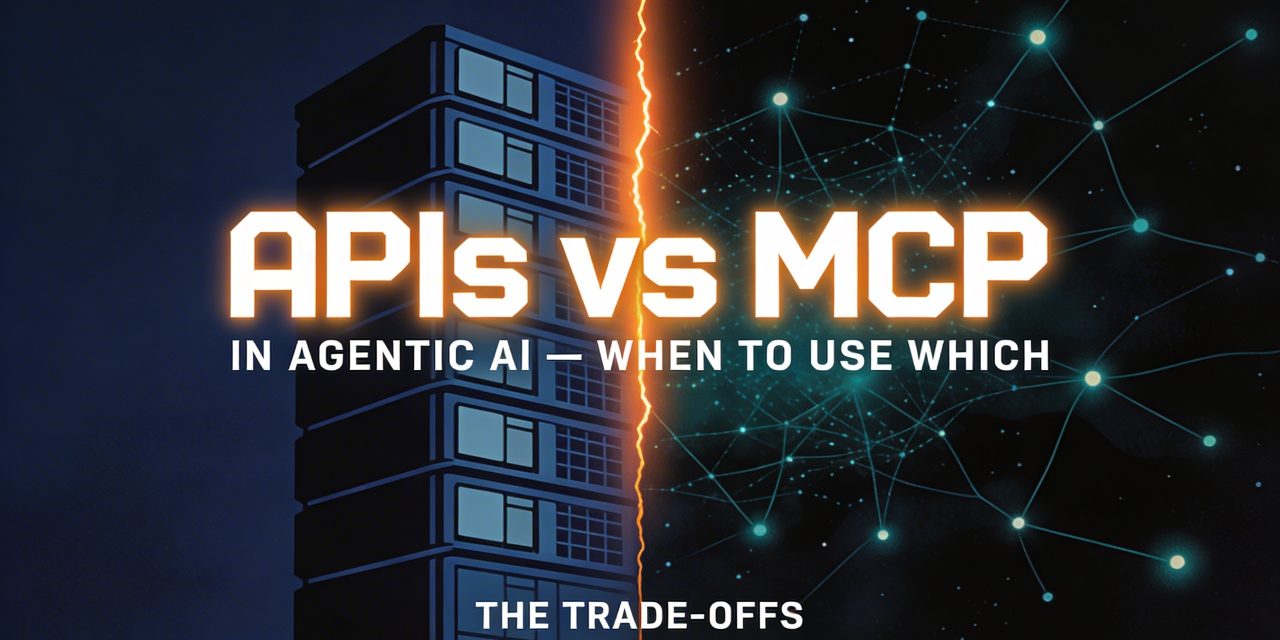
A model that can reason well but cannot access calendars, databases, internal applications, or business workflows remains limited. That is why the discussion around APIs vs MCP in agentic AI has become so important.
APIs are the traditional way to connect software systems. MCP, or Model Context Protocol, is the newer standard designed to help AI agents discover and use tools more naturally. In reality, this is not a winner takes all decision. Most serious agentic architectures will use both.
When does your agent need deterministic integration, and when does it need flexible tool discovery and autonomous reasoning?
What APIs and MCP actually do
Traditional APIs such as REST or GraphQL are the backbone of software integration. They expose specific endpoints, parameters, authentication rules, and predictable outputs. Developers choose exactly which operations are available and how they are called. In agentic AI, this often means your application code or tool calling layer invokes these APIs in a controlled way.
MCP is different. It is a standardized protocol that presents tools, resources, and prompts in a format AI systems can discover and use dynamically. Instead of hard wiring every capability into the agent at design time, an MCP server exposes a menu of available actions and context. The model can then decide which tool to use, in what order, and with what arguments.
APIs are precise integration contracts. MCP is an agent friendly interaction layer built on top of tools and data sources, often using APIs underneath.
Why MCP matters for agentic AI
MCP has gained traction because it fits how modern AI agents operate. Agents are not only responding to prompts. They are planning, selecting tools, chaining actions, asking follow up questions, and adjusting their strategy while a task unfolds. That kind of behavior benefits from a protocol that supports discovery and iterative tool use.
In practice, MCP can expose three kinds of building blocks.
- Tools for executable functions such as searching a CRM, sending an email, or running a query
- Resources for contextual data the model can read
- Prompts for structured guidance and repeatable interaction templates
This makes MCP especially attractive for assistants, copilots, internal knowledge agents, and multi system enterprise workflows where the model must decide what to do next rather than follow one rigid path.
The advantages of direct APIs in agentic AI
Despite the excitement around MCP, direct APIs remain essential. In many production systems they are still the best option.
Deterministic behavior
APIs are explicit. If your code calls a billing endpoint or reads a customer record, you know exactly what should happen. That matters when you need repeatability, strong validation, and clear failure handling.
Performance and lower latency
Direct API calls are usually faster because they do not add an extra reasoning layer before execution. An LLM using MCP often needs to inspect tool definitions, decide what to call, possibly ask for approval, and then interpret the result before continuing. That flexibility is powerful, but it introduces latency.
Better handling of bulk and structured data operations
Large scale operations are often awkward for autonomous tool use. Pagination, batch retrieval, filtering, joins, and transformations are usually easier and cheaper to manage in conventional code. A developer controlled API pipeline can fetch exactly the right records, aggregate them, and then pass only the useful subset to the model.
This avoids context window waste and reduces the risk of an agent making too many calls or missing data because it did not paginate correctly.
Mature security and governance models
Most organizations already have API management patterns for authentication, rate limiting, audit logging, versioning, and policy enforcement. Existing API gateways and IAM controls are proven. That makes APIs a safer operational foundation in environments where control matters more than flexibility.
The disadvantages of direct APIs
Limited flexibility
Direct integrations are usually fixed at build time. The developer decides which tools exist and how they are used. That is fine for narrow workflows, but it reduces the agent’s ability to explore options dynamically.
Higher development and maintenance burden
Every integration needs custom work. You must handle authentication, retries, schema changes, error cases, versioning, and edge conditions yourself. This becomes painful when an agent must work across many services.
Poor scalability across many tools
One or two APIs are manageable. Ten to fifty integrations are another story. At that scale, maintaining a growing set of wrappers, schemas, and auth flows becomes a serious engineering burden.
Less natural for conversational agents
Models are not great at generating arbitrary HTTP requests safely and accurately. Tool calling improves this, but direct API use still is to require stronger developer mediation than MCP based approaches.
The advantages of MCP in agentic AI
Dynamic tool discovery
This is the biggest strength of MCP. The agent can inspect what tools are available and decide which ones fit the task. That makes MCP ideal for open ended workflows where the exact path cannot be predicted in advance.
An enterprise assistant might need to search documents, check a calendar, inspect a database, and update a ticketing system in one session. MCP gives the model a common way to discover and use those capabilities.
Supports agent autonomy
Agentic systems often work in loops. They call a tool, inspect the result, decide they need more information, then call another tool. MCP is well suited to this pattern because it lets the model choose and chain actions during the conversation.
That autonomy is especially useful in analytics, research, support triage, software engineering assistants, and workflow orchestration.
Faster prototyping
MCP is excellent for experimentation. You can connect an LLM to one or more MCP servers, describe the task, and quickly validate whether the agent can complete it. For teams exploring new agent use cases, this can dramatically reduce time to first working prototype.
In many cases, the prototype shows whether the concept is viable before any custom application logic is written. That is a major advantage in a fast moving field.
Standardization across tools
Instead of managing many SDKs and integration styles, MCP offers a common interface for tool exposure and invocation. This simplifies the agent side of the problem. As the ecosystem matures, this standardization may reduce vendor specific complexity and make architectures more reusable.
More natural fit for LLM consumption
Well designed MCP tools are easier for models to use than raw APIs. Tool definitions can be constrained, described clearly, and executed deterministically by the server. That reduces malformed requests and shifts validation into code rather than hoping the model formats everything correctly.
The disadvantages of MCP
Added latency and cost
MCP often means more reasoning steps. The model may need to load tool definitions, choose among many tools, make several iterative calls, and interpret multiple responses. That increases token usage and response time.
For simple tasks, this overhead may not be worth it.
Security risks are real
MCP expands the attack surface because it gives models access to tools and data sources that can affect real systems. The most discussed risk is prompt injection. If an agent retrieves malicious content from a tool or resource, that content may try to steer the model into unsafe actions.
There are other risks too.
- Over permissioned connectors
- Leaked or stolen tokens
- Compromised MCP servers or third party wrappers
- Insufficient audit trails
- Unexpected tool behavior changes
MCP can be secured, but it requires discipline. Least privilege, approval flows, server trust reviews, token scoping, encryption, logging, and policy enforcement are not optional extras.
Still an early ecosystem
MCP adoption is growing fast, but maturity varies widely. Some servers are robust and well maintained. Others are immature, poorly documented, or inconsistent in behavior. That means developer experience and operational reliability can differ a lot depending on the source.
Too much freedom can backfire
Agent autonomy sounds attractive until the agent chooses badly. An LLM may overcall tools, combine sources poorly, miss pagination, or use a valid tool in an unhelpful sequence. In high stakes systems, that unpredictability becomes a drawback.
When to use APIs in agentic AI
Use direct APIs or tightly controlled function calling when the task requires precision and operational discipline.
- High performance or low latency workflows
- Bulk retrieval, batch jobs, and heavy data transformation
- Financial, legal, healthcare, or regulated operations
- Fixed workflows with limited tool variation
- Cases where strict auditability and validation are mandatory
- Internal systems where you already have strong API governance
When to use MCP in agentic AI
Use MCP when flexibility, discovery, and multi step reasoning are central to the problem.
- Conversational assistants that must access many tools
- Enterprise copilots spanning documents, calendars, email, and databases
- Research and analytics agents that decide what to query next
- Rapid prototyping
When the best answer is both
This is the most practical answer for production. Use MCP for flexible orchestration and direct APIs for controlled execution paths.
This hybrid pattern offers the best of both worlds.
- MCP for discovery, interactive workflows, and reasoning loops
- APIs for deterministic operations, large data handling, and governance critical actions
You can also place an MCP gateway or policy enforcement layer in front of approved tools. This helps centralize authentication, allowlisting, inspection, logging, and approval rules. In enterprise settings, that pattern is becoming increasingly important.
A practical decision framework
If you are deciding between MCP and APIs, ask these questions.
How predictable is the workflow
If the path is known in advance, APIs are often enough. If the workflow depends on evolving context and agent decisions, MCP is stronger.
How many integrations are involved
For one or two stable systems, direct APIs are efficient. As the number of tools grows, MCP becomes more attractive.
How sensitive are the actions and data
For destructive, regulated, or high risk operations, keep a tight API controlled layer and require approval where needed.
What are the latency requirements
If the system must be fast and predictable, lean toward APIs. If richer reasoning matters more than raw speed, MCP is viable.
Are you prototyping or scaling production
MCP is fantastic for validating ideas quickly. APIs often become more important as you optimize reliability and cost.
Security and governance should shape the choice
No discussion of APIs vs MCP in agentic AI is complete without governance. The more autonomy you give an agent, the more you need controls around that autonomy.
For MCP based systems, strong practices include:
- Allowlisting trusted servers and tools
- Using scoped and short lived tokens
- Filtering available tools to the minimum necessary set
- Requiring human approval for sensitive actions
- Inspecting and logging tool calls and outputs
- Applying zero trust principles to connectors and gateways
- Monitoring for abnormal tool chaining or data volume spikes
Direct APIs also need security discipline, but the governance surface is usually more familiar. That is one reason APIs remain attractive in environments where compliance and operational assurance dominate architectural decisions.