How to choose a humanoid robot for household chores
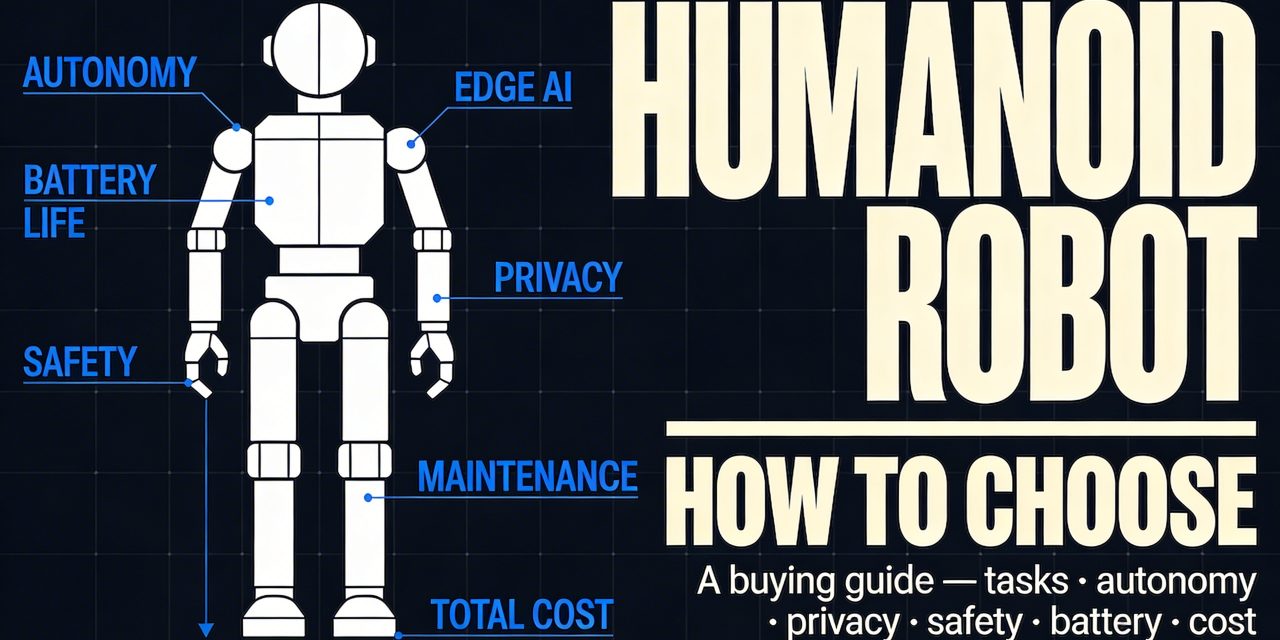
A humanoid robot for the home sounds simple on paper. You picture a machine that loads the dishwasher, folds laundry, carries groceries, tidies clutter, and answers a quick question while moving naturally through your rooms. In practice, choosing one is less about the marketing promise and more about understanding what today’s robots can actually do, where they still fall short, and what trade-offs you accept when you place an AI powered machine inside your home.
If you are seriously considering a humanoid for household chores, the best approach is to treat it like a major technology purchase rather than a novelty gadget. You need to match the robot to your home, your tasks, your tolerance for privacy risk, and your willingness to live with early stage technology. That matters even more now that consumer humanoids such as 1X’s NEO are being positioned as home assistants rather than lab demos.
This guide walks you through the key questions to ask before choosing a humanoid robot for domestic use.
Start with the most important question
Do you actually need a humanoid robot?
This is the part many buyers skip. A humanoid robot looks appealing because homes are built for humans. We have stairs, shelves, door handles, standard counter heights, baskets, drawers, and dishwashers designed around two hands and two legs. On that level, a humanoid form makes sense.
But that does not automatically make it the best choice for housework.
If your main problem is dirty floors, a robot vacuum is cheaper, quieter, and more mature. If you want help moving objects, a wheeled robot with a capable arm may be more practical than a full bipedal machine. If you want laundry folded, a specialized appliance may eventually do that one job better than a general purpose humanoid.
So before comparing brands, write down the exact chores you want automated. Not general goals like help around the house. Actual tasks, such as:
- loading and unloading the dishwasher
- picking up clutter from the floor
- carrying grocery bags from the hallway to the kitchen
- putting laundry into baskets
- wiping surfaces
- opening doors
- bringing items from one room to another
If a cheaper and simpler machine can do most of that, a humanoid may not be the smartest buy yet.
Match the robot to the chores you care about
Physical capability matters more than demos
Household chores look easy because humans perform them without much thought. For robots, they are difficult because homes are messy, unpredictable, and full of variation. A plate can be wet. A towel can be twisted. A child may leave toys in the hallway. A pet may suddenly cross the room.
When comparing humanoid robots, check these practical capabilities.
Payload and carrying ability
A robot may be able to lift a decent amount while standing still, yet carry much less while walking. That difference matters. Moving a mug from a table is one thing. Carrying a loaded laundry basket across the house is another.
Look for realistic carry capacity, not just peak lift numbers. Ask what the robot can carry safely while in motion and for how long.
Dexterity and hand design
Many domestic chores depend on fingers, grip control, and fine motor precision. Folding laundry, stacking plates, opening packaging, and picking up small objects all require far more dexterity than a clean promotional video suggests.
If your priority is tidying and handling mixed household objects, the robot’s hand design and degrees of freedom matter a lot. More articulation can help, but only if the software can use it reliably.
Mobility inside real homes
Ask yourself whether your home is actually robot friendly. Thick rugs, narrow hallways, stairs, reflective surfaces, poor lighting, cluttered rooms, and multi level layouts all increase difficulty.
A humanoid can theoretically navigate spaces designed for people. In reality, current systems still perform best in organized environments with fewer surprises. If your home changes constantly, the robot will have a harder job.
Understand the difference between autonomy and assistance
Fully autonomous is still not the norm
This is one of the most important parts of choosing a humanoid robot for household chores. Many products are marketed as autonomous, but some still rely on remote human assistance for more complex tasks.
NEO, for example, has been presented as a home robot that works autonomously by default, while difficult chores can involve a remote expert who supervises or guides the robot. That setup can help the system complete tasks and gather data for learning. It also changes what you are really buying.
You are not always buying a self sufficient household robot. In some cases, you are buying a partly autonomous machine supported by remote human labor.
That leads to several questions you should ask before choosing any model:
- Which tasks are truly autonomous today?
- Which tasks require remote supervision?
- When can a human operator access the robot?
- Is remote help always scheduled, or can it happen on demand?
- Are sessions recorded for training or quality purposes?
- Can you disable remote access completely?
If the robot needs a human operator for many of the chores you want done, the value proposition changes significantly.
Privacy is not a side issue
A home robot sees a lot more than a smart speaker
A humanoid robot in your home is not just another connected device. It moves through private spaces, captures video and audio, maps rooms, observes routines, and may retain context to personalize interaction. That can be useful. It also creates an unusually intimate data footprint.
The privacy question is not whether data exists. It is how much is collected, where it is processed, who can access it, and whether it leaves your home at all.
This is where edge AI becomes highly relevant. A robot that processes navigation, object recognition, voice commands, and decision making locally on device has major advantages. It can respond faster, work even when connectivity is weak, and reduce the need to send sensitive household data to the cloud.
Some modern humanoid systems use powerful onboard compute platforms. NEO, for instance, is described as using a 1X NEO Cortex built on Nvidia Jetson Thor hardware. That points toward increasingly capable local processing. Still, onboard hardware alone does not guarantee privacy. What matters is the actual data architecture.
Before choosing a humanoid robot, ask:
- What data stays on the device?
- What data is sent to the cloud?
- Are audio and video streams stored?
- Who can review recordings?
- Can your data be used to improve future models?
- Can you opt out without losing core features?
If the answers are vague, treat that as a warning sign. A useful household robot should not require you to be casual about privacy.
Check how the robot handles safety
Home safety is different from factory safety
Humanoid robots are often demonstrated in controlled settings. Homes are not controlled settings. Children run unpredictably. Pets move underfoot. Furniture shifts. People leave objects where they should not be.
That is why safety design matters as much as intelligence.
Look for features such as:
- soft outer materials that reduce impact
- joint protection that prevents pinching
- gentle actuators and low inertia movement
- reliable obstacle detection
- stable recovery behavior if the robot is blocked or confused
- clear visual or audio indicators showing what the robot is doing
NEO, for example, emphasizes a soft outer structure, covered joints, and tendon driven movement designed for gentler interaction. Those are good signs. But hardware safety is only part of the story. The harder question is what happens in edge cases. What does the robot do when it misidentifies an object, loses track of a child, or tries to grasp something fragile?
You should not just ask how well it works 99 percent of the time. You should ask what the 1 percent failure looks like inside your actual home.
Battery life will shape your experience
Long chore lists need real endurance
Battery specs can be misleading. A humanoid may have enough energy for light movement and occasional interaction, but more demanding physical tasks drain power quickly. Carrying objects, repeated arm motion, and continuous navigation all increase energy use.
For household chores, battery life determines whether the robot feels useful or interrupted. Can it complete a morning routine in one run? Does it need frequent charging? Can it dock and recharge by itself? How long until it is ready again?
Self charging is an important convenience feature. NEO is presented as managing its own battery life and plugging itself in when needed. That helps. Still, autonomy is only useful if the robot can finish meaningful work before it needs to recharge.
When evaluating a robot, focus on real task endurance rather than ideal lab figures.
Look beyond AI claims and ask what the software is good at
General intelligence is not the same as reliable household competence
Many humanoid robots now combine computer vision, speech systems, navigation models, memory, and conversational AI. Some also use vision language models and world models to interpret scenes and plan actions. This sounds impressive, and parts of it are impressive. But the question for your home is narrower.
Can the robot repeat everyday tasks with consistency?
A robot that can answer trivia, tell a joke, or maintain a natural conversation is not necessarily good at sorting laundry or unloading plates safely. In the home, reliable execution matters more than conversational flair.
That means you should prioritize:
- task repetition and consistency
- adaptation to your home layout
- recognition of common household objects
- error recovery when something goes wrong
- easy scheduling and task management
Natural language interaction is useful because it lowers the barrier to using the robot. But it should support the chores, not distract from the robot’s actual domestic performance.
Think about maintenance, updates, and long term support
A humanoid is not a buy once appliance
It is better to think of a humanoid home robot like a connected vehicle or a computing platform than like a toaster or a dishwasher. It will likely need software updates, replacement parts, servicing, and ongoing support.
That is why upfront price alone tells you very little.
Some humanoids may have a purchase price around the level of a small used car. Others may rely on a subscription model. Either way, the total cost of ownership is what matters. Consider:
- software subscription fees
- service and repair response times
- battery replacement costs
- warranty terms
- availability of spare parts
- how long the company commits to updates
A robot that looks affordable at first can become expensive if key functionality depends on paid services or if repairs are slow and specialized.
Use a practical checklist before you decide
The best questions to ask before buying
If you want to compare humanoid home robots in a structured way, use this checklist:
- Which exact household chores can it do today without supervision?
- How often does it need remote human assistance?
- How much data does it collect inside the home?
- How much AI runs locally through edge AI rather than in the cloud?
- Can it function safely around children and pets?
- What is the real battery life during active chores?
- How easy is it to schedule tasks and correct mistakes?
- What does maintenance look like over two to three years?
- What happens if the company changes its subscription model or shuts down support?
- Would a non humanoid robot solve your problem more effectively?
Who should buy a humanoid robot right now
At this stage, humanoid robots for household chores make the most sense for early adopters with a strong interest in robotics and a realistic understanding of the limitations. If you enjoy experimenting with emerging technology and accept that the robot may still need supervision, updates, and adaptation, then the experience may be worth it.
If what you want is dependable domestic automation with minimal friction, you are usually better off buying specialized tools today and watching the humanoid market mature over the next few years.