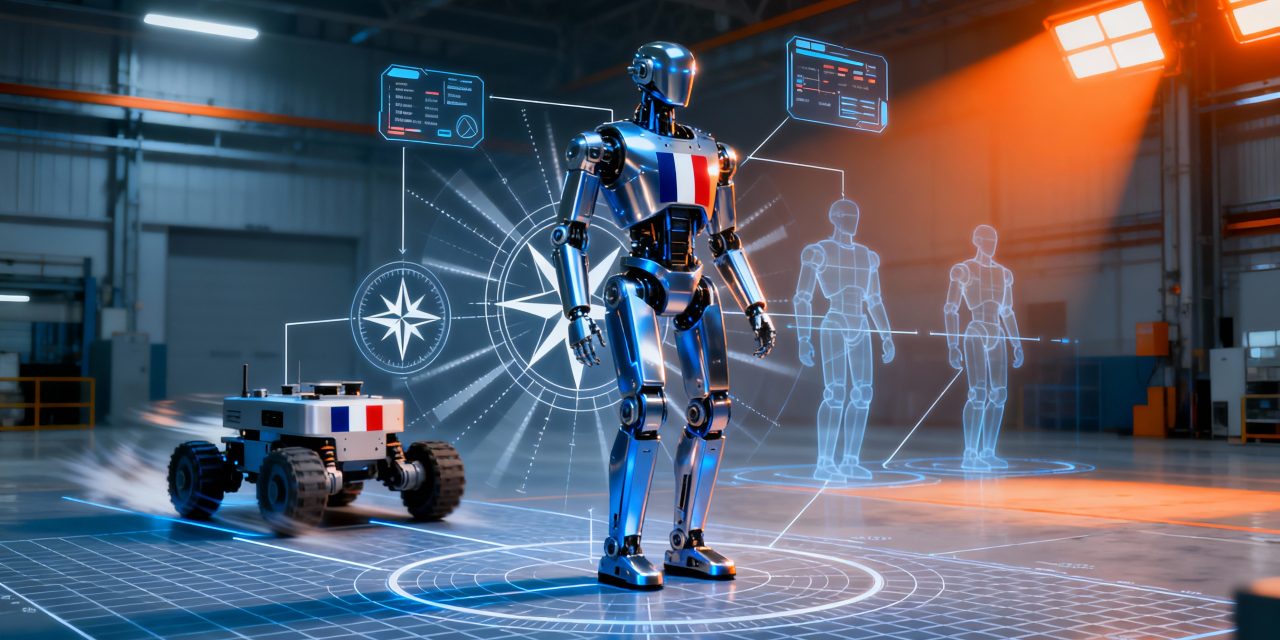
The world of robotics is currently undergoing a massive transformation. For years, the industry was dominated by two distinct categories: the rigid, wheeled rovers that offered stability but limited mobility, and the emerging bipedal humanoids that promised versatility but struggled with balance and energy efficiency. But what if there was a middle ground? What if a robot could shapeshift to adapt to its environment, combining the stability of a rover with the agility of a climber?
Enter Aru, the latest innovation from the French company Nio Robotics. This isn’t just another robotic dog or a warehouse cart; it is a polymorphic machine designed to tackle the most complex, hazardous, and unstructured environments in the industrial sector. In this deep dive, we will explore what Aru is, the brilliant minds behind it, what makes it fundamentally different from its competitors, and where it fits—and doesn’t fit—in the modern industrial landscape.
Who is Nio Robotics?
Before understanding the machine, we must understand the creators. Nio Robotics is a forward-thinking robotics firm based in Toulouse, France—a city already renowned as a European hub for aerospace and high-tech engineering. The company is built on a foundation of rigorous engineering and a vision to push the boundaries of what mobile robots can physically achieve.
The team behind Nio Robotics is a diverse group of young, talented engineers and experts from all over the world, including key figures like Titouan Le Marec. Their background is rooted in a desire to solve a specific problem: the limitations of current mobile robots in “brownfield” environments—existing industrial facilities that were designed for humans, not machines. Unlike Silicon Valley startups that often focus on consumer-facing AI, Nio Robotics (associated with Nimble One) has taken a pragmatic, hardware-first approach, focusing on industrial durability and mechanical ingenuity.
Their philosophy is clear: robots shouldn’t just look cool; they must perform tasks that are currently too dangerous or difficult for humans, and they must do so in environments that haven’t been modified to accommodate them.
What is Aru? The Polymorphic Revolution
Aru is described as a “polymorphic” robot. In biological terms, polymorphism refers to the occurrence of two or more clearly different morphs or forms. In robotics, this means Aru is a shape-shifter. It defies standard classification. Is it a snake robot? A rover? A quadruped? A humanoid? The answer is: it is a blend of all of them.
At first glance, Aru might look like a centaur or a complex rover. However, its design allows it to alter its physical configuration to suit the task at hand. This adaptability is its superpower. While a wheeled robot is stopped by a flight of stairs and a bipedal robot might fall over on loose debris, Aru adjusts its center of gravity and limb configuration to conquer both.
The “Compass” System
One of the most innovative aspects of Aru’s engineering is its limb design, referred to as the “compass” system. The robot utilizes a unique leg/wheel hybrid structure. This design allows for the efficiency of rolling on flat surfaces—saving battery life compared to walking robots—while retaining the ability to articulate legs to step over obstacles, climb stairs, or elevate its body to reach high shelves.
From a maintenance perspective, this is a stroke of genius. Nio Robotics has designed Aru so that its compass limbs are identical. This means an industrial facility doesn’t need to stock a left leg, a right leg, a front wheel, and a rear wheel. You only need to keep one full “compass” in stock. If a part breaks, it can be replicated and replaced easily. This modularity is critical for downtime reduction in factories and power plants.
What Makes Aru Different?
The robotics market is crowded. We have Boston Dynamics’ Spot (the famous yellow dog), Agility Robotics’ Digit, and Tesla’s Optimus. So, why does the industry need Aru?
1. Stability Meets Agility
The primary differentiator is the balance between stability and agility. Bipedal humanoids are impressive, but they are computationally expensive to keep upright and can be risky in hazardous environments where a fall could cause an explosion or damage sensitive equipment. Aru offers the stability of a multi-legged, wheeled platform. It won’t tip over easily. Yet, because of its articulated arms and “centaur-style” body, it can reach overhead compartments and manipulate objects just like a humanoid.
2. Interaction Capabilities
Many inspection robots are passive observers—they roll around with cameras and report back. Aru is an interactive robot. It is equipped with articulated arms and grippers designed for precise manipulation. It can:
- Open heavy industrial doors.
- Turn valves to shut off gas or water.
- Press buttons on control panels.
- Pick up and move debris.
This moves Aru from the category of “surveillance tool” to “active worker.” It doesn’t just see a problem; it can potentially fix it.
3. Modular Payload System
Aru is built to be a carrier. Its payload system is modular, allowing industries to swap out tools depending on the mission. It can carry high-resolution cameras for visual inspection, thermal imaging for heat detection, LiDAR for 3D mapping, gas detectors for leak identification, and even radiation detectors for nuclear environments. The robot adapts to the sensor, not the other way around.
Where is Aru Suitable? (Best Use Cases)
Given its robust design and interactive capabilities, Aru is tailored for sectors where human presence is dangerous, costly, or inefficient.
Industrial Inspection and Maintenance
This is Aru’s home turf. In sprawling factories, Aru can perform routine rounds, checking gauges and thermal readings. Its ability to climb stairs means it isn’t restricted to the ground floor, a common limitation for wheeled AGVs (Automated Guided Vehicles).
Oil, Gas, and Energy
Offshore rigs and refineries are hazardous. Gas leaks, high pressure, and extreme temperatures make them risky for human workers. Aru can be deployed to inspect pipes, detect corrosion, and even turn valves in emergency situations without risking human life.
Nuclear Decommissioning
Radiation is the ultimate barrier for human workers. Aru’s robust frame and ability to carry radiation detectors make it ideal for the dismantling of old nuclear facilities. It can navigate the clutter of a demolition site, manipulate tools to cut or move waste, and withstand environments that would be lethal to biological staff.
Civil Security and Rescue
In the aftermath of a disaster—like a building collapse or a chemical spill—first responders need eyes on the ground. Aru’s polymorphic nature allows it to traverse uneven, rubble-filled terrain that would stop a tank-tread robot. It can search for survivors using thermal cameras and open blocked pathways.
Where is Aru Less Suitable?
Despite its impressive engineering, Aru is not a one-size-fits-all solution. It is important to understand where this technology might not be the best fit.
High-Speed Open Terrain
If the goal is to cover vast distances of flat, open ground quickly (like perimeter security for a massive solar farm), a drone or a simple four-wheeled rover would be faster and more energy-efficient. Aru’s complex mechanism is designed for verticality and obstacle negotiation, not speed racing.
Social Environments
While Aru has “humanoid” traits, it is an industrial machine. Its appearance—described by some observers as “disturbing and awe-inspiring”—is functional, not comforting. It is not designed to be a receptionist, a waiter, or a companion in a nursing home. Its aesthetic is “Mars Rover meets Sci-Fi,” which fits a factory floor but might unsettle customers in a retail setting.
Ultra-Confined Spaces
While Aru is agile, it still has physical bulk. For inspecting the inside of small pipelines or extremely narrow HVAC ducts, specialized snake robots or micro-crawlers would be superior. Aru is a macro-manipulator, not a micro-inspector.
The Verdict: A French Leap Forward
Nio Robotics has created something truly distinct with Aru. In an era where many companies are simply copying the “robot dog” form factor, Nio has taken a step back to analyze what industrial environments actually require. They realized that the world isn’t flat, but it also isn’t perfectly suited for bipeds yet.
Aru represents a pragmatic evolution in robotics. It acknowledges that to be useful today, a robot must be able to open a door, climb a flight of stairs, and survive a fall, all while carrying heavy sensors. By combining the best elements of different robotic species, Aru is poised to become a vital asset for industries looking to automate their most dangerous and dull tasks.
As we look toward 2026 and beyond, the presence of robots like Aru in our industrial infrastructure will likely become the new normal. It is a testament to the innovation coming out of the French tech ecosystem and a signal that the future of robotics is not just about artificial intelligence, but about mechanical versatility.
This article is based on the dutch article about ARU on Robot.be.