Building autonomous AI agents has, until recently, felt like assembling a fragile house of cards. You stitch together Python libraries, wrestle with dependency conflicts, and cross your fingers that your agent doesn’t hallucinate a command that deletes your file system. The current landscape of agent orchestration is dominated by flexible but often brittle frameworks. Enter OpenFang.
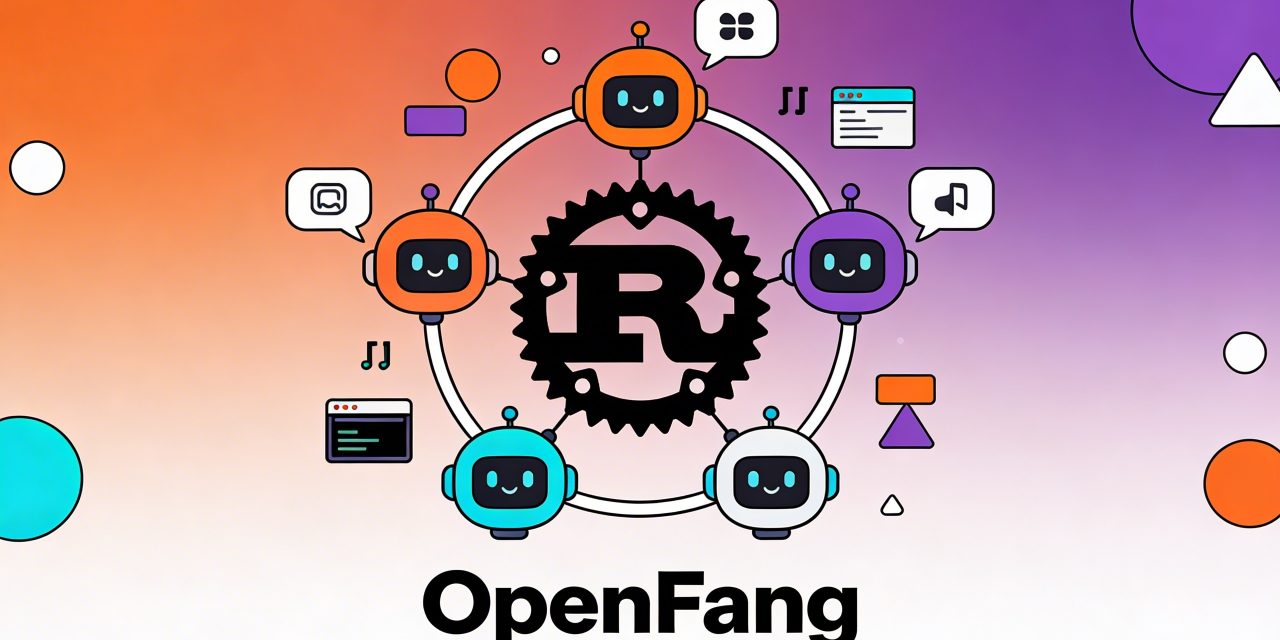
OpenFang represents a fundamental shift in how we deploy artificial intelligence. It is not just another library to import into your project; it is a standalone Agent Operating System. Built entirely in Rust, it compiles 137,000 lines of code into a single, production-ready binary. It promises to move us from the era of “chatting with bots” to an era where agents work autonomously, securely, and efficiently on your behalf.
In this deep dive, we will explore what OpenFang is, how its architecture solves the critical security and stability problems of current AI agents, and why it stands apart from popular orchestrators like LangGraph, AutoGen, or CrewAI.
What is OpenFang?
At its core, OpenFang is the primitive layer for building, running, and deploying autonomous agents. While most developers are used to piecing together agents using Python scripts and API keys, OpenFang takes a “kernel-grade” approach. It provides a unified workspace where agents live, breathe, and execute tasks without constant human hand-holding.
The system is designed around a “batteries-included” philosophy. Instead of spending weeks configuring tools, vector databases, and API connections, OpenFang ships with:
- 30 Pre-Built Agents: Ranging from code reviewers to customer support specialists.
- 40 Channel Adapters: Allowing agents to live natively on Slack, Discord, Telegram, WhatsApp, and Teams simultaneously.
- 38 Built-In Tools: Including web search, browser automation, and Docker management.
- 26 LLM Providers: Support for Anthropic, Gemini, Groq, DeepSeek, and more, with intelligent routing based on cost and performance.
However, the true differentiator of OpenFang is not just the quantity of integrations, but the concept of “Hands.”
The Concept of Hands, Agents That Work For You
Most AI interactions today are reactive. You type a prompt, the AI replies. You stop typing, the AI stops working. OpenFang introduces Hands—autonomous capability packages that run on schedules, independent of your direct input.
Unlike a standard chatbot, a Hand has a job description, a schedule, and a mandate to deliver results to your dashboard. They don’t wait for you to ask; they execute. OpenFang ships with seven distinct Hands:
- Lead: An autonomous lead generation engine that discovers, enriches, and scores qualified leads daily, building Ideal Customer Profile (ICP) graphs.
- Researcher: A fact-checking engine that cross-references sources and evaluates claims using the CRAAP method (Currency, Relevance, Authority, Accuracy, and Purpose), generating cited reports.
- Collector: An OSINT-style intelligence gatherer that monitors targets for changes and sentiment shifts.
- Predictor: A superforecasting engine that uses Brier scores to track its own accuracy over time.
- Clip: A media agent that turns long-form video into short, viral clips with captions and thumbnails.
- Twitter: A social media manager that creates content in rotating formats and manages engagement.
- Browser: A web automation agent capable of navigating sites and filling forms (with a mandatory human-approval gate for purchases).
Each Hand is defined by a HAND.toml manifest and a SKILL.md knowledge file, compiled directly into the binary. This structure ensures that the agent’s “personality” and operational playbook are rigid and reliable, rather than fluid and prone to drift.
Architecture: How OpenFang Works Under the Hood
To understand why OpenFang claims to be an “Operating System,” we have to look at its architecture. It solves the “spaghetti code” problem of multi-agent systems by enforcing strict architectural boundaries.
1. The Rust Advantage and Single Binary
Speed and safety are the primary reasons OpenFang is built in Rust. Python, while excellent for prototyping, introduces significant overhead and runtime errors in complex, long-running agent loops. OpenFang runs as a single binary with zero “clippy” warnings. This results in a minimal memory footprint and instant cold start times, which is crucial when running multiple agents in parallel.
2. Sandboxed Execution (WASM)
Security is often an afterthought in agent frameworks. If you give an agent Python’s subprocess access, you are effectively giving an LLM root access to your machine. OpenFang mitigates this by running tool code inside a WebAssembly (WASM) sandbox.
This sandbox features “dual metering,” which tracks both fuel (computational resources) and epoch interruption. If an agent enters an infinite loop or tries to consume too much memory, the OS kills the process gracefully. File operations are confined to specific workspaces, and subprocesses are environment-cleared. This creates a blast radius containment that is essential for enterprise deployment.
3. Persistent Memory and Knowledge Graphs
One of the biggest hurdles in agent orchestration is memory. Agents usually forget context the moment a session ends. OpenFang utilizes a SQLite-backed storage system with vector embeddings. It maintains cross-channel canonical sessions. This means if you tell an agent something on Telegram, it remembers that context when it later reports to you on a dashboard or Slack. It also performs automatic LLM-based compaction, summarizing old conversations to keep the context window efficient without losing critical data.
4. Connectivity: MCP, A2A, and OFP
OpenFang is designed to talk to the world. It fully supports the Model Context Protocol (MCP), acting as both a client and a server. This allows it to connect to external MCP servers or expose its own tools to other agents. Furthermore, it implements the Google A2A (Agent-to-Agent) task protocol and its own OpenFang Protocol (OFP) for peer-to-peer networking. This allows your agents to communicate securely with agents running on other systems using HMAC-SHA256 mutual authentication.
OpenFang vs. The Landscape
The market is flooded with agent frameworks: LangChain, LangGraph, AutoGen, OpenClaw, CrewAI, and others. How does OpenFang compare? The distinction lies in the difference between a framework and an operating system.
Frameworks (CrewAI, AutoGen, LangGraph)
Most current tools are libraries. You write code to import them, you manage the runtime, you handle the error logging, and you are responsible for the security. They are incredibly flexible but require significant “glue code” to make production-ready. They often suffer from “dependency hell” and can be slow due to the interpreted nature of Python.
The OpenFang Approach
OpenFang is an application. You install it, configure it via TOML files, and it runs. It handles the lifecycle of the agents, the memory management, and the security enforcement. It is “measured, not marketed,” benchmarking itself on cold start times, install size, and security depth rather than just hype.
Where a framework like AutoGen might require you to write a script to define how two agents talk, OpenFang provides a pre-compiled workflow engine that supports fan-out, conditional logic, and loops out of the box. It is less about writing code to make an agent and more about configuring an agent to do a job.
Security: The Critical Differentiator
As agents become more capable, they become more dangerous. The concept of “Agentic AI” turning into an insider threat is real. An agent with shell access and internet connectivity is a prime target for prompt injection attacks. If an attacker can trick your agent into executing a command, they own your infrastructure.
OpenFang implements 16 distinct security systems to combat this, aligning with high-standard security checklists for agent platforms:
- WASM Dual-Metered Sandbox: Prevents code execution from escaping the designated environment.
- Taint Tracking: Monitors data flow to ensure untrusted input doesn’t reach critical system functions.
- SSRF Protection: Prevents the agent from making unauthorized network requests to internal services.
- Ed25519 Manifest Signing & Merkle Audit Trails: Ensures that the code the agent is running hasn’t been tampered with and that every action is logged immutably.
- Secret Zeroization: Ensures API keys and sensitive data are wiped from memory when not in use.
This “defense-in-depth” strategy is rarely seen in open-source Python frameworks, where security is often left as an exercise for the developer.
Operationalizing Agents (AgentOps)
Moving from a prototype to production requires “AgentOps”—the operational side of managing AI. OpenFang simplifies this through its native Tauri 2.0 desktop application. This isn’t just a command-line tool; it provides a full dashboard in a native window with system tray integration and notifications.
Through this dashboard, you can monitor the “Hands” as they work. You don’t need to check a log file to see if the Lead generator found new prospects; the dashboard updates in real-time. The system also handles the complex logic of “human-in-the-loop.” For sensitive actions, like the Browser agent making a purchase, OpenFang enforces a mandatory approval gate, ensuring that autonomy never overrides safety.
Getting Started with OpenFang
Despite its complexity under the hood, OpenFang is designed for rapid deployment. The “Quick Start” promise is to have your first agent spawned in under two minutes. Configuration is handled entirely through config.toml and environment variables, making it easy to version control your agent’s infrastructure.
For developers looking to extend the system, the “Build Your Own” capability allows you to define a HAND.toml with specific tools and system prompts, which can then be published to FangHub, a marketplace for agent capabilities.