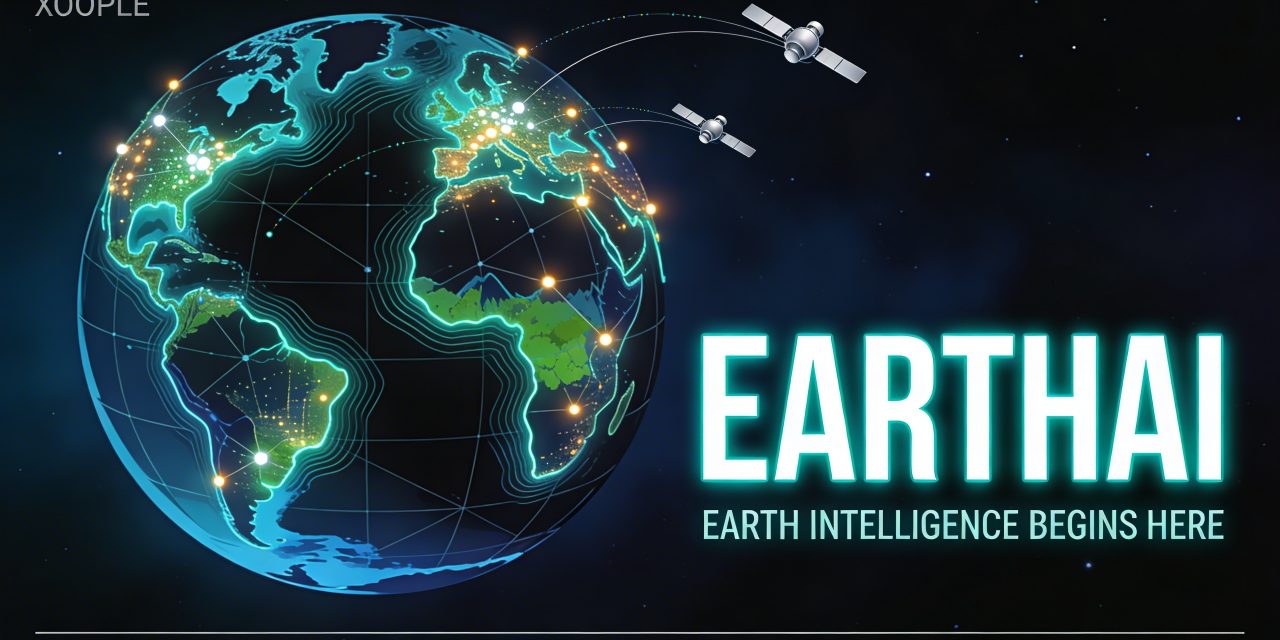
EarthAI is Xoople’s attempt to build something the AI market increasingly needs but has struggled to access at scale: a continuous, structured, AI ready view of the Earth’s surface. Rather than treating satellite imagery as a set of pictures for analysts to inspect, Xoople frames Earth observation as data infrastructure for machine learning. AI systems that support risk analysis, infrastructure monitoring, environmental forecasting, or disaster response need more than occasional images. They need consistent streams of validated geospatial data that can be queried, compared over time, and merged with operational systems.
Xoople, a Madrid based geospatial company founded in 2019, has drawn major attention after raising $130 million in Series B funding, bringing total funding to $225 million. The round was led by Nazca Capital, with participation from MCH Private Equity, CDTI, Buenavista Equity Partners, and Endeavor Catalyst. At the same time, the company announced a partnership with L3Harris Technologies to develop sensors for its future satellite constellation. Together, these moves position Xoople as one of the more ambitious European players in AI driven Earth intelligence.
What is EarthAI
EarthAI is best understood as an end to end Earth intelligence platform. It collects surface data from satellite sources, processes that information into standardized and AI ready datasets, and makes it usable for applications such as change detection, risk prediction, environmental monitoring, and infrastructure assessment.
The key distinction is that Xoople is not simply offering access to images. It is building a system designed for continuous surface intelligence. That means the output is meant to function as a persistent data layer rather than a collection of isolated snapshots. For AI models, that is a major difference. Temporal consistency, structured data, and repeatable inputs are far more useful than fragmented imagery archives.
Xoople’s broader thesis is that the next generation of geospatial AI will not be built on workflows created for human interpretation. It will be built on machine native data pipelines from the beginning. In practical terms, EarthAI aims to become a kind of digital reference layer for what is happening on the ground, when it changes, and why that change matters.
Why the EarthAI concept arrives at the right time
Earth observation is not new. Governments, research institutions, and commercial operators have been collecting satellite data for decades. What has changed is the pressure to turn observation into operational intelligence. Climate volatility, supply chain disruption, resource constraints, infrastructure stress, and disaster exposure all require faster and more reliable situational awareness.
Traditional satellite workflows often fall short because the data is fragmented across providers, formats, update cycles, and quality levels. A user might know that a coastline is shifting, a crop is under stress, or a transport corridor is disrupted, but not have enough structured context to model the cause, estimate the impact, or forecast the next step with confidence.
This is where EarthAI fits into a wider AI trend. Large models and predictive systems need high quality real world inputs. In sectors tied to the physical world, that means geospatial ground truth. The more AI moves into enterprise operations, insurance, logistics, infrastructure, and environmental management, the more valuable continuous Earth surface data becomes.
From observation to ground truth
One of the most important ideas behind EarthAI is the move from passive observation to ground truth. In geospatial practice, ground truth refers to validated information about actual conditions on the Earth’s surface. Without it, AI systems may identify patterns, but they cannot reliably connect those patterns to real world states and outcomes.
Xoople argues that businesses and public institutions still operate with incomplete understanding because available Earth data is often siloed, inconsistent, or too difficult to integrate into enterprise tools. EarthAI is meant to reduce that gap. The goal is not just to show what changed, but to create a system that supports reasoning over change.
Xoople’s unusual strategy of distribution first
One reason Xoople stands out is its go to market sequence. Many Earth observation companies started by building or launching hardware, then looked for customers later. Xoople did the opposite. It spent years embedding its platform into existing enterprise ecosystems before deploying its own satellite infrastructure.
This is a significant strategic choice. EarthAI runs on Microsoft Azure and is integrated with Microsoft’s geospatial environment, while Esri acts as a distribution partner. Those are not niche channels. Microsoft and Esri are central platforms in cloud, GIS, enterprise analytics, and operational geospatial workflows. By positioning itself inside those environments, Xoople gains proximity to enterprise buyers and public sector users where actual purchasing and deployment decisions happen.
That also lowers one of the biggest barriers in geospatial technology adoption. Companies do not want to rebuild their full stack just to use a new data source. They want data that fits into the tools they already use. Xoople’s bet is that if the distribution pipes are already in place, proprietary data can be adopted more quickly once the company’s own constellation becomes operational.
The satellite constellation question
For now, EarthAI relies on data from government spacecraft and third party satellite networks. The next phase is more ambitious. Xoople has announced a partnership with L3Harris Technologies to build sensors for its own satellite constellation, focused on optical data collection.
The company claims this future system could deliver a stream of data two orders of magnitude better than existing monitoring systems. That is a striking statement. If achieved, it would represent a major leap in the quality and continuity of commercial Earth monitoring. But it is also where expectations should remain disciplined.
Building and deploying space hardware is expensive, slow, and execution heavy. The Earth observation market already includes mature operators with orbiting assets and established processing pipelines, including Planet Labs, BlackSky, Airbus Defence and Space, ICEYE, Capella Space, and others. In other words, Xoople is trying to move from a software and data layer strategy into a capital intensive hardware phase while competing with firms that already control their own upstream supply.
That does not weaken the logic of EarthAI, but it does highlight the challenge. Investors are not just backing a software platform. They are backing the creation of a vertically integrated Earth intelligence stack.
Why the funding matters beyond the headline
The $130 million Series B is important not only because of the amount, but because of what it says about investor conviction in geospatial AI infrastructure. Deep tech funding often depends on whether investors believe a company can bridge the long gap between technical promise and commercial scale. In Xoople’s case, that gap includes platform development, enterprise integration, hardware design, and eventually satellite deployment.
The investor mix is also notable. It includes private equity, public backed technology funding, and growth focused investors. That blend reflects the reality of strategic technology markets such as geospatial intelligence, aerospace, climate infrastructure, and dual use systems. These are markets where commercial opportunity and public interest are increasingly intertwined.
Xoople’s rise also says something broader about Europe’s role in AI and space technology. Rather than competing only through foundation models or consumer AI applications, European companies may be strongest where advanced engineering, regulated industries, industrial software, and physical world intelligence intersect. EarthAI sits directly in that category.
Use cases where EarthAI could have real impact
Agriculture and land management
Farmers and agribusinesses need earlier signals on crop stress, irrigation efficiency, disease risk, and land condition. Continuous Earth intelligence could improve planning cycles and support more targeted interventions. It may also help quantify land based sustainability metrics, including those relevant to carbon programs.
Insurance and climate risk
Insurers increasingly need granular, dynamic views of exposure. Static historical averages are less useful in an environment shaped by more frequent weather extremes. EarthAI could support pricing models, claims verification, and proactive risk assessment with fresher and more spatially precise data.
Critical infrastructure
Roads, rail, power networks, industrial sites, pipelines, and ports all degrade over time and under stress. If EarthAI can continuously detect subtle change, it could improve maintenance planning and reduce the cost of failure. This is especially relevant for operators managing large distributed asset networks.
Government and emergency response
Natural disasters demand better situational awareness. A platform that combines near real time surface monitoring with predictive analysis could help agencies prepare evacuation routes, assess damage faster, and allocate resources more effectively. Similar logic applies to environmental enforcement and urban resilience planning.
Supply chains and enterprise operations
Many supply chain disruptions begin with physical events such as drought, flooding, infrastructure damage, or land use change. EarthAI could become a layer that connects physical world signals to procurement, logistics, and operational planning systems before disruption becomes visible in business data.
The competitive landscape
Xoople is entering a crowded market, and that matters. Companies such as Planet, BlackSky, Airbus, and other Earth observation providers already have live systems, customer bases, and AI related analytics offerings. Google also sets a benchmark in geospatial AI through its cloud capabilities, models, and planetary scale data platforms.
So where could Xoople differentiate?
- AI native data design rather than retrofitting imagery archives for machine learning.
- Platform distribution through Microsoft and Esri before deploying proprietary hardware.
- Focus on continuous surface intelligence instead of isolated imagery products.
- Potential vertical integration from sensor layer to enterprise delivery.
The real test will be execution. A compelling thesis is one thing. Delivering superior data quality, low latency access, and reliable integration at enterprise scale is another.
What to watch next
Several questions will determine whether EarthAI becomes a category leader or remains an ambitious platform story.
- Can Xoople deploy its own data collection infrastructure on a realistic timeline?
- Will its sensor quality meaningfully outperform existing monitoring systems?
- Can it translate Microsoft and Esri access into large scale enterprise adoption?
- Will customers buy raw data, packaged insights, or both?
- Can it maintain technical credibility while moving from public and partner data to proprietary supply?
Those questions are open, but the market conditions are favorable. The Earth observation sector continues to grow, while AI demand for high quality physical world data is rising faster. If Xoople can align hardware execution with its software and distribution strategy, EarthAI could become a meaningful part of how organizations monitor risk, infrastructure, land, and climate related change.