Why Suno v5.5 matters
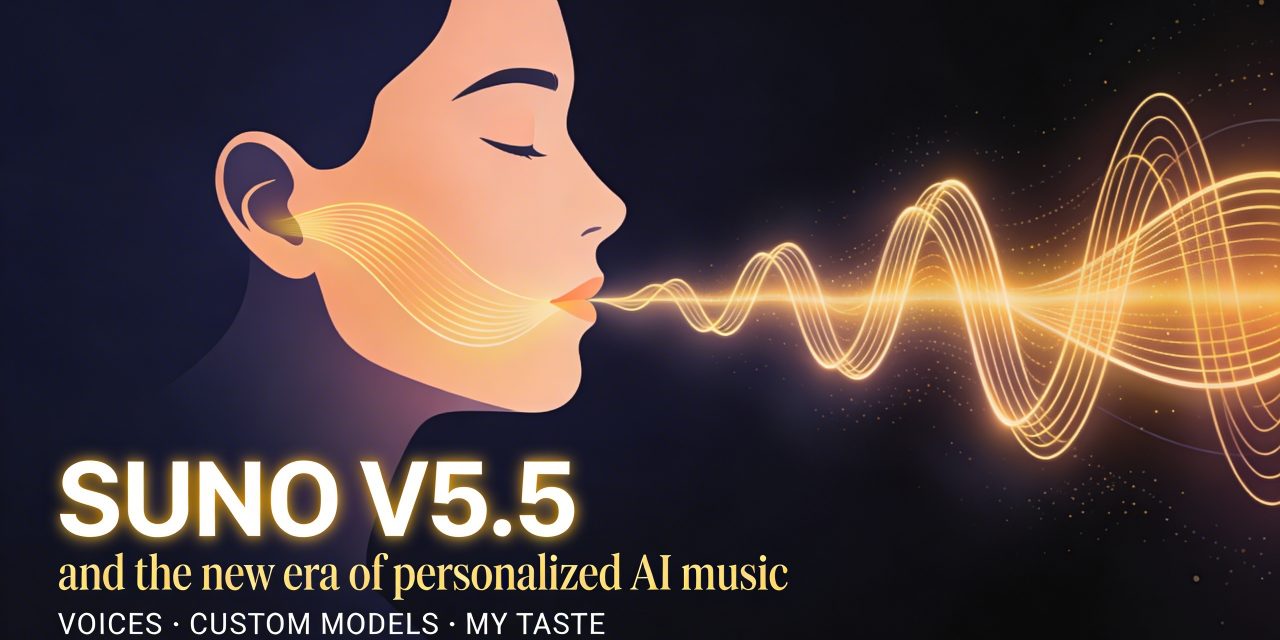
Suno v5.5 moves toward personalization. The central promise is simple. Instead of generating music that sounds generically good, Suno aims to generate music that feels more like you.
That matters because AI music is maturing. The conversation is no longer only about whether a model can create a catchy song from a prompt. It is increasingly about whether creators can shape the outcome in a meaningful way, preserve artistic identity, and integrate AI into real creative workflows. In that sense, Suno v5.5 is a notable development for musicians, producers, hobbyists, and anyone tracking the evolution of artificial intelligence in music.
The release centers on three features. Voices lets users create songs with a model based on their own singing voice. Custom Models lets users tune the system with their own catalog. My Taste learns from user preferences over time to steer style choices. Together, these tools push AI music away from one size fits all generation and toward a more individualized creative environment.
What is new in Suno v5.5
Suno describes v5.5 as its most expressive model so far, and the supporting feature set helps explain why. The update combines core model improvements with user level controls that make outputs more tailored and more repeatable.
Voices
Voices is arguably the headline feature. It allows users to capture the essence of their own voice and use it in Suno generated songs. Users can sing directly into a device microphone or upload audio, including cleaner vocal takes and even completed tracks. The better the source material, the easier it is for the model to learn the vocal characteristics accurately.
Suno has also added a verification step. Users are asked to speak a random phrase so the system can match the singing voice to a live identity check. The goal is to reduce unauthorized voice cloning and keep control in the hands of the original user. According to the release details, these voices are private by default, which is a meaningful design choice in a market where voice likeness is becoming both a technical asset and a legal risk.
Custom Models
Custom Models extend personalization beyond the voice. Instead of adapting only to how someone sounds, Suno can adapt to how someone writes and produces. Users upload original tracks from their own catalog, and the model learns stylistic patterns from that material. This includes aesthetic tendencies such as genre combinations, arrangement instincts, mood preferences, and sonic identity.
In practical terms, this means a creator who consistently works in dreamy synth pop, stripped back indie folk, or cinematic trap can steer the model toward that zone with more consistency than a text prompt alone would allow. Pro and Premier users can create a limited number of these custom variants.
My Taste
My Taste is subtler, but potentially powerful over time. Rather than relying on explicit uploaded training materials, it learns from the user’s behavior. If someone repeatedly gravitates toward certain genres, moods, textures, or artist adjacent prompt patterns, Suno uses that history to shape future suggestions and style generation.
This feature reflects a broader trend in AI systems. Personalization increasingly comes from ongoing interaction, not just single commands. In other words, the model starts to build a profile of your creative preferences through use.
From prompt machine to creative partner
Musicians do not only want variation. They want recognizability. They want to hear their own instincts reflected in the output. They want an idea generated today to still feel compatible with the creative world they are building next month.
Suno v5.5 addresses that gap by giving users a way to encode parts of themselves into the system. A personal voice. A personal catalog. A personal pattern of taste. This moves the tool closer to a creative partner model, even if it is still very much software rather than collaborator in the human sense.
Who benefits most from Suno v5.5
The update is broad enough to appeal to several user groups, but the value looks different for each one.
Independent musicians
For solo artists and independent producers, v5.5 is useful for ideation and demo creation. Voices makes it possible to hear rough song concepts in a familiar vocal identity without setting up a full recording chain every time. Custom Models can help maintain a coherent sonic brand across experiments. That is attractive if you already have a catalog and want AI to extend your process rather than replace it.
Songwriters
Songwriters who think in toplines, hooks, and arrangement sketches use these tools to test ideas faster. Instead of waiting until a later production stage to hear whether something suits their vocal range or artistic direction, they can prototype earlier. This shortens the loop between concept and evaluation.
Non singers and hobby creators
There is also a more casual but still meaningful use case. Many people have musical ideas but do not feel comfortable singing publicly or do not have access to a studio. Voices lowers that barrier. Hearing your own voice integrated into an AI generated song could be creatively empowering.
The larger trend behind AI music personalization
Suno is not operating in a vacuum. The entire AI audio space is moving toward systems that do more than generate generic outputs. We are seeing a convergence of several forces.
- Identity as a feature where a user’s voice, style, and preference history become central inputs
- Workflow integration where AI fits into songwriting, pre production, and editing rather than replacing the entire chain
- Professional adoption as more artists and producers test AI tools for production support, arrangement, and demo work
- Rights awareness as copyright, licensing, and authorship questions become harder to ignore
That last point is critical.
The copyright and authorship questions Suno v5.5 cannot avoid
Any serious discussion of Suno v5.5 has to include copyright. AI music tools are becoming more capable, but legal frameworks remain uneven and often unclear. Guidance from rights organizations increasingly emphasizes a distinction between AI generated works and AI assisted works.
A common principle is that copyright protection depends on meaningful human authorship. If a song is generated almost entirely by AI from minimal prompting, its copyright status may be weak or disputed, depending on jurisdiction. If, however, a human creator contributes original melody, lyrics, arrangement, editing, and artistic direction, and AI is used as an assistive tool, the case for protectable authorship is stronger.
This matters directly for Suno users. Tools like Voices and Custom Models encourage deeper personal involvement, but that does not automatically settle authorship. A personalized output may still rely heavily on automated generation. The real question is how much human creativity shaped the final work.
There is also the issue of training data and infringement risk. Creators need to think not only about whether they can use an output, but whether the system behind it was trained and deployed in a way that respects rights.
Is Suno v5.5 a breakthrough
If breakthrough means a sudden leap to fully autonomous, artist level music creation, then no. AI music still faces familiar limits. Generated songs may sound impressive on first listen but reveal structural weakness, lyrical flatness, or emotional sameness over time. Personalization improves relevance, but it does not magically solve every musical problem.
But if breakthrough means a meaningful step toward usable, personalized, creator centric AI music tools, then Suno v5.5 deserves attention. It shows that the next stage of AI music is less about novelty and more about control. Less about random output and more about artistic identity.
Some music we created with Suno V5.5.
Razor on the dancefloor by Lazysailor (Funky)
Dancing on the Edge by Lazysailor (Bluesy)