The dawn of predictive sleep medicine
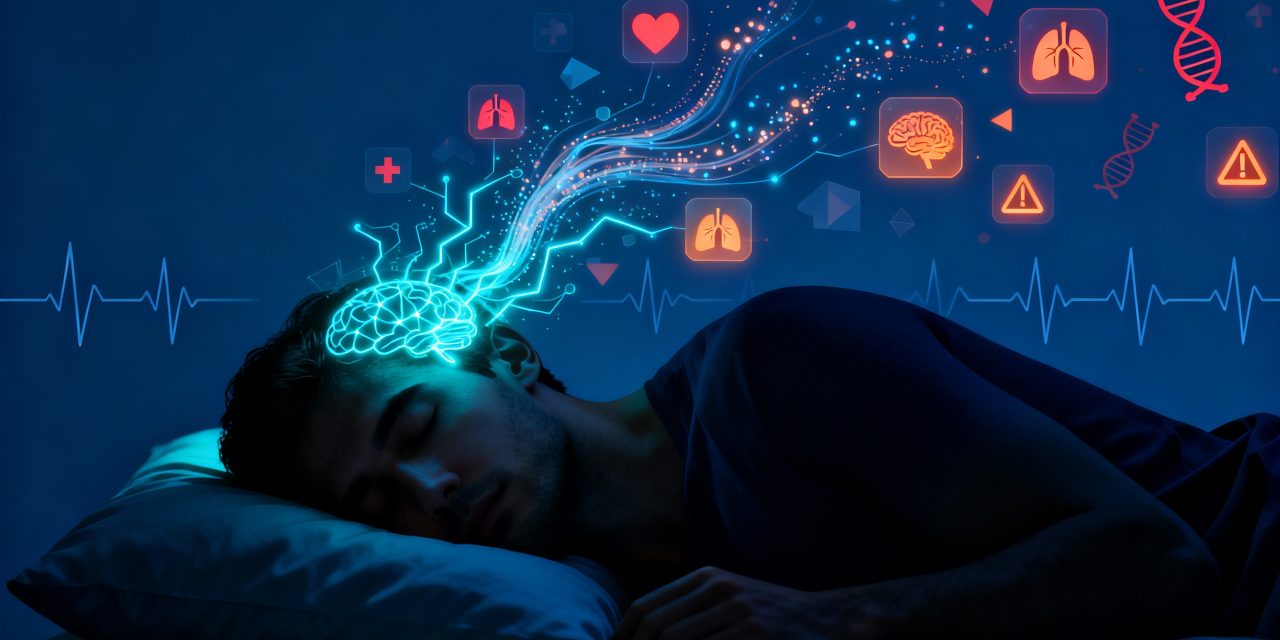
Imagine lying down for a regular night’s sleep, only to wake up with insights into your health that could predict diseases years before symptoms appear. This isn’t science fiction anymore. Researchers at Stanford Medicine have developed SleepFM, an artificial intelligence model that can forecast your risk of developing more than 130 health conditions based on data collected during just one night of sleep.
Sleep has always been recognized as essential for health, but until now, we’ve barely scratched the surface of what our sleeping patterns can reveal about our future wellbeing. SleepFM represents a quantum leap in how we understand the relationship between sleep and disease, transforming overnight sleep studies from diagnostic tools into powerful predictive instruments.
What exactly is SleepFM?
SleepFM is a multimodal foundation model, a type of advanced artificial intelligence system trained on massive amounts of sleep data. Think of it as a highly sophisticated pattern recognition system that has learned to read the language of sleep by analyzing over 585,000 hours of polysomnography recordings from approximately 65,000 participants.
Polysomnography, often called a sleep study, is the gold standard for evaluating sleep. During these studies, various sensors record brain activity through electroencephalogram (EEG), heart rhythms via electrocardiography (ECG), muscle activity using electromyography (EMG), and respiratory patterns. These recordings create a rich tapestry of physiological data that most current medical approaches only partially utilize.
What makes SleepFM revolutionary is its ability to integrate all these different data streams simultaneously. Rather than looking at brain waves or heart rate in isolation, the model examines how these various physiological signals interact and relate to each other throughout the night. This holistic approach allows it to detect subtle patterns that human experts might miss and that traditional analysis methods cannot capture.
The model uses a sophisticated technique called leave-one-out contrastive learning, which essentially teaches the AI to understand how different physiological signals should relate to each other during healthy sleep. When these relationships deviate from normal patterns, even in ways too subtle for human observation, SleepFM can flag potential health risks years before clinical symptoms emerge.
The origins of this breakthrough
The development of SleepFM emerged from a convergence of several scientific trends. First, sleep medicine has accumulated vast archives of polysomnography data over decades, but lacked the computational tools to fully exploit this information. Second, advances in artificial intelligence, particularly foundation models, have demonstrated remarkable abilities to find meaningful patterns in complex, multimodal datasets.
The research team, led by Emmanuel Mignot and James Zou at Stanford Medicine, recognized that sleep data presented unique opportunities and challenges. Unlike many medical datasets, sleep recordings capture continuous physiological information over extended periods, providing a window into how multiple body systems function and interact when we’re at rest.
The project drew on data from four primary sources: the Stanford Sleep Clinic, BioSerenity sleep laboratories, the Multi-Ethnic Study of Atherosclerosis (MESA), and the Outcomes of Sleep Disorders in Older Men (MrOS) study. This diverse dataset, spanning participants from age 2 to 96 years, ensured that SleepFM could learn patterns applicable across different ages, demographics, and health conditions.
Training such a model required innovative approaches to handle the variability in how sleep studies are conducted. Different sleep centers use different sensor configurations, and even within the same facility, the number and type of recording channels can vary. The researchers developed a channel-agnostic architecture that could learn from this heterogeneous data, making SleepFM remarkably flexible and generalizable.
Problems that SleepFM addresses
Traditional medicine often operates reactively, diagnosing diseases after symptoms appear. By that point, conditions may have progressed significantly, limiting treatment options and outcomes. SleepFM tackles this fundamental limitation by enabling truly predictive medicine.
The model demonstrates impressive accuracy across a wide spectrum of conditions. For all-cause mortality, it achieves a concordance index of 0.84, meaning it correctly ranks patient risk 84% of the time. For dementia, the score reaches 0.85, while heart failure scores 0.80, chronic kidney disease 0.79, and stroke 0.78. These aren’t just abstract statistics; they represent the potential to identify at-risk individuals years before disease onset.
Consider Parkinson’s disease, where SleepFM achieves a concordance index of 0.89. Sleep disturbances, particularly REM sleep behavior disorder, often precede Parkinson’s diagnosis by years or even decades. By detecting these early warning signs, SleepFM could enable interventions during a critical window when treatments might be most effective.
Similarly, for Alzheimer’s disease and other forms of dementia, the model shows exceptional predictive power. Sleep abnormalities, including reduced slow-wave activity and disrupted REM sleep, appear long before cognitive symptoms become apparent. Early identification could allow patients to participate in clinical trials, make lifestyle modifications, or begin preventive treatments as they become available.
The model also addresses a practical challenge in sleep medicine: the labor-intensive nature of manual sleep analysis. Currently, trained technicians must spend hours reviewing sleep recordings to identify sleep stages and abnormalities. SleepFM can perform these analyses automatically while simultaneously assessing disease risk, potentially making comprehensive sleep evaluation more accessible and affordable.
Another critical problem SleepFM solves is the fragmentation of medical knowledge. Traditionally, researchers have studied connections between sleep and specific diseases in isolation. SleepFM’s ability to simultaneously evaluate risk for 130 different conditions reveals that sleep disturbances may be a common pathway through which multiple diseases develop, suggesting new avenues for preventive interventions.
Real-world applications and future potential
The practical applications of SleepFM span multiple domains of healthcare. In clinical settings, the model could transform routine sleep studies into comprehensive health screenings. A patient referred for suspected sleep apnea might leave not only with that diagnosis but also with personalized risk assessments for cardiovascular disease, diabetes, and neurodegenerative conditions.
For primary care physicians, SleepFM could serve as a powerful risk stratification tool. Rather than relying solely on traditional risk factors like age, blood pressure, and cholesterol levels, doctors could incorporate sleep-based biomarkers into their assessments. This could help identify high-risk patients who might otherwise be overlooked and guide decisions about preventive interventions.
In research contexts, SleepFM opens new possibilities for understanding disease mechanisms. By identifying which sleep patterns predict specific conditions, researchers can generate hypotheses about the biological pathways linking sleep disturbances to disease development. This could accelerate the discovery of new therapeutic targets.
The model’s transfer learning capabilities are particularly promising. When tested on the Sleep Heart Health Study, a dataset completely excluded from training, SleepFM maintained strong predictive performance. This suggests the model has learned genuinely generalizable patterns rather than memorizing specific dataset characteristics, a crucial requirement for real-world deployment.
Looking toward the future, as wearable sleep technology continues to advance, models like SleepFM might eventually work with data from consumer devices. While current wearables don’t match the precision of clinical polysomnography, ongoing improvements in sensor technology and signal processing could bridge this gap. Imagine receiving personalized health risk assessments based on data your smartwatch collects each night.
In public health, SleepFM could enable population-level screening programs. Sleep studies are less invasive and expensive than many other diagnostic procedures, making them potentially suitable for broader deployment. Identifying at-risk individuals early could reduce healthcare costs by preventing or delaying disease onset.
The model could also enhance clinical trial design. By identifying individuals at high risk for specific conditions, researchers could recruit more targeted participant populations, potentially reducing the time and cost required to demonstrate treatment efficacy.
Challenges and considerations
Despite its impressive capabilities, SleepFM faces several challenges before widespread clinical adoption. The model was trained primarily on data from patients referred for sleep studies, who may not represent the general population. People without sleep complaints or those with limited healthcare access are underrepresented, potentially limiting the model’s applicability to broader populations.
Interpreting SleepFM’s predictions presents another challenge. While the model can identify risk with high accuracy, understanding exactly which sleep patterns drive specific predictions remains difficult. This “black box” nature of deep learning models can make clinicians hesitant to act on their recommendations without understanding the underlying reasoning.
Ethical considerations also arise. Predicting disease risk years in advance carries psychological implications. How should healthcare providers communicate these predictions? What support systems should be in place for individuals identified as high-risk? These questions require careful consideration as predictive models move from research to clinical practice.
Regulatory pathways for AI models like SleepFM remain evolving. While the FDA has made progress in developing frameworks for AI/ML medical devices, many foundation models still lack clear approval pathways. Establishing appropriate validation standards and post-market surveillance mechanisms will be essential.
The future of sleep-based health monitoring
SleepFM represents more than just a technological achievement; it embodies a fundamental shift in how we think about sleep and health. Rather than viewing sleep merely as a restorative process, we’re beginning to recognize it as a window into our overall physiological state, offering insights that extend far beyond traditional sleep medicine.
As the model continues to evolve and as complementary technologies advance, we may be approaching an era where comprehensive health monitoring happens passively each night. Combined with data from electronic health records, genetic information, and other sources, sleep-based AI models could become central components of truly personalized, predictive healthcare systems.
The journey from research breakthrough to clinical reality will require continued collaboration between AI researchers, sleep medicine specialists, clinicians, ethicists, and policymakers. But the potential rewards, earlier disease detection, more targeted interventions, and ultimately better health outcomes, make this effort worthwhile.
SleepFM demonstrates that the future of medicine lies not just in treating disease but in predicting and preventing it. By learning to read the subtle signals our bodies send while we sleep, artificial intelligence is helping us take a giant leap toward that future. The question is no longer whether AI can predict disease from sleep data, but how quickly we can responsibly translate these capabilities into tools that improve human health.