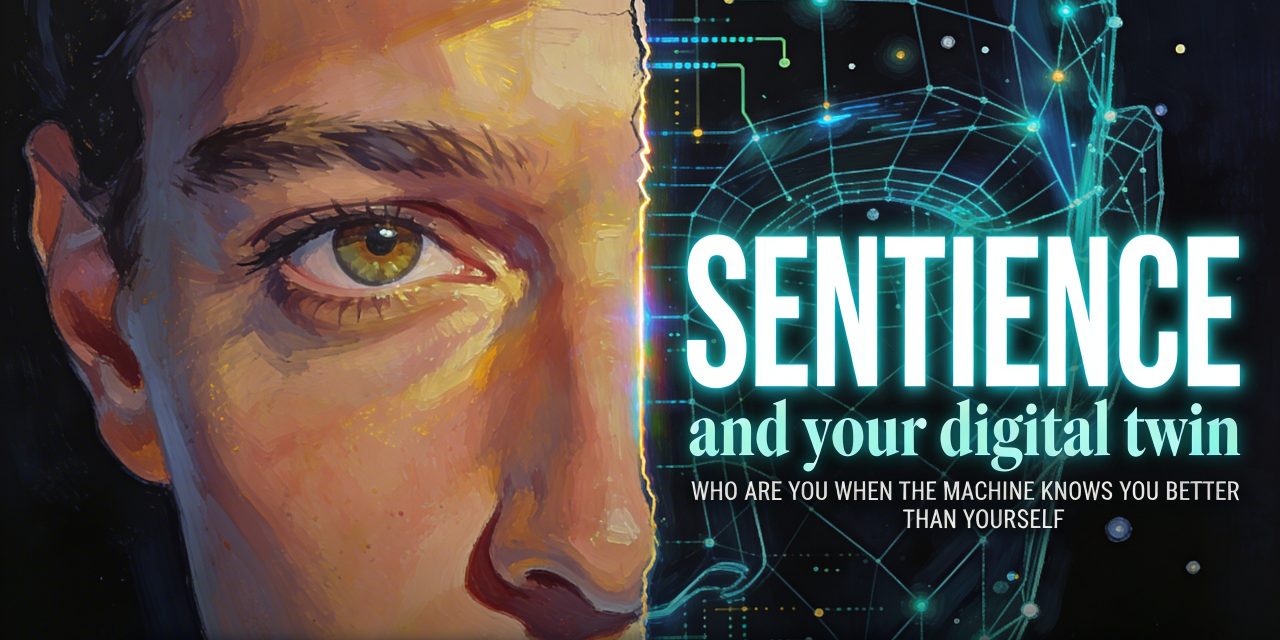
Sentience and the idea of a digital twin
One of the boldest ideas in the AI space is the digital twin. In the consumer AI context, that means a model that does not just react to one prompt, but gradually becomes a functional representation of you. It can learn your communication style, your priorities, your decision patterns, and possibly even your values. Sentience is often discussed through that lens. The central promise is simple and provocative at the same time. It aims to create an AI based version of you that can act, assist, and perhaps eventually interact on your behalf.
That immediately raises bigger questions. What exactly is Sentience? Who is building it? How could such a system work in practice? And perhaps most importantly, what does it realistically promise to become, beyond the hype that so often surrounds artificial intelligence?
What is Sentience
At its core, Sentience can be understood as an effort to create a persistent AI identity layer around an individual. Instead of treating every chat session or automation flow as isolated, the platform ambition is to maintain continuity. That continuity is what makes the idea different from a standard chatbot or digital assistant.
A regular assistant helps with tasks. A digital twin tries to understand the person behind those tasks.
If Sentience succeeds, the result would not merely be a profile with static preferences, such as favorite foods or meeting habits. It would be a living computational model that adapts over time. It could absorb your written communication, your knowledge base, your choices, and your habits. From that, it could generate responses that are closer to how you would respond, prioritize actions the way you would prioritize them, and interact with systems in a way that reflects your personal context.
This is why the phrase digital twin of you has attracted attention. It suggests something more ambitious than personalization. It suggests simulation of identity.
Why the idea matters now
The timing is not accidental. Several technology trends have converged.
- Large language models have become strong enough to mimic style, summarize long histories, and generate context aware responses.
- Multimodal AI can process voice, text, images, and eventually video, making personal representation richer.
- Persistent memory architectures allow systems to store and retrieve long term user context.
- Agentic AI is shifting from simple conversation toward action, such as booking, scheduling, drafting, filtering, and decision support.
- Digital identity infrastructure is becoming more important as users seek continuity across apps and platforms.
Together, these developments make the dream of a personal AI twin more feasible than it was only a few years ago. Not perfect, not complete, but technologically plausible enough to attract builders, investors, and public curiosity.
Who is behind Sentience
With projects like Sentience, the key question is not only which company or founding team is involved, but also what kind of ecosystem stands behind it. In AI, ambitious personal twin systems require a blend of disciplines. You need expertise in machine learning, human computer interaction, privacy engineering, product design, and often decentralized identity or data control models.
What matters most is whether the people behind Sentience understand two things at once. First, building a convincing digital twin is a hard technical challenge. Second, building one that users trust is an even harder governance challenge.
Any serious effort in this area is likely to involve a combination of:
- AI researchers and engineers working on memory, personalization, agent frameworks, and fine tuning
- Product teams shaping how users train, inspect, and control their twin
- Security and privacy specialists designing consent, authentication, and data protection mechanisms
- Investors or strategic backers interested in the next layer of consumer AI and digital identity
- Advisors from robotics, social computing, and platform design who can help position the product beyond chat interfaces
For a domain focused on artificial intelligence, this is the important lens. The question is not just who started Sentience, but whether the actors behind it are capable of carrying a system from demo to durable platform. Many AI projects can stage an impressive prototype. Far fewer can build a trusted personal infrastructure layer.
How a digital twin like Sentience could work
To understand Sentience, it helps to break the system into layers. A digital twin is not one model doing one thing. It is more likely a stack of interacting components.
1. Data ingestion
The twin first needs source material. That can include emails, messages, documents, calendar patterns, notes, voice recordings, browsing context, and other digital traces that reflect how you think and act. The challenge is not just collecting this information, but selecting what is relevant and doing so with clear user control.
This layer determines how rich the twin can become. A system trained only on a few prompts will remain shallow. A system with access to years of writing, preferences, and interactions could become much more convincing.
2. Identity modeling
Once data is available, the system needs to build a structured model of the person. This goes beyond raw storage. It may involve extracting values, recurring goals, decision tendencies, areas of expertise, communication tone, social context, and preference hierarchies.
For example, the system might learn that you write differently to colleagues than to friends, that you prefer short direct replies in the morning, or that you are cautious when discussing financial commitments. These patterns can then inform future outputs.
3. Memory architecture
One of the biggest limitations of many AI systems is unstable memory. A true Sentience digital twin would need a robust memory layer that combines short term context with longer term personal history. That memory would need to be searchable, rankable, and editable.
In practical terms, this likely means a hybrid system. Part of the memory may sit in vector databases for semantic retrieval. Part may be stored in structured knowledge graphs that represent relationships, events, projects, and people. Another part may be distilled into preference rules or latent personality embeddings.
4. Behavioral generation
This is the part users see. The system generates replies, suggestions, decisions, or actions that are meant to resemble the user. If done well, it should not only sound like you. It should prioritize like you.
That is much harder than style transfer. Mimicking tone is relatively easy. Mimicking judgment is not.
A strong behavioral layer would likely combine a frontier language model with personal fine tuning, memory retrieval, rule based constraints, and reinforcement through user feedback. Over time, the twin could become more aligned with the real person through correction loops.
5. Agency and action
The next stage is where the concept becomes especially powerful and risky. Rather than only answering questions, the twin could perform tasks. It might draft responses, manage scheduling, prepare reports, filter inbound communication, or represent you in low stakes interactions.
At that point, Sentience would no longer be a passive profile. It would be an active software agent.
6. Oversight and control
No personal AI twin can be credible without transparent controls. Users need the ability to inspect what the system knows, what it inferred, what it is allowed to do, and where it is likely to fail. A serious platform would need permission layers, activity logs, correction tools, and emergency shutoff mechanisms.
This control layer is not a detail. It is central to whether the product feels empowering or unsettling.
What Sentience promises to become
The most ambitious vision is not a better chatbot. It is a persistent digital counterpart that extends your capacity. If that vision matures, the future version of Sentience could evolve in several directions.
Personal intelligence layer
In this version, your twin becomes the interface between you and the digital world. Instead of configuring every application separately, your AI twin carries your preferences, history, style, and goals across systems. It becomes a continuity layer for work, communication, and personal organization.
Delegated agent
Here, the twin can perform limited tasks on your behalf. It may answer routine questions, triage information, maintain a knowledge base, or prepare drafts that are close enough to your usual output to save time without losing your voice.
Legacy model
One of the more emotionally charged possibilities is a long term identity archive. A digital twin could preserve expertise, stories, voice patterns, and personal knowledge. In a family context, that could become a memory system. In a professional context, it could preserve institutional knowledge after someone leaves a role.
Companion identity
More controversially, the twin might become a semi autonomous representation used in digital spaces. That could include meetings, support interactions, learning platforms, or eventually even social and immersive environments. In that scenario, your twin does not just assist you. It stands in for you in selected contexts.
That is where the philosophical implications become hard to ignore. A system that acts like you in public settings changes the meaning of presence, authorship, and responsibility.
What makes the concept attractive
The appeal of Sentience is easy to understand. Modern digital life is fragmented and overloaded. People spend time repeating themselves across apps, channels, and tasks. A digital twin offers the possibility of continuity and leverage.
- Productivity gains through automation that reflects personal style and priorities
- Better personalization than generic assistants can provide
- Knowledge preservation for individuals and teams
- Reduced cognitive load from offloading routine decisions and repetitive communication
- Scalable presence when one person cannot be everywhere at once
If delivered well, a digital twin could become one of the most important application layers in consumer and professional AI. It shifts AI from being a general tool to being a personal extension.
The hard problems Sentience cannot ignore
This is also where realism matters. A convincing demo can hide deep structural challenges.
Identity is not static
People change across time, context, mood, and relationships. There is no single version of you. A digital twin that freezes your past behavior may become less accurate just when you need it most.
Inference is not understanding
Even if the system predicts your next sentence well, that does not mean it understands your intentions or values. Statistical resemblance can easily be mistaken for deeper alignment.
Privacy risk is extreme
A product that centralizes your communications, preferences, memories, and behavioral patterns creates an exceptionally sensitive data environment. This is not ordinary app data. It is identity level data.
Misrepresentation is costly
If the twin drafts the wrong response, misreads a relationship, or makes a poor decision on your behalf, the consequences can be social, legal, or financial. Errors become more serious when AI is tied to identity.
Consent and ownership are complicated
Who owns the twin model? Can it be moved between platforms? Can it be deleted completely? What happens if a company changes its business model or disappears? These are not secondary questions. They go to the heart of digital personhood.
How Sentience fits into the broader AI landscape
Sentience sits at the intersection of several major AI trajectories. It touches generative AI, because language and multimodal models are core to self representation. It touches agentic AI, because the twin may eventually act. It touches robotics and embodied AI, because a personal model could later be used as the mind layer for humanoid or social robots. And it touches digital identity, because control over one’s data, profile, and representation becomes foundational.
That broader framing matters. The future of AI may not be defined only by bigger models. It may be defined by who owns the intelligent layer closest to the person. A digital twin is one possible answer to that question.
What to watch next
If you want to judge whether Sentience is becoming a serious platform or remaining an intriguing concept, watch for a few signals.
- User control over training data, permissions, and model behavior
- Memory quality that goes beyond superficial personalization
- Action reliability in real world delegated tasks
- Transparency around storage, governance, and model ownership
- Interoperability across tools and platforms rather than closed silos
- Clear safety boundaries for where the twin can and cannot act autonomously
If these pieces come together, Sentience could become more than a novelty. It could become a foundational layer in personal AI.