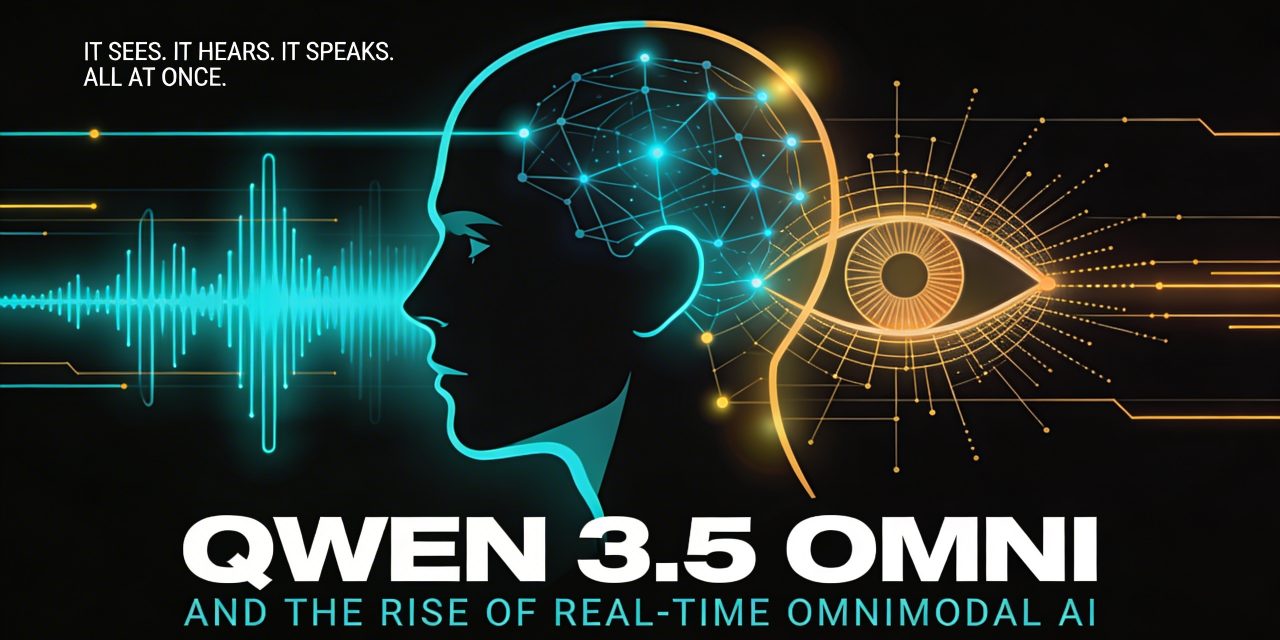
Qwen 3.5 Omni is positioned as a native omnimodal model. It is built to understand text, images, audio, and video together, and to respond in text or natural speech in real time.
It changes latency, coherence, and the quality of interaction. It also changes what AI can do inside actual workflows. Instead of acting like a chatbot with extra adapters, an omnimodal model can behave more like an always on interface for human communication, screen activity, sound, and context.
What is Qwen 3.5 Omni
Qwen 3.5 Omni is Alibaba’s latest omnimodal foundation model. It is designed to process multiple input types natively, including text, images, audio, and video, while generating both text and speech output. The focus is not just broad modality support, but real time interaction.
In practical terms, that means the model aims to handle live spoken conversations, audio visual reasoning, and streaming responses without depending on a chain of separate systems for transcription, OCR, and visual analysis. This is the central idea behind the term omnimodal AI. The model is not merely multimodal in the loose marketing sense. It is presented as an end to end system that reasons across modalities as part of one architecture.
Alibaba released multiple variants, including Plus, Flash, and Light configurations, and the broader Qwen3 Omni family also includes instruct, thinking, and captioning oriented model variants. The open documentation around Qwen3 Omni highlights a 30B A3B model line, with distinct components for understanding and generation.
Why native omnimodal design matters
The difference between native omnimodal AI and stitched multimodal pipelines is not cosmetic. It affects four areas directly.
Latency
Every additional subsystem adds delay. If a model has to extract audio, transcribe it, sample video frames, run OCR, and then pass all of that into a language model, response time increases sharply. Native models reduce handoff overhead and can stream outputs faster.
Temporal coherence
Video and audio are time based media. A person’s tone, a gesture, a subtitle, and an environmental sound can all matter at once. Separate tools often lose this alignment. An omnimodal model can preserve relationships between what is seen and what is heard.
Interaction quality
Real conversations are messy. People pause, interrupt, speak in fragments, or react with short acknowledgments. Traditional voice interfaces often misread these signals. Native real time models can improve turn taking and make spoken dialogue feel less brittle.
Application scope
Once a system can process live speech, ambient sound, visual inputs, and screen recordings together, new use cases open up. This matters for assistants, robots, industrial inspection, remote support, education, accessibility, and developer tools.
The key capabilities behind Qwen 3.5 Omni
Several features stand out in the current Qwen 3.5 Omni positioning.
Real time audio and video understanding
The model is built for low latency streaming interaction. It can process spoken input, visual scenes, and mixed audio visual signals while producing immediate responses. This moves it closer to voice native AI assistants than conventional chat based systems.
Speech output with stronger turn taking
One of the more useful upgrades is semantic interruption. Instead of stopping every time it detects a sound, the model is designed to distinguish between background noise, acknowledgment sounds, and genuine user interruption. This may seem like a small feature, but it is essential for natural conversation.
Improved speech rendering through alignment
Alibaba describes a technique called ARIA, or Adaptive Rate Interleave Alignment, which aims to better synchronize text generation and speech output. A common weakness in speech enabled AI is unstable pronunciation of numbers, named entities, and unusual terms. Better alignment could make generated speech more accurate and more natural.
Voice cloning
Qwen 3.5 Omni also enters the voice synthesis space by supporting voice cloning from a sample. That places it in direct competition with specialist voice tools, at least for some use cases. For enterprise workflows, media localization, and assistant customization, this is significant. It also raises obvious governance questions around consent, provenance, and misuse.
Multilingual operation
The Qwen3 Omni documentation describes support for a very broad language range in text, alongside more limited but still meaningful coverage for speech input and output. Public reporting around Qwen 3.5 Omni also points to expanded speech recognition across far more languages and dialects than in the previous generation. In a global AI market, multilingual voice support is not a side feature. It is a strategic requirement.
Audio visual vibe coding
Perhaps the most forward looking feature is what Alibaba calls audio visual vibe coding. The idea is that the model can watch a recording of a coding task or interface interaction and infer functional code from what it sees and hears, even without a formal text prompt. This suggests a future where AI systems observe workflows directly instead of requiring users to translate every action into text instructions.
What the architecture suggests
The technical material around Qwen3 Omni points to a Thinker Talker architecture built on a mixture of experts design. The terminology is useful because it clarifies what the model is trying to optimize.
- Thinker handles reasoning and multimodal understanding
- Talker handles speech generation and streaming interaction
- MoE design helps allocate compute more efficiently across tasks
- Multi codebook speech design is used to reduce generation latency
This separation reflects a broader trend in AI system design. Rather than forcing one monolithic stack to do everything equally well, model builders are developing specialized internal pathways for reasoning, speech, and perception. If done well, this can preserve general capability while improving responsiveness.
It also helps explain why Qwen3 Omni is interesting beyond benchmarks. The architecture is aimed at deployment reality. Real time AI needs more than benchmark accuracy. It needs stable streaming, manageable memory use, efficient inference, and controllable behavior.
Benchmarks matter, but workflow tests matter more
Alibaba and external coverage both highlight strong benchmark performance. The broader Qwen3 Omni family is reported to achieve state of the art or open source state of the art results on many audio and audio visual benchmarks.
Those results are relevant, but the more meaningful test is whether an omnimodal model performs well on messy inputs. Public examples suggest that Qwen 3.5 Omni can analyze a video clip directly and identify speakers, topics, and contextual meaning far more quickly than a stitched pipeline that must separately transcribe, inspect frames, and read subtitles.
This is where native design shows practical value. In ideal conditions, pipelines can work. In real conditions, they break. Audio is noisy. Videos are dim. Speech overlaps. Text on screen is partial or blurred. A model that reasons across these signals jointly has a better chance of staying useful.
What this means for AI assistants
Qwen 3.5 Omni points toward a different model of AI assistant design. The old paradigm is a text box with optional voice input. The emerging paradigm is a persistent multimodal agent that can listen, observe, speak, and react in context.
That has implications in several areas.
Enterprise copilots
Support agents, analysts, and operations teams increasingly work across dashboards, calls, documents, alerts, and live video. An omnimodal model can observe more of that environment directly, reducing the need for manual context switching.
Robotics and embodied AI
For robots and humanoid systems, omnimodal perception is not optional. A robot must integrate voice, vision, ambient sound, and spatial cues continuously. Models like Qwen 3.5 Omni do not solve robotics on their own, but they move conversational perception closer to what embodied systems need.
Accessibility
Detailed audio captioning, cross modal explanation, and speech based interaction can improve accessibility for users with different sensory or motor needs. A strong open source or open weight audio captioner is especially relevant here.
Developer tooling
Screen aware coding assistants, interface interpretation, and workflow observation are likely to become major categories. Audio visual vibe coding is still early, but the direction is clear. Future coding tools may watch what a user does, not just read what they type.
The deployment reality
It is easy to focus on capability and overlook infrastructure. Qwen3 Omni also matters because its documentation engages directly with deployment choices.
The model can be used through local inference stacks, containerized environments, and API access. The documentation strongly emphasizes performance considerations, especially for mixture of experts inference, GPU memory requirements, and the tradeoffs between text only and speech enabled operation.
Several practical points stand out.
- Using only text output can reduce memory use and improve speed
- vLLM style serving is preferred for lower latency and larger scale deployment
- Speech and video support require attention to environment setup, codecs, and GPU compatibility
- Prompt design still matters for multimodal reasoning, especially in multi turn interactions
In other words, Qwen 3.5 Omni is not just a research demo. It is positioned as a deployable omnimodal AI platform. That makes it more relevant for technical teams evaluating production systems.
The competitive context
Alibaba’s pace matters here. Qwen has moved from strong text and vision models into broader multimodal and now omnimodal territory at high speed. That reflects a wider pattern in AI competition. The leading labs are converging on the same strategic objective: build systems that handle the full bandwidth of human communication.
That includes:
- text reasoning
- image understanding
- live speech input and output
- video comprehension
- tool use and web access
- agent like behavior inside workflows
Qwen 3.5 Omni is important because it strengthens open and semi open competition in this space. It suggests that frontier multimodal interaction will not be defined by only a small number of US based platforms. For developers and enterprises, that broader competition can affect cost, openness, localization, and deployment options.
The risks and open questions
As with any fast moving AI release, capability is only part of the story.
Voice cloning safety
Voice cloning is useful, but it creates immediate concerns around impersonation and fraud. Any serious deployment needs authentication, logging, consent standards, and clear provenance controls.
Benchmark inflation versus real reliability
Strong benchmark results do not guarantee stable real world performance. Omnimodal systems still need stress testing on noisy environments, edge devices, industry specific terminology, and multilingual code switching.
Latency at scale
Real time interaction in a demo is one thing. Real time interaction across large volumes of concurrent users is another. Infrastructure efficiency will determine whether omnimodal AI can move from premium feature to standard interface.
Governance and trust
If a model can watch, listen, infer, speak, and search the web in real time, transparency becomes more important. Users need to know what the system perceived, what it inferred, and when it used external data.
Why Qwen 3.5 Omni matters now
For years, AI products were organized around text first interaction. Even when they added speech or images, those features were often attached as separate modules. Omnimodal systems are different. They treat voice, video, text, and visual context as part of one interaction loop.
That shift aligns with where computing itself is heading. Interfaces are becoming more ambient, more conversational, and more embedded in tools, rooms, vehicles, machines, and devices. In that environment, the winning AI systems will not just answer prompts. They will interpret context as it unfolds.