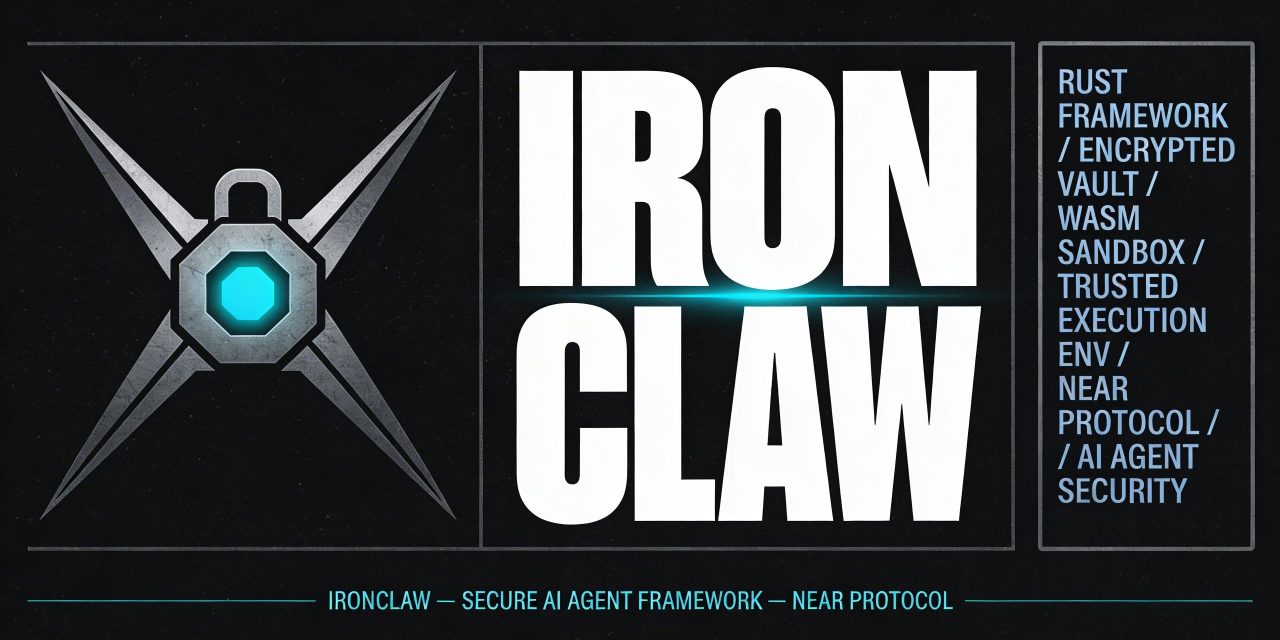
IronClaw by NEAR puts security at the center of agent design
IronClaw by NEAR is not trying to be just another AI agent wrapper. Its core idea is much more specific. It aims to make autonomous AI assistants useful in real work without turning API keys, tokens, passwords, and internal context into collateral damage.
That matters because modern AI agents are no longer limited to answering questions. They browse the web, call APIs, write code, trigger workflows, monitor systems, and interact with services like Slack, Telegram, databases, and internal tools. As soon as an agent becomes operational, it also becomes a security problem. The more useful it is, the more access it needs. The more access it gets, the greater the blast radius if something goes wrong.
IronClaw is NEAR’s answer to that tension. It is an open source, Rust based implementation inspired by OpenClaw, but rebuilt around privacy, isolation, and control. Instead of assuming the model can be trusted with secrets, IronClaw is designed so secrets stay outside the model wherever possible. That is the real distinction, and it is what makes the project worth paying attention to.
What IronClaw is and why it exists
IronClaw is presented as a secure personal AI assistant and a safer alternative to OpenClaw style deployments. The promise is simple. You still get an agent that can automate, research, code, and operate across tools, but you do not have to expose raw credentials directly to the LLM.
That design choice is a response to a very real weakness in many agent setups. If an LLM can access your secrets in plain form, then prompt injection becomes far more dangerous. A malicious webpage, document, tool output, or plugin can try to manipulate the model into revealing credentials or using them in unintended ways. Once that happens, telling the model to be careful is not a serious security strategy anymore.
IronClaw tries to solve that structurally. Credentials are stored in an encrypted vault and are injected only at the host boundary, only for approved endpoints, and only when needed. In other words, the model can trigger work that depends on credentials, but it does not need direct visibility into the raw values themselves.
Why AI agents create a different security challenge
Traditional software security often assumes that permissions, users, and system boundaries are relatively stable. AI agents break that assumption. They are probabilistic systems that interpret instructions from many sources, combine context dynamically, and can take action across multiple tools. That makes them flexible, but also unusually susceptible to indirect manipulation.
There are several common risk patterns in agentic systems:
- Prompt injection where external content tries to override system intent or extract sensitive information.
- Credential leakage when keys or tokens are visible to the model, plugins, or logs.
- Malicious or overprivileged tools that gain broader access than they should have.
- Data exfiltration through outbound requests to unapproved destinations.
- Infrastructure trust issues when cloud hosts can inspect memory, storage, or runtime state.
IronClaw is interesting because it does not frame these as edge cases. It treats them as normal design constraints for production grade AI agents.
The main architectural ideas behind IronClaw
IronClaw combines several defensive layers rather than relying on one magic control. That matters because no single protection is enough in an agent system. The stack is built around isolation, secret handling, runtime restrictions, and deployment security.
Encrypted secret storage
Secrets such as API keys, passwords, and tokens are stored encrypted. The key design point is not just encryption at rest. It is that tools and the model are not supposed to receive raw secrets directly. Instead, credentials are injected only when a request crosses the host boundary and only toward destinations you explicitly allow.
This sharply reduces the chance that a model output, tool bug, prompt injection attack, or careless log statement exposes a credential in clear text.
WebAssembly sandboxing
IronClaw runs untrusted tools inside isolated WebAssembly containers. This is one of the strongest parts of the design. Each tool gets capability based permissions, explicit limits, and narrow access rules. That means a tool is not automatically trusted just because it is available to the agent.
Compared with a broad plugin model, WebAssembly sandboxing helps make tool execution more predictable. The agent can still extend its capabilities, but each extension lives inside a more constrained environment.
Endpoint allowlisting
One of the simplest ways to reduce exfiltration risk is to restrict where data can go. IronClaw uses allowlisting so HTTP requests can only be sent to approved hosts and paths. That prevents silent outbound calls to unknown infrastructure and makes data movement easier to audit.
This is especially important for agent systems that interact with many external APIs. Without clear outbound restrictions, even a minor compromise can become a serious leak path.
Leak detection on outbound traffic
IronClaw adds another layer by scanning outbound traffic for patterns that resemble secrets. If something sensitive appears to be leaving the environment, it can be blocked automatically. No detection system is perfect, but in a layered model this is valuable because it catches cases that slipped past earlier controls.
Prompt injection defense
The project also describes pattern detection, sanitization, policy enforcement, and safe wrapping of external content before it reaches the model context. This is a realistic approach. Prompt injection cannot be solved with a single rule, so practical systems need several filters and policies working together.
Rust as a security choice
IronClaw is implemented in Rust, which is not just a performance decision. Rust’s memory safety model removes entire classes of low level bugs that have historically affected systems software, including buffer overflows and use after free errors. That does not make the application automatically secure, but it does improve the baseline for a tool that is supposed to run sensitive workloads.
How NEAR AI Cloud changes the deployment model
IronClaw can be run locally, but NEAR clearly positions its cloud environment as a major part of the value proposition. On NEAR AI Cloud, IronClaw runs inside Trusted Execution Environments, or TEEs. This changes the trust model in a meaningful way.
A TEE is designed to protect code and data during execution, even from parts of the surrounding infrastructure. In practical terms, that means memory is protected in a way that reduces visibility for the cloud host itself. NEAR frames this as provider blind execution, where even the infrastructure operator cannot inspect the workload in the usual way.
For teams that want hosted AI agents without handing total trust to a cloud provider, this is a compelling middle path. It avoids the operational burden of self hosting everything on dedicated local hardware while still improving isolation beyond a standard virtual machine deployment.
The combination of TEEs with IronClaw’s vault model is the more important point. Secret handling inside the application is one layer. Runtime protection at the infrastructure level is another. Together they create a stronger story than either would on its own.
IronClaw versus OpenClaw
IronClaw is closely tied to OpenClaw, but the difference is not just branding or implementation language. The two systems reflect different assumptions about how much freedom an agent should have and how much risk an operator is willing to tolerate.
OpenClaw is positioned as highly capable and flexible, with deep machine access and broad autonomy for long running workflows. That makes it powerful for builders who want full control. It also creates obvious security concerns if the deployment involves sensitive credentials, persistent memory, or broad system permissions.
IronClaw takes a more structured approach. Rather than giving the agent wide open freedom over the machine, it emphasizes controlled task execution, explicit permissions, sandboxed tooling, and secret isolation. You could describe it as a shift from agent maximalism to operational discipline.
That makes IronClaw particularly relevant for teams, internal operations, and environments where auditability matters more than unrestricted flexibility. It is less about making the wildest possible agent and more about building one that can survive contact with real security requirements.
Feature set beyond security
Security is the headline, but IronClaw is not only a hardened shell around a limited assistant. The project also includes features that make it practical as a real agent framework.
- Multi channel support including REPL, webhooks, browser access, and integrations such as Telegram and Slack.
- Routines and background automation through cron schedules, event triggers, webhook handlers, and heartbeat style monitoring tasks.
- Parallel job handling with isolated execution contexts.
- Hybrid search that combines full text and vector retrieval for persistent memory and contextual recall.
- Plugin architecture for adding WebAssembly based tools and channels without major rework.
- MCP support for connecting to Model Context Protocol servers and extending capabilities.
- Flexible LLM support including NEAR AI, OpenAI, Anthropic, Gemini, Mistral, Ollama, and OpenAI compatible backends.
This matters because a secure agent that cannot do useful work will not get adopted. IronClaw seems to understand that. The platform is trying to balance operational breadth with tighter control surfaces.
Who IronClaw is really for
IronClaw will appeal to a specific kind of user more than a general audience. It is especially relevant if you fall into one of these groups:
- Developers and technical teams who want self directed AI automation without giving the model unrestricted access to secrets.
- Organizations with compliance or governance needs where audit logs, restricted endpoints, and clearer permission boundaries matter.
- Operators deploying internal agents for support, research, workflow automation, or monitoring.
- Security conscious AI builders who like the promise of autonomous agents but dislike the usual trust assumptions around plugins, hosted inference, and credential storage.
It is probably less suited to users who want the quickest possible consumer AI setup with no technical configuration at all. Even with one click cloud deployment, the concepts behind IronClaw are still infrastructure and security heavy. That is a strength, not a weakness, but it defines the audience.
Why this matters for the broader AI agent market
IronClaw reflects a larger shift in AI infrastructure. The first wave of agent enthusiasm focused on capability. Could the model take actions, use tools, and handle longer workflows. The next wave is much more about control. Can those same systems be deployed safely enough for real business use.
That is where many agent demos break down. They look impressive in isolated scenarios, but become hard to justify once security teams ask obvious questions. Where are the credentials stored. What can plugins access. What stops a malicious document from hijacking the agent. Can the cloud operator inspect memory. Which destinations are allowed. Is there a log of every tool execution.
IronClaw is notable because it addresses those questions in the product architecture itself. It does not treat security as a policy document layered on after the fact. It treats it as part of how the agent works. That is likely to become the standard for serious deployments over time.
Where IronClaw still needs scrutiny
No security architecture should be accepted uncritically, especially in AI. IronClaw’s design is thoughtful, but the real test is how these controls hold up under independent review, red teaming, and production usage.
Several questions remain important for any team evaluating it:
- How mature is the policy model for prompt injection defense in messy real world content flows?
- How easy is it to manage allowlists and permissions at scale across many tools and teams?
- What does observability look like without undermining privacy?
- How strong is the operational experience for updates, incident response, and rollback?
- How much agent flexibility is lost in exchange for stricter boundaries?
Those are not criticisms unique to IronClaw. They are the right questions for any agent platform that wants to move from interesting demo to trusted infrastructure.
The real significance of IronClaw
IronClaw by NEAR matters because it pushes the AI agent conversation away from raw autonomy and toward constrained, verifiable execution. That is a healthier direction for the ecosystem.
If AI agents are going to handle research, internal operations, messaging, coding tasks, and workflow automation, they cannot depend on blind trust in the model. They need hardened runtimes, strict tool boundaries, secret isolation, and infrastructure that reduces provider level exposure. IronClaw is one of the clearer examples of that philosophy being implemented in a concrete product.
The more interesting takeaway is not that every team should adopt IronClaw tomorrow. It is that future agent platforms will likely be judged less by how freely they can act and more by how safely they can act under pressure. On that metric, IronClaw is pointing in the right direction.