AI Week Milan 2026 guide to Europe’s largest AI event
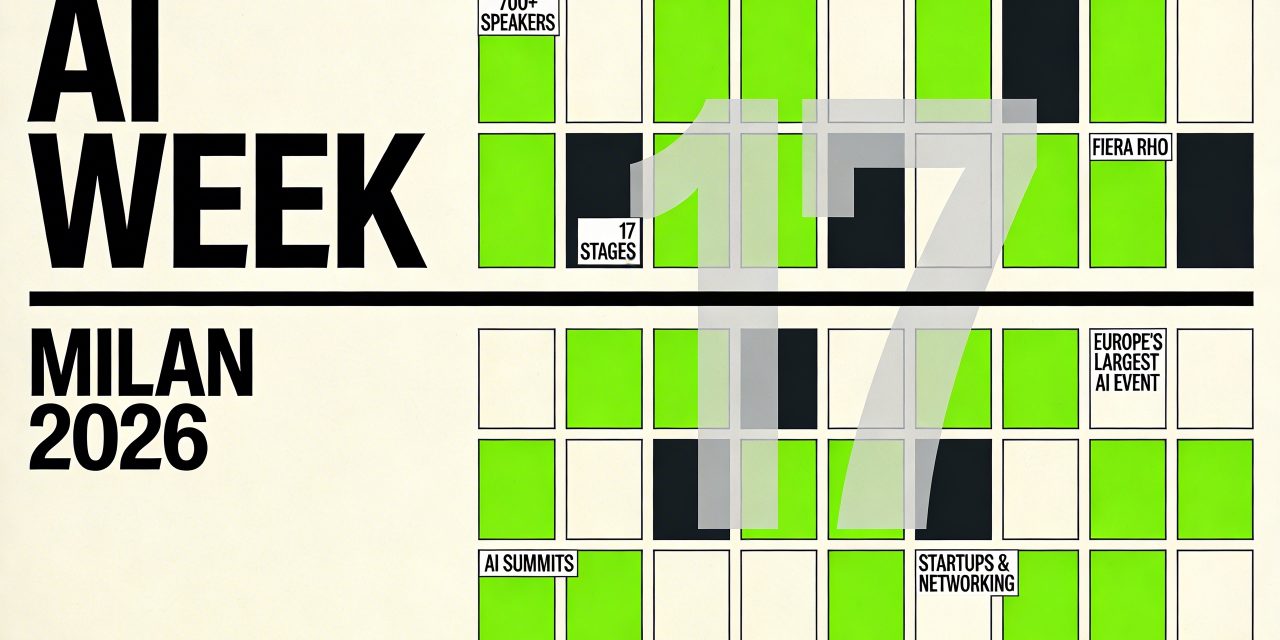
AI Week Milan 2026 is shaping up to be one of the biggest meeting points in Europe for people who want to understand where artificial intelligence is going and how to apply it in real business settings. Scheduled for 19 to 20 May 2026 at Fiera Milano Rho, the event is built around a simple promise: bring together the people building AI, the companies adopting it, and the professionals trying to make sense of what comes next.
That matters because AI events are not all the same. Some are academic. Some are vendor showcases. Some are networking gatherings with very little practical value once you leave the venue. AI Week in Milan appears designed to sit at the intersection of all three without becoming too narrow. It combines keynote talks, masterclasses, live demos, workshops, startup and investor meetings, and sector specific tracks that focus on how AI is already changing work in areas such as marketing, cybersecurity, healthcare and sport.
If you are deciding whether AI Week deserves a place on your calendar, the better question is not whether AI is important. It is whether this event gives you enough substance, enough access and enough variety to justify the trip. Based on the program structure, speaker profile and range of tracks, the answer looks like yes for a broad professional audience.
What AI Week Milan is and who it is for
AI Week is positioned as a large scale B2B artificial intelligence event aimed at managers, entrepreneurs and professionals. That positioning is important. This is not just an event for AI researchers or developers, although both groups will likely find useful content. It is also for business leaders, innovation teams, marketing departments, HR professionals, startup founders, consultants and corporate decision makers who need to move beyond general AI enthusiasm and into practical implementation.
The event claims a very large scale, with more than 700 international speakers, multiple stages and a sizable exhibition and networking component. Across previous editions and partner messaging, the audience appears to include executives from enterprise technology, consulting, cloud, cybersecurity and digital transformation. That suggests AI Week is not only about what models can do, but also about governance, infrastructure, deployment, compliance and return on investment.
In other words, if your role sits anywhere between strategy and execution, the program looks relevant.
Why Milan makes sense for an AI event
Milan is a logical host city for a large AI conference. It combines business density, international accessibility and strong links to finance, industry, design, media and technology. For an event that wants to connect AI with actual decision makers, that is a better fit than a purely symbolic location.
There is also a wider Italian context worth paying attention to. The country’s AI ecosystem includes academic institutions, applied research groups, public sector discussions around governance, and a growing startup scene. Other Milan based AI events and forums have increasingly emphasized a practical theme: not just what AI can do in theory, but how to build, deploy and regulate it properly. That same practical orientation appears in AI Week’s mix of case studies, hands on sessions and sector tracks.
This is one reason the event may attract more than casual interest. It sits in a city where enterprise adoption, industrial use cases and policy discussions naturally overlap.
What stands out in the 2026 edition
The 2026 edition is structured around scale and specialization. AI Week highlights two days, seventeen stages and one event format, which points to a broad editorial spread rather than a single track conference. For visitors, that is both an opportunity and a challenge. You are unlikely to see everything. You will need to plan based on your role and goals.
Several elements stand out:
- A large speaker roster with international experts, enterprise leaders, researchers, authors and policy voices.
- Sector focused summits that translate AI into domain specific language and use cases.
- Hands on training and workshops aimed at immediate skills and operational understanding.
- Live demos and tool exploration rather than theory alone.
- Startup, investor and venture activity for people looking at funding, partnerships or emerging companies.
- Networking formats that go beyond scheduled talks, including lounges, meetups and community sessions.
This mix makes AI Week Milan 2026 more than a keynote driven conference. It looks more like an ecosystem event, where the value comes from moving between content, product discovery and conversations.
The topics likely to matter most
The strongest part of the event design is not simply the number of speakers. It is the way the agenda reflects the current AI landscape. Businesses no longer need another generic explanation of generative AI. What they do need is help with prioritization. Which tools are actually useful. Which architectures make sense. Which risks are manageable. Which departments are ready. Which workflows should be redesigned first.
That is why the following tracks look especially relevant.
Startup, investor and venture
This track should be one of the most interesting for anyone tracking European AI entrepreneurship. It is positioned as a meeting point for startups, investors and companies looking for new opportunities. That matters in a market where many firms are still trying to distinguish between AI products with genuine defensibility and those built on thin wrappers around third party models.
Milan is a useful place for this discussion because Italy’s AI startup scene is growing across recruitment, legal tech, skills assessment, media optimization, accounting assistants, satellite data and content detection. A startup focused summit offers a practical way to understand where the local and regional ecosystem is maturing. Expect conversations around go to market strategy, enterprise readiness, fundraising climate, model costs, data advantage and integration challenges.
Marketing and creative AI
AI adoption in marketing is already mainstream enough that the interesting questions are no longer whether teams should use tools like ChatGPT, Midjourney or Runway. The better questions are how to use them without flooding workflows with low quality content, how to preserve brand consistency, and how to connect creative generation with measurable business outcomes.
A track focused on marketers, communicators and creatives makes sense because marketing is one of the areas where AI can produce fast wins, but also fast mistakes. Real value usually comes from combining automation with stronger editorial processes, clearer review systems and better performance analysis. Live demos and case studies should be especially useful here if they move beyond surface level prompting tips.
AI cybersecurity summit
Cybersecurity is one of the most serious and practical AI topics in any enterprise setting. AI can help detect anomalies, prioritize threats and improve response workflows. It can also be used by attackers to scale phishing, automate reconnaissance and generate more convincing social engineering content.
A dedicated cybersecurity summit suggests the event recognizes that AI risk is not only about hallucinations or model bias. It is also about operational resilience. This track is likely to appeal to security leaders, IT teams, compliance professionals and executives trying to understand how AI changes both defense and attack dynamics.
Healthcare AI
Healthcare remains one of the most promising and sensitive AI domains. The event’s focus on assisted diagnosis, personalized care pathways, clinical data and hospital operations reflects the right balance. The interesting conversations in healthcare AI are rarely about replacing professionals. They are about improving triage, reducing administrative load, supporting diagnosis, allocating resources better and making data more usable across systems.
If the sessions are grounded in real deployments rather than broad optimism, this could be one of the most valuable tracks in the program.
Sport and performance
The sport related content may seem less central at first glance, but it is actually a smart addition. Sport offers visible and measurable AI use cases, from performance analytics and injury prevention to fan engagement and operational planning. It also works as a bridge topic. People can grasp the impact quickly because results are easier to visualize than in many enterprise environments.
For readers interested in robotics, edge AI and real time systems, sport technology can also reveal where low latency analytics, sensor processing and computer vision are heading.
Why the speaker mix matters
Large AI conferences often advertise speaker volume, but quantity alone does not guarantee quality. What matters more is the mix of perspectives. AI Week appears to combine researchers, senior enterprise leaders, product heads, policy specialists, authors and practitioners. That kind of mix is useful because AI adoption problems rarely belong to one discipline.
A company trying to deploy AI at scale does not only need technical insight. It also needs answers on governance, privacy, infrastructure, workflow redesign, procurement, training and change management. A conference that includes these different voices is more likely to reflect what implementation really looks like.
There is also a practical side to this. Events become more valuable when attendees can compare narratives. Researchers may emphasize model capability limits. Enterprise leaders may talk about integration friction. Policy speakers may focus on compliance and accountability. Founders may highlight speed and experimentation. The tension between those views is where useful insight often appears.
What you are likely to gain from attending
If the event delivers on its structure, AI Week Milan should offer value in four areas.
1. Better market awareness
You can quickly see which AI themes are getting serious budget and which are mostly hype. The exhibition space, startup presence and partner ecosystem should make this easier than following news online.
2. Practical implementation ideas
Hands on sessions, workshops and case studies are where abstract interest becomes actionable. For many attendees, the real takeaway will not be a new theory of AI. It will be a shortlist of tools, architectures and governance practices worth testing back at work.
3. Useful peer comparison
One underrated benefit of events like this is calibration. You learn whether your organization is ahead, behind or confused in exactly the same ways as everyone else. That helps with planning and expectation setting.
4. Cross sector insight
AI lessons often transfer across industries. A healthcare workflow problem may resemble a logistics problem. A cybersecurity governance challenge may echo a marketing review process. Sector specific tracks are useful, but the overlap between them can be even more valuable.
How to approach AI Week if you attend
The bigger the event, the easier it is to leave with a notebook full of disconnected ideas. A better approach is to arrive with a filter.
- If you are an executive, focus on governance, implementation case studies, infrastructure choices and measurable business outcomes.
- If you work in marketing or product, prioritize live demos, tool comparison sessions and examples tied to workflow improvement.
- If you are technical, look for sessions on architecture, AI agent infrastructure, deployment models, security and model operations.
- If you are a founder or investor, spend time in startup and venture sessions, but also attend enterprise tracks to understand buyer expectations.
It also helps to treat networking as research rather than social obligation. Ask people what actually worked in production. Ask what failed. Ask what they stopped doing. Those answers are usually more useful than polished stage messaging.
The broader significance of AI Week in Europe
AI Week Milan is part of a broader European shift. AI discussion is moving from fascination with model releases to questions of deployment, sovereignty, regulation, energy cost, workforce adaptation and sector specific value. Europe’s position in AI will not be defined by whether it can mimic every consumer platform story coming from the US. It will depend on whether it can build strong industrial, scientific and business applications that fit its regulatory and economic realities.
That is where events like AI Week matter. They create a space where enterprise users, researchers, policymakers and startups can test assumptions against each other. That does not guarantee progress, but it improves the quality of the conversation. And in AI, the gap between what is demo ready and what is organization ready is still large enough that honest discussion is worth a lot.
Should AI Week Milan 2026 be on your radar
If you are looking for a focused technical conference on one niche discipline, AI Week may feel too broad. But if you want a panoramic view of AI in business, AI strategy, AI tools, AI governance and applied AI across industries, it looks like one of the stronger events on the 2026 calendar.
The combination of scale, practical sessions, startup visibility and sector specific programming gives it a wider range than many conferences that lean too heavily on keynotes. Milan adds a useful business context, and the event’s B2B orientation should help keep discussions anchored in deployment rather than pure speculation.
The smartest reason to follow AI Week Milan 2026 is not that it is large. It is that AI has now reached the stage where scale alone means little unless people can connect ideas to implementation. An event that helps you sort signal from noise, compare approaches and understand how different sectors are using AI can still be worth your time. Right now, AI Week looks built for exactly that purpose.